[Editor’s note: This is the third in an occasional series of stories on issues affecting the eduation of teachers in the region.]
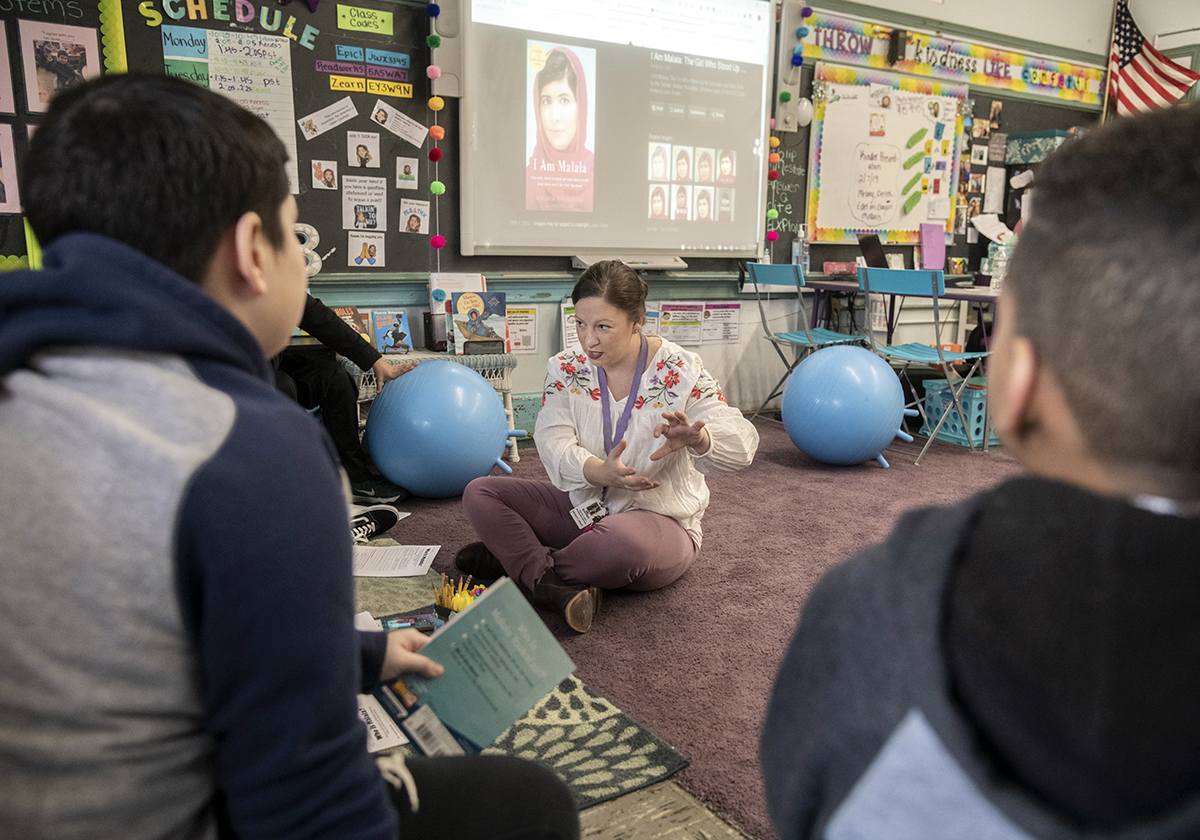
Nearly all the students in Karey Bouvier’s Carl Lauro Elementary School fifth grade classroom in Providence are native Spanish speakers. Bouvier, on the other hand, is not.
“I know a lot of academic vocabulary … in order to be able to explain topics to my students,” she said, but “I’m not fluent.”
In instances when she is uncertain how to explain a subject, Bouvier will recruit a student whose English is advanced and ask them to translate the material.
And, as an educator, she’s not alone.
As more and more Providence students whose primary language isn’t English enroll, the demand for English as a second language, or ESL, teachers – let alone training opportunities – is a constant challenge, said Bouvier.
While adult education administrators at Roger Williams University say statewide demand for ESL teachers dates back to the early 1990s, the R.I. Department of Education’s three most recent counts of emergency certificates – authorization given to educators to teach a certain subject when the district cannot find a more-qualified individual to fill the post – documents a falling demand, but one that represents more than one-quarter of all such accreditations.
Of the 275 emergency certificates issued for the 2015-16 academic year, nearly 4 in 10, or 39%, were for ESL or bilingual language education. The following academic year that figure fell to 29% then to 26% in 2017-18, the most recent findings.
In order to better communicate with her students – and understand the linguistic challenges they face learning in a nonnative language – Bouvier sought ESL certification to improve her practices. Her employer, Providence Public Schools, had been developing just such an opportunity with the help of RWU’s University College since 2017.
PPS reached out to RWU and, in January 2018, launched a pilot program designed to prepare teachers for the RIDE ESL certification exam with as little interruption or out-of-classroom time as possible.
At that time, PPS Superintendent Christopher Maher estimated of the district’s 2,000 teachers, 372 held ESL certification.
‘One single program can’t, and probably shouldn’t, try to solve this shortage.’
KELLY DONNELL, Roger Williams University associate professor of education
The initial cohort, which launched in summer 2018, was made up of 30 participants from Providence and Pawtucket.
Prior to the start of the term, participants from both cities took part in online courses, practicum experiences with English language learner, or ELL, summer camps, as well as classroom-style lectures. Once class was in session, participants were able to continue their studies throughout the school year while applying what they had learned over the summer, as well as material from ongoing ESL courses, in their classrooms.
Kristina Soprano, director of the RWU ESL certification program, explained the program was designed around Teaching English to Speakers of Other Languages, or TESOL, core competency requirements.
“Rather than asking teachers to participate in a certain number of courses” similar to collegiate curriculums, said Kelly Donnell, RWU associate professor of education, “The program uses the 56 national standards for working with ELLs and [participating teachers] must be able to reflect their competencies in those backgrounds” in order to be eligible for certification.
Throughout the academic year, said Soprano, participants “submit evidence along the way to demonstrate what they’re learning,” all the while checking off TESOL competencies.
Once RWU coursework was complete, participants were eligible to apply for RIDE’s ESL teacher certification exam.
Approval to expand the ESL course statewide was granted by RIDE at the beginning of the year.
According to RIDE spokesperson Meg Geoghegan, the RWU program is “unique” in the state. She added that RIDE is “unaware of any emerging programs that take a similar competency-based approach.”
While Soprano and Donnell feel the program will not meet the state’s documented need for ESL-certified teachers, they feel it is a positive move in a direction that will support the needs of a larger demographic of students.
“One single program can’t, and probably shouldn’t, try to solve this shortage,” said Donnell. “Across the state, we need strong, viable options so teachers can decide from which learning experience they would like to benefit.”
Bouvier applauds the focus on ESL/ELL teaching in the RWU program and is excited to see more teachers join forthcoming cohorts.
While the pilot enrolled a select group of educators from Providence and Pawtucket, going forward, RWU would like to engage additional school districts throughout the state.
“We’re hoping to expand,” said Soprano, “but we haven’t set a cap on that number.” Although she would not share the names, Soprano said RWU is in conversations with several districts.
She suggested interested districts reach out to RWU to get a better understanding of the “intensive nature of the program” and prepare potential participants for the necessary practicums and ELL-related work that will occur throughout the year.