Some companies fold under pressure, others thrive. Middletown-based civil engineering company SGE is an example of the latter. The company has followed market opportunities where they led, growing first from a typical civil engineering firm in Rhode Island into a Middle East reconstruction firm and now, a domestic renewable energy project builder.
The infrastructure engineering and construction-program management company was dealing with a very competitive market and little work when its principals decided to seek out new terrain – literally. Following the Iraq invasion, the United States started commissioning American firms to work on Iraq reconstruction projects, so SGE spun off a Baghdad branch, Secure Global Engineering LLC to join in.
“We got work we never expected to get – the types of projects that very large companies typically get,” Blake Henderson, chief executive officer of SGE says.
Over five years in Baghdad, that division completed the master sewer plan for the city, a 10-megawatt power generation system for a Marine base in Habannyah, 50 overhead and underground electrical feeder projects throughout Iraq and other projects.
Based on its success in Iraq, SGE opened an office in Dubai (SGE Power) and began winning large-scale projects there as well.
Expecting its success to snowball, SGE started looking for opportunities in Saudi Arabia and Abu Dhabi, but the world financial crisis stopped the firm in its tracks. At one point last year, SGE had more than $10 million of pending civil engineering contracts in Dubai canceled in 30 days.
“So we had to stop and think again, and look at where change had opened an opportunity for us,” Henderson says.
SGE executives saw the green building and renewable energy market as their next path for growth and took the steps last year to participate in that market by engaging in U.S. Green Building Council’s Leadership in Energy and Environmental Design (LEED) training and certifications.
Meanwhile, the newly elected U.S. administration provided $93 million from the American Recovery and Reinvestment Act of 2009 to support further development of wind-energy projects. In Rhode Island, the Renewable Energy Fund, supported by a charge on every electric user’s bill, became available for renewable energy projects.
“Combine the facts that Rhode Island, Massachusetts and Connecticut pay the highest [electricity] rates [per capita] in the country, and Massachusetts and Rhode Island have an excellent wind environment, and you have an economic opportunity,” Henderson explains, one that the company responded to by forming Sustainable Global Energy LLC.
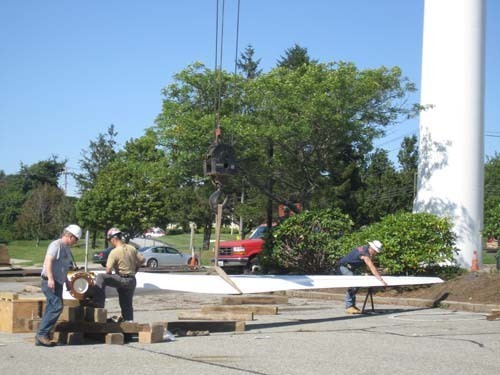
With its experience in power systems and coastal engineering, the new business was a “no brainer,” says Henderson. SGE has jumped in, studied the engineering and economics of wind turbines and used its own office building in Middletown as a test bed for a 100 kW wind turbine.
At the time there was only one 100 kW wind turbine built and in operation in southern New England, and there were very few companies with practical experience in the engineering, permitting, and construction of any wind turbine size, according to SGE.
“Wind turbines are basically just power systems, and we know power systems,” Henderson says.
SGE presented its case for installing a wind turbine to the Middletown Zoning Board and, after addressing concerns such as shadow flicker, ice throw, bird strikes and noise, the board gave unanimous approval to erect Middletown’s first wind turbine.
SGE’s on-site wind turbine project was scheduled to be completed on Sept. 22. And though it will generate less energy than SGE’s total demand, the company has supplemented wind energy with solar panels. By next year, SGE intends to be energy independent, Henderson says. SGE calculates that its 100 kW wind turbine will save 5 million pounds of carbon dioxide from stack emissions in the first 25 years of operational life.
In addition to the power costs the company will save, under the new federal stimulus funds policy, SGE will receive tax rebates for building turbines, as well as accelerated depreciation.
For Rhode Island, offsetting high energy costs using renewable sources could also mean attracting more businesses into the state. “Using wind to generate energy can lower energy costs and make us more competitive in attracting new business,” Henderson says.
SGE now has three wind turbines at different stages of construction, and could have six more under contract for construction by the end of 2009 in Rhode Island and Massachusetts. While civil engineering work remains its core business, renewable energy work makes up about 30 to 40 percent of SGE’s business today. •