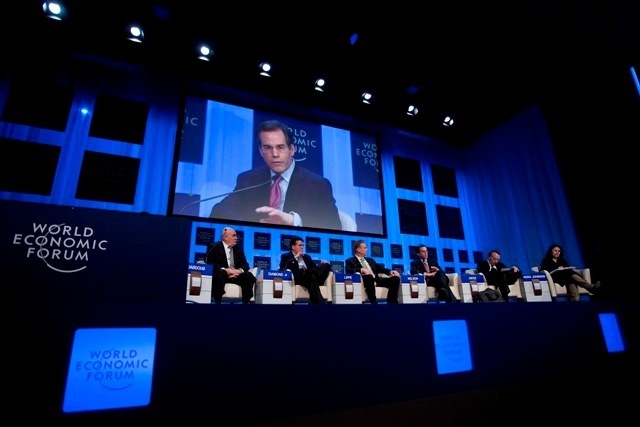
PROVIDENCE – Brown University President Ruth J. Simmons and Rhode Island School of Design President John Maeda were among the leaders who attended the annual World Economic Forum last week in Davos, Switzerland.
More than 2,500 political, business and financial leaders from across the globe gather each year at the World Economic Forum. This year’s attendees included Microsoft Corp. Chairman Bill Gates, French President Nicolas Sarkozy and President Barack Obama’s top economic adviser, Lawrence Summers.
Beyond Cash Donations: How New Forms of Giving Are Transforming Not-for-Profit Accounting
Evolving Funding Landscape for Not-for-Profits Not-for-profit organizations are being asked to do more with less,…
Learn More
The two local college presidents were among a number of their peers from top American higher-educational institutions attending Davos last week to meet with alumni, woo faculty and talk with donors (or would-be donors), according to Bloomberg News.
This was Simmons’ third year attending the Davos summit, said Sarah Kidwell, a spokeswoman for Brown.
“As Brown seeks to advance its international scope and presence, President Simmons’ participation is a rare opportunity to gather with 2,500 world leaders … in one place over the course of several days to discuss and identify strategies to address issues that confront these many sectors,” Kidwell said.
“Included in many of these discussions is the role that higher education can and must plan in being part of solutions — whether through capacity building among higher education internationally, or through advancing research and scholarship around issues like climate change and world health,” she added.
In Davos, Simmons hosted a reception, which Kidwell said was funded by private donations, on Friday for Brown alumni, parents and friends as well as guests from the business and higher education sectors.
She also signed the Sustainable Campus Charter, an agreement between more than two dozen universities committing themselves to reducing greenhouse gas emissions and promoting sustainability.
The pact was organized by the International Sustainable Campus Network, a nonprofit association, and the Global University Leadership Forum, which is made up of 25 heads of schools from nine nations. In addition to Brown, other signatories included Harvard University, Yale University and the London School of Economics.
“The Sustainable Campus Charter will keep these issues in focus and enlarge the community of academic and civic leaders who are productively engaged in the important principles of conservation, sustainability and environmental health,” Simmons said in a statement.
In addition, Simmons moderated a “Restoring Faith in Economics” panel that featured former British Prime Minister Tony Blair; the historian Niall Ferguson; Stephen S. Roach, chairman of Morgan Stanley Asia; Reinhard Marx, Roman Catholic Archbishop of Munich and Freising in Germany.
However, that panel drew some criticism last Tuesday from Felix Salmon, the influential finance blogger at Reuters.com. “Davos is great at throwing a couple of archbishops onto a panel with Niall Ferguson entitled ‘Restoring Faith in Economics’ (geddit?),” he wrote.
“But what I see none of in the programme is an indication that much if not all of the crisis was caused by the arrogance of Davos Man and by his unshakeable belief that the combined efforts of the world’s richest and most powerful individuals would surely make the world a better, rather than a worse, place,” he continued.
Like Simmons, RISD’s Maeda was attending Davos for the third time. He “is there representing Rhode Island on a global stage,” said RISD spokeswoman Jaime Marland.
Maeda spoke on several panels that looked at art, technology, design and leadership development, including one that featured Harvard President Drew Gilpin Faust. He shared impressions of his trip on Twitter and risd.edu.
Maeda spoke on a panel at the World Economic Forum’s Global Agenda Council on Design and discussed themes he first addressed in his 2006 book “The Laws of Simplicity.”
“When I wrote the book four or five years ago, it was during the rise of complex all-in-one devices that coincided with the ‘more is better’ mood,” Maeda told The New York Times shortly before the summit. “Now we’re in a situation where simplicity isn’t just a good idea – it’s a necessity.”
Another local person in attendance was Jonathan M. Nelson, chief executive of Providence Equity Partners, the media and telecommunications buyout firm he founded in 1989. Nelson argued against the new push for shrinking large financial institutions, according to The Times.
“Some say less diversified banks are weaker banks,” he said. “As customers, we like big banks because they can provide us with a variety of products.”
Nelson also called on political leaders to stop pointing fingers at bankers and other financiers for causing the crisis, Reuters reported.
“We need to get away from the blame game. We all share responsibility for what happened here,” he said. “There was reckless lending, there was reckless borrowing too, all against a background of public policy that [made it] desirable.”