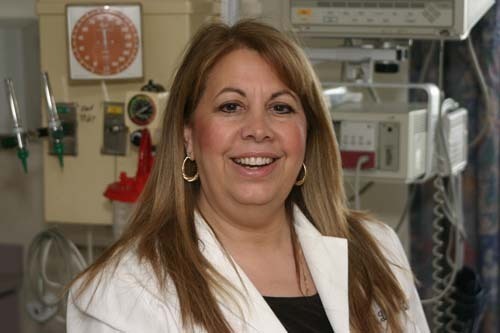
The intensive care unit at Memorial Hospital of Rhode Island has only 18 beds, but its reach goes well beyond that. If a patient anywhere in the hospital shows signs of respiratory distress or other major problems, an ICU doctor will rush to his side.
It doesn’t matter what day of the week it is, or what time – at Memorial, intensivists, as those specialists are called, are always on duty, both to care for ICU patients and to consult as needed with colleagues across the hospital.
That is how it’s been for about a decade, since shortly after Dr. Vera A. DePalo, a strong believer in specialized ICU staffing, became director of pulmonary and critical care at Memorial.
For DePalo, it was common sense: “We recognized how sick these patients could be, and how dynamic their situations could be,” she said. So Memorial put intensivists on duty 24/7, and also put them on the rapid-response team, which jumps in when a patient has a crisis.
Such an approach, the business-led Leapfrog Group says, has been linked to a 30 percent reduction in hospital mortality and a 40 percent reduction in ICU mortality when compared with hospitals where most ICU patients are not treated by intensivists.
Given that about 200,000 patients die in America’s ICUs each year – an average of 10 to 20 percent of ICU patients at each hospital – that’s a lot of lives that could potentially be at stake. Yet while so-called “closed” ICUs run by dedicated teams of intensivists are the norm in much of the world, they are not in the United States. As of 2007, Leapfrog found in a survey, only 30 percent of responding hospitals met Leapfrog’s own standard: that ICUs be led by intensivists who are present during the day and provide clinical care exclusively in the ICU and, when not present, return pages within five minutes 95 percent of the time.
If that standard were met in all urban hospitals with ICUs across the nation, Leapfrog has estimated, more than 54,133 deaths would be prevented each year. In addition, hospital and ICU stays could be shortened, yielding clinical benefits and reducing costs.
The answer is, it’s not so simple.
For starters, intensivists are still a relatively new breed – and in short supply. The first ICU residency was established in 1962, and the American Board of Medical Specialties only approved a certification of special competence in critical care in 1986.
In 2003, of more than 750,000 U.S. doctors in active practice, fewer than 5,000 were trained and certified in critical care, according to the American Medical Association. And in 2006, a study commissioned by Congress found that even though the number of practicing pulmonary and critical care doctors nearly doubled from 1998 to 2001, to about 2,000 full-time equivalent physicians, more than 3,100 FTEs were needed to provide just two-thirds of ICU care.
At the current rate of work force growth, the study found, there will be about 2,800 FTE intensivists by 2020, far short of the 4,300 needed by an aging, ever-sicker patient base. Given the shortage and the high pay these doctors command, many hospitals find they can’t afford 24/7 coverage, so they use a mix of ICU specialists and other doctors and/or residents, especially at night.
Rhode Island Hospital, The Miriam Hospital and Newport Hospital – all teaching facilities – partly staff their ICUs with fellows in critical care. They are board certified but still getting their specialized training, and may not always have an intensivist on site.
Dr. Mary Cooper, vice president and chief quality officer for Lifespan, the three hospitals’ corporate parent, said “all of us agree that having people who specialize in an area is always the ideal,” but unlike some other quality-improvement strategies for ICUs, 24/7 intensivist staffing isn’t fully proven.
Last year, in fact, Dr. Mitchell M. Levy, head of the medical ICU at Rhode Island Hospital and president of the Society for Critical Care Medicine, published a retrospective analysis of data for patients treated in 123 ICUs nationwide and found a higher hospital mortality rate for those treated by critical care experts, even after adjusting for the severity of their conditions.
Dr. Lynn McNicoll, co-principal investigator of the Rhode Island ICU Collaborative, said Levy’s findings are tempered by “multiple other studies and meta-analyses that show that care given by intensivists is better.” But it is unclear, she said, how much is needed.
“The assumption is that more is better, but it’s extremely costly, and logistically extremely difficult,” McNicoll said.
That’s why the ICU Collaborative never considered physician staffing as one of the areas to address, McNicoll said: 24/7 intensivist coverage “would be prohibitive for most hospitals.”
“We applaud that Memorial has been able to do it, and they’ve invested a lot of money into that, but [by doing so], you’re not investing in other things,” she said. “So we chose to focus on [strategies] that were relatively low cost, relatively easy to implement, and where there was significant-enough evidence to support them.”
In another way, however, the ICU Collaborative is very much aligned with Memorial’s approach: building stable, cohesive ICU teams that communicate well and work in tandem. As DePalo noted, it’s not just doctors who staff ICUs, but also nurses, respiratory therapists, pharmacists and others, and patients will do best if they are all well-trained in critical care.
“When I started, we had only a small amount of patients in our ICU,” said DePalo. “Now we’re almost full. … [Plus] people are much sicker than they used to be. Patients with chronic diseases are now surviving to older age, and with more significant organ system problems.” •
To learn more about the Leapfrog Group and its
recommendations for ICU staffing with intensive care specialists, or “intensivists,” visit www.LeapFrogGroup.org.
Cybersecurity Awareness Month: What to Do When Your Identity Is Stolen
In recognition of Cybersecurity Awareness Month, it is important to remember that identity theft affects…
Learn More