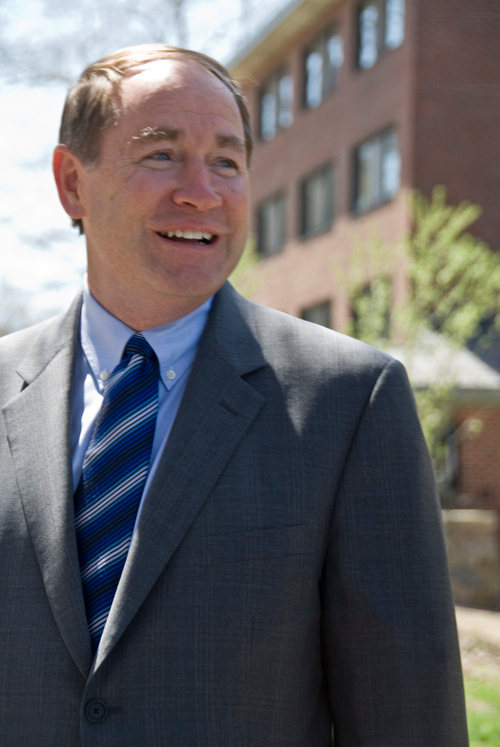
Ever since David M. Dooley became the University of Rhode Island’s 11th president in July, he has talked publicly about the importance of boosting the school’s research capabilities and the important role that could play in Rhode Island’s future.
Dooley, a chemist, has been meeting with faculty members, alumni, state officials and business groups to find out what people think of URI and what they would like to see in the future.
He has already made one high-profile change in school policy, ending a ban on alcohol at football tailgate gatherings on campus.
PBN: You’ve talked a lot about boosting the research profile at URI. Where does the proposal to build a 30-acre research and technology park stand?
DOOLEY: What I’m striving to do is to make the best assessment we can about the prospects for success of a research park and who our partners will be. The critical question is not so much the details of the site. I know that’s an issue for the campus. Before we grapple with that, we have to make a decision as to whether a research park can be competitive and viable here in Kingston.
Seifert Systems Invests in Energy Efficiency to Strengthen Operations
For manufacturers, energy is more than just another operating expense. It plays a critical role…
Learn More
PBN: But if it’s not viable, doesn’t that hinder your plans to strengthen the school’s research capabilities and reputation?
DOOLEY: Not necessarily. A research park can be a hugely important component of what the university does – to develop partners, to transfer intellectual property to the private sector, to stimulate economic growth. … [But a research park is] only one way to partner with the private sector.
PBN: Is URI behind the times? Has the state been too slow to act in using the university in economic-development strategy?
DOOLEY: The way I would put it is URI has yet to take advantage of all of its unique attributes. I don’t think URI has really taken advantage of its growing identity as a research-intensive university – in part because a lot of that research growth has occurred relatively recently. It’s just now reached a level of critical mass where the institution can really begin to ask these kinds of questions about knowledge generation and intellectual property policies, procedures and transfer, how to partner aggressively with the private sector and other public entities, how to cooperate with other universities. The university has had for a long time areas of great strength, strong pieces of a foundation to build on.
PBN: Your predecessor, Robert Carothers, lamented the declining appropriation from state government, saying URI is virtually a state school in name only. Have you talked to state leaders about the situation yet?
DOOLEY: State leaders are in a tough position with the decline in revenues, with the growing federal deficits, the downturn in the economy. … And I appreciate the difficulty of that position. … Almost every state has decreased funding for public higher education, or constrained it. … That’s why we’ve seen over the last 10 to 20 years significant growth in tuition. Rhode Island has cut funding rather more precipitously than other states. That burden has largely been shifted to students and their families. I would argue that everybody in Rhode Island has a stake in the success of URI. The legislators I’ve talked to realize that. They want to be able to do more, the question is how.
One of the points I’ll be making to them is to … look at the possibility of creating one-time monies to invest in higher education … that could be used to jump-start particular kinds of initiatives. I think it’s worth looking at the state budget from the perspective of what are the biggest pieces … that need to be brought into alignment with revenues. And if you do that, you’ll find that’s not education.
PBN: I’ve heard you would like to start a manufacturing extension at URI.
DOOLEY: This is an idea I really want to explore, whether it’s applicable to Rhode Island. I don’t want to assume that it is. Frankly, Rhode Island can rebuild a robust manufacturing sector. Certain kinds of manufacturing are going to be difficult to be competitive in the United States, but other kinds of things can be very competitive. It depends on what you’re trying to make, whether you can make it efficiently and in a cost-competitive fashion. What we [had] at Montana State that was enormously successful was, many years ago, in partnership with the federal government, [Montana State University] created an organization called the Montana Manufacturing Extension Center. Although it has manufacturing in it, and it helps a lot of small manufacturers, it actually helps any business. If you have a problem, whether it’s an engineering problem, science problem or a business problem, make a phone call to the center, and they’ll put you in touch with experts employed by the state, in partnership with the federal government, and students who are working with those experts, to help you solve your problem. Whether it’s modernizing your production line, finding a better supplier, building a better business plan, marketing plan, doing better accounting. … It’s touched hundreds of companies in Montana. It’s been very successful.
I would like to ask the question: Could such an entity, if we could find a way together to fund it, be useful to Rhode Island? •
INTERVIEW
David M. Dooley
POSITION: President of URI
BACKGROUND: He served as provost and vice president for academic affairs at Montana State University for eight years. Dooley, a chemist, started his career as an academic in 1981 as a visiting scientist at the Massachusetts Institute of Technology, then was a visiting scholar at Stanford University. From 1978 to 1993, he was on the chemistry faculty at Amherst College in Massachusetts. From 1984 to 1993, he also worked in the celluar biology department at the University of Massachusetts. He moved to Montana State in 1993, serving as head of the chemistry and biochemistry department until 1999.
EDUCATION: B.A. in chemistry, 1974, University of California, San Diego; Ph.D in chemistry, 1979, California Institute of Technology, Pasadena
FIRST JOB: Cleaned offices and state buildings for his grandfather’s janitorial company in Sacramento, Calif., at age 16.
RESIDENCE: South Kingstown
AGE: 57