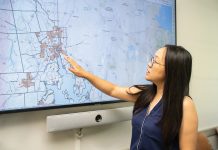
They may not sound like the sexiest research topics, but it turns out that studying algae, deer ticks and E. coli in mouse intestines are drawing more University of Rhode Island students than ever before.
The school’s 12-year-old Coastal Fellows Program, an eight-month work-study curriculum, attracted a record pool of 84 applicants this year, from which 45 students were selected to participate starting in May.
“The goal is to give students an opportunity to network and, most importantly, to get more experience in their field and see what it’s like to conduct their own research or outreach project,” said Tara Watson, the program’s coordinator.
URI junior Emily Field, who majors in marine biology and French, said that the chance to conduct research is why she first signed up for the program.
“This is my second summer as a Coastal Fellow,” she said. “It’s a great way to get into doing research because in college there aren’t those opportunities for undergraduates.”
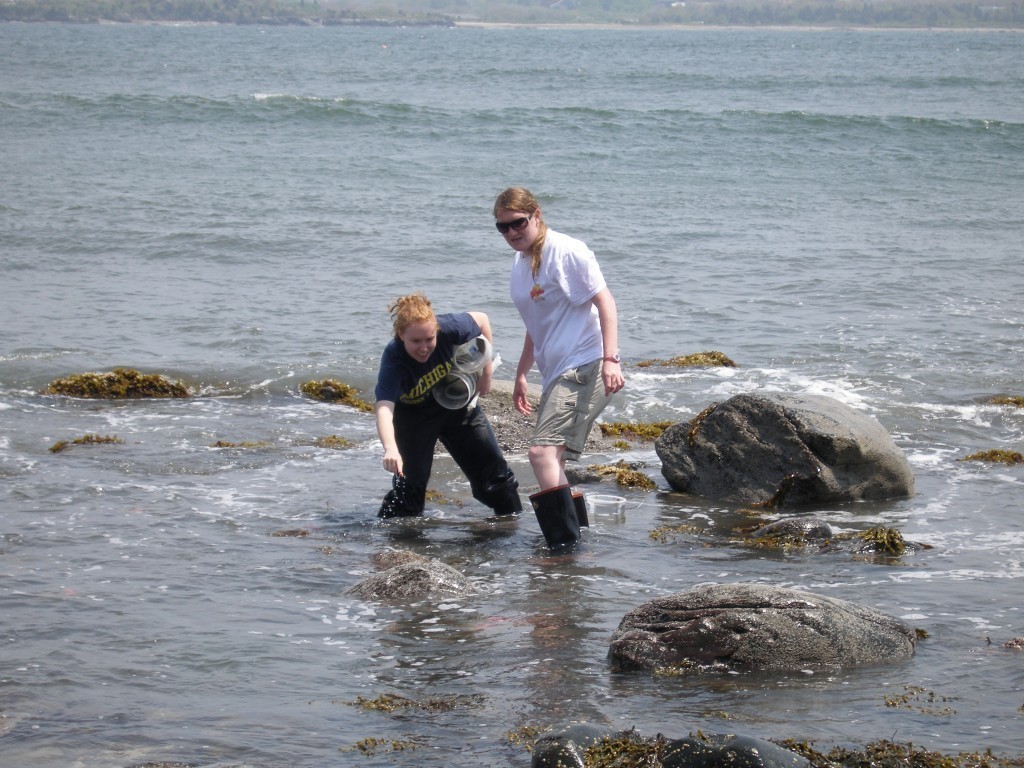
Her fellowship involves working in Greenwich Bay surveying the macroalgae on the shore and conducting experiments at URI’s Bay Campus, working with herbivores to see how much algae they eat.
Joanna Panosky, a sophomore majoring in geosciences, said she wanted to see what working as a scientist would entail and whether she would enjoy it before pursuing it as a career.
“I’m working with [URI’s] Center for Vector Borne Disease. I’m on a team that goes into the woods and looks for deer ticks,” she said. “When I heard about this program, I thought it would be a great way to get a feel for the sciences.”
Once students are selected, they have the opportunity to either choose a research project or are assigned one.
“Generally they are grant-funded projects that the students are recruited to work with, and their projects are really diverse,” Watson said. “We have students working in the microbiology department; we’ve got students looking at human uses of Narragansett Bay, students looking at pollution removal from streams and a student working with the National Park Service at Glacier Bay National Park and Preserve in Alaska.”
The students then work with either URI faculty, usually from the College of the Environment and Life Sciences, or partner groups such as the National Park Service, the Natural Resources Conservation Service, the Narragansett Bay Research Reserve, Save the Bay and the Divers Alert Network.
The fellows work a minimum of 20 hours per week (and up to 40) during the summer (for $8.60 per hour) and 10 hours in the fall without pay but in exchange for three credits. In the fall they also take a two-credit course, Communicating Environmental Research & Outreach, which “guides students, in a step-by-step process, through the analysis and synthesis of their fellowship work.”
The course ends with students presenting a scientific poster that details their work during the fellowship at a December conference.
“The great thing is it culminates in a scientific poster conference,” Watson said. “The students learn during the fall how to create a scientific poster … Last year 300 people showed up to look at them.” •