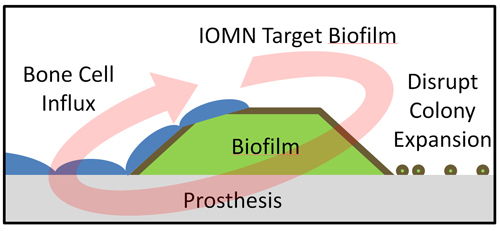
The particles are not only lethal, but guided by magnets they can hit their targets with laser-sharp precision: colonies of staphylococcus epidermidis growing on the surface of devices and implants inside the body, coated in their own slimy, protective film.
The iron-oxide nanoparticles – already used successfully to enhance MRIs, among other things – penetrate the film, break it down, and kill the bacteria. Within 48 hours, lab experiments at Brown University showed, up to 28 percent of the bacteria on an implant had been eliminated with just 10 micrograms of nanoparticles.
Repeat the dose three times over six days, and virtually all the bacteria were gone, the researchers found. And as a bonus, the particles stimulated bone growth around the implant.
The results of the study, conducted by Erik Taylor, a graduate student, and professor Thomas Webster, a biomedical engineer, were recently published in the International Journal of Nanomedicine, which Webster edits.
It was the first time that iron-oxide nanoparticles had been shown to eliminate bacterial infections on an implant, and as the news has spread, Webster said, “a number of companies” have contacted him, eager to put the technology to work.
“There’s nothing concrete, but we’re definitely interested,” he said.
At this point, the technology has been tested only in the lab, but Webster said the potential applications are numerous. For starters, there are hip and knee implants, hundreds of thousands of which are performed each year, at a cost of $5 billion to Medicare alone in 2006 (and the numbers are rising fast). About 2.5 percent of such implants get infected.
Then there are the thousands of American soldiers who’ve lost limbs, Webster noted; they’re often fitted with metal rods to which prostheses can be attached, and that’s “a huge site for infection.” Plus there are pacemaker leads and other implanted devices. Even wound dressings on skin grafts for burn victims, Webster said, might be improved with nanoparticles.
Webster said the next step for him and Taylor is to test the nanoparticles in live animals, most likely rats first, then larger animals. At the current pace of the work, the technology could be ready for human use within about five years, he said.
But it could be sooner.
For starters, the nanoparticles are already approved for human use by the U.S. Food and Drug Administration, though for different purposes – to enhance magnetic resonance imaging quality, for example. And scientists know how to move the particles around through the body using magnets.
Some of the companies that have expressed interest in using the technology, Webster said, see potential beyond implants – for items such as catheters that now get infected sometimes, say, during kidney dialysis. “They all suffer from the same problem of infection,” he said, “and they’re all looking for a nondrug solution to decrease infection.”
The technology is still owned by Brown and hasn’t been licensed to anyone yet, Webster said, but “we’re definitely interested in some of those collaborations.”
And if industry did get involved, he added, chances are it would bring the nanoparticles to the market more rapidly.
“That would bring the expertise of the company, the manufacturing process, the expertise in getting something approved for implantation – something we don’t really focus on; we do lab-type research,” he said. “But if we could partner with a company, I’m convinced that commercialization process would go quicker.” •