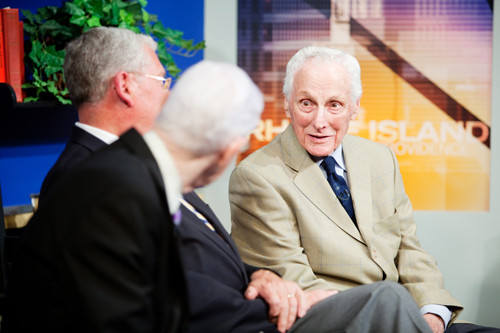
Laurie White remembers that after taking the job as president of the Greater Providence Chamber of Commerce in 2005, former Gov. Bruce G. Sundlun invited her to lunch at the University Club.
As White and Sundlun sat alone at a table in the exclusive East Side club, he imparted a piece of advice that she’s attempted to follow ever since.
“Don’t equivocate,” he told her.
White recalled that lunch meeting recently after Sundlun, once a prominent businessman and Rhode Island’s governor from 1991 to 1995, died on June 21. He was 91.
“He didn’t pull any punches,” White said. “He didn’t care what you thought of him.”
Business leaders and former members of the Sundlun administration last week remembered him as an unequivocal backer of Rhode Island’s business community, armed with a no-nonsense style honed as CEO of the Outlet Co.
T.F. Green Airport, Providence Place mall, the R.I. Convention Center and adjoining hotel, the Shepherd Building and even the Combined Sewer Overflow project – the Sundlun administration has been credited with pushing all those projects forward despite formidable obstacles.
“He was very much of a disciple of Franklin Roosevelt in that he saw building infrastructure projects as a way to put people to work when the economy was down. And he also saw the value of it over the long term,” said David Preston, Sundlun’s communications director when he was governor and his 1992 campaign manager.
And it wasn’t just about building things. Sundlun grappled with the credit union crisis from the first day of his administration in 1991, and later directed staffers to work with legislators and business and labor representatives to fix the state’s faltering workers’ compensation system.
“There are times when events require bold, decisive and forceful leadership,” said Maureen Moakley, a political science professor at the University of Rhode Island, where Sundlun taught after retiring. “There was a confluence of what was going on and [Sundlun’s] skills.”
That’s not to say Sundlun, his style and his decisions were popular. Throngs of depositors, unable to get their money after the governor ordered 45 state-chartered credit unions and investment companies closed, rallied at the Statehouse or wherever Sundlun went. James Hagen, then-president of the Providence Chamber of Commerce, recalled protesters jeering Sundlun as he arrived at a restaurant in northern Rhode Island in 1991.
“Certainly, he was the man for a moment of crisis,” Preston said. “But by ’94, the crisis was over, the economy was bouncing back. I think the voters were ready for something else.”
Sundlun had been involved in politics, serving as a member of the R.I. Constitutional Convention in 1986 and a member of the Providence School Committee, an appointment of then-Providence Mayor Joseph Paolino Jr.
Years earlier, he had been close with the Kennedy family and had been tapped to arrange John F. Kennedy’s inaugural parade in 1961.
“It wasn’t like he dropped out of the sky,” Preston said. “He had been around and observed.”
Still, Sundlun was one of the pioneers on a political path that back then was rarely traveled. Instead of working his way up from the local political arena, building up chits along the way, Sundlun used his own resources amassed as a businessman to get to the governor’s office.
It took him three tries. He lost in 1986 and 1988 to then-Gov. Edward D. DiPrete, a Republican. DiPrete’s administration was weakened by scandals by 1990, allowing Sundlun to cruise to victory.
By then, dark clouds were looming. The Rhode Island Share and Deposit Indemnity Corporation, a private, state-created bank insurance fund, was failing, and the state’s fiscal picture was bleak – a $164 million shortfall, which at the time was more than 10 percent of the $1.3 billion budget.
“Because of the credit union crisis, people forget the state had a serious deficit when [Sundlun] took office,” said Gary S. Sasse, who served as the administration’s fiscal adviser for the first six months while on leave from the Rhode Island Public Expenditure Council.
The early days were difficult. Preston remembers there was a honeymoon of a few weeks following the inauguration before credit union depositors turned angry.
Former members of his administration said Sundlun refused to be distracted. “He focused on the six to eight things that he felt were important and he stayed with them,” said Sasse, who is now the director of Bryant University’s Institute for Public Leadership.
The Sundlun administration instead created the R.I. Airport Corporation and gave it the authority to obtain financing through moral obligation bonds. The agency moved forward on the governor’s proposal to build a new $200 million terminal, what has now been lauded as a huge success for the state.
“There were a lot of naysayers, saying the state couldn’t afford it,” said Sasse. “But he recognized that a modern infrastructure was essential to economic development.”
Keith W. Stokes, Sundlun’s senior policy adviser from 1991 to 1993, said he had a passion about development in Providence, playing a part in not only getting the R.I. Convention Center and Providence Place off the ground, but getting involved in the Shepherd Building, a former downtown department store.
When officials determined the Convention Center was suffocating because of a lack of hotel rooms in the city, Sundlun didn’t need to study. He decided the state needed to build what became The Westin Providence, despite the objections of other hotel owners.
In August 1991, Sundlun traveled to Seattle to meet with executives of the upscale retailer Nordstrom to persuade them to become an anchor store at then-proposed Providence Place. Hurricane Bob, which was bearing down on the state, cut his visit short.
“He was not a guy who missed a crisis,” Preston said. “He caught the red eye, the last flight into Green.”
Sundlun’s management style wouldn’t be as effective in handling today’s budget problems and pension-fund crisis, according to Moakley.
“Sundlun wasn’t a consensus-builder,” she said. “If you look at the crisis we’re dealing with now, it requires a really slow, steady educational process and consensus-building.”
“[The Sundlun administration] is a case where the business model worked for government,” she said, noting he also had legislative support. “But it had a lot to do with the context of the times.” •