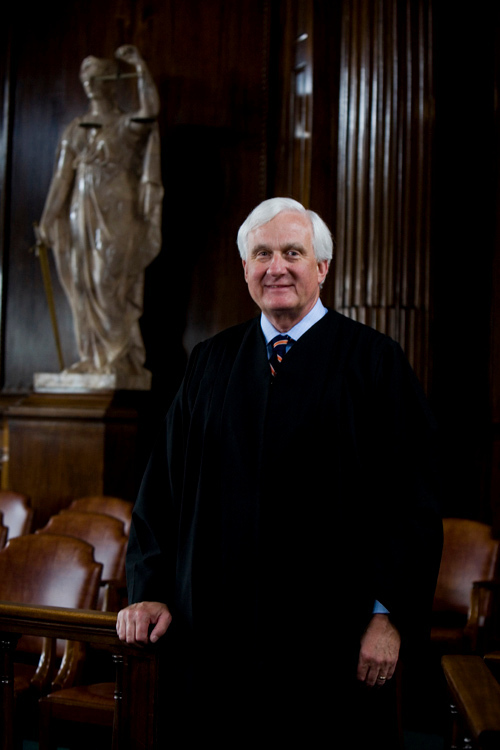
Gifted with a calm temperament, R.I. Supreme Court Justice Paul A. Suttell, nominated last month to become chief justice of the state’s highest court, is the kind of judge who can help opposing parties achieve consensus, say judges, attorneys and others who know him.
“The strongest point about Paul, and you learn it as soon as you spend any time with him, is his remarkably calm demeanor, the kind that permeates a room and everyone in it,” said retired Family Court Justice Pamela Macktaz, who served on the bench with Suttell during his 13 years at Family Court, ending in 2003.
Family Court is “the most emotional court in the state,” she noted, where petitioners fight over such sensitive matters as divorce settlements and child custody. Suttell’s ability to “put everybody in a frame of mind to be reasonable” proved “a wonderful characteristic” for Family Court, Macktaz said.
David Logan, dean of Roger Williams School of Law in Bristol and a law professor there, revealed that Suttell has asked one of his former law clerks, a young attorney relatively new to the profession, to be one of only a handful of witnesses who will testify on his behalf during upcoming confirmation hearings. He could have asked anyone, Logan noted, and certainly someone with more political clout.
“That kind of respect is a real testament to the working relationship he has with his colleagues,” Logan said. “People really like working with him. His instinct to choose a junior lawyer to testify on his behalf speaks volumes about the kind of person he is, not as a public justice but as a private person.”
Like Macktaz, he also pointed to the nominee’s ability to gain consensus among warring parties.
“He will be a wonderfully collaborative chief justice,” Logan predicted. “He’s a really good people person and he can get the court, from top to bottom, working toward the same goal. He is, by nature, a team-builder.”
More than any other chief justice in recent memory in Rhode Island, Williams opened up the court process to the public and the media, visiting newspapers for editorial conferences at least once a year and occasionally taking the high court on the circuit for sessions in local cities and towns, such as Woonsocket, where members of the public were encouraged to attend.
“He’s an excellent choice, outstanding,” Williams said of Suttell. “Of course, he has a different style than I do. I’m a Type A, I’m outspoken and he’s a little more low-key than I am, but I expect he will be just as effective.”
Williams also changed the way the court operating budget is approved at the Statehouse. Rather than submitting it to the governor for approval, he insisted the courts are a separate, independent branch of state government with no need for executive department action. The governor can offer recommendations, he has said, but it is the legislature that has ultimate control. “We haven’t talked about it,” Williams said, “but I would be shocked if he (Suttell) didn’t continue this independence.”
Suttell has declined all requests for media interviews until after he is confirmed by the House and the Senate. No date has been set yet for the hearings.
“I’ve found him to be a pleasure on the bench. His opinions are thoughtful and well-crafted,” said John A. “Terry” MacFadyen, a prominent appellate lawyer who helped win reversal of Claus von Bulow’s murder conviction and handled the successful appeal in the state’s high court of the multimillion dollar verdict against lead-paint companies.
Speaking as an attorney who has been an advocate before the state Supreme Court, MacFadyen said Suttell asks “probing questions” generally designed to allow attorneys to explain what may be the most difficult part of a case so “you can put your best foot forward.” MacFadyen said Suttell never uses the bench as a bully pulpit or to make law. “He is the diametrical opposite of that,” MacFadyen said. “When he asks questions, he is looking for an answer” rather than grandstanding.
She said she tried half a dozen cases before Suttell when he was on the Family Court bench. “He is scholarly, he knows the cases you’re talking about, he is unerringly polite to litigants,” she said, “and he has the perfect judicial temperament. He’s as calm and reflective a person as you would want to see on the bench.”
Victoria M. Almeida, president-elect of the 6,200-member Rhode Island Bar Association, has known Suttell since the two met on their first day of law school 36 years ago at Suffolk University in Boston. As did others, Almeida spoke of his calm demeanor, consensus-building ability and courtesy to all, but said the main attribute she sees in him, which she called the “greatest quality of any judge, especially a chief justice,” is humility.
“Justice Suttell has the ability, in a very humble way, to make people feel at ease and feel as if they are the center of the court’s attention,” she said.
Suttell, 60, is a Little Compton resident who received his law degree from Suffolk University Law School in 1976 and his bachelor’s from Northwestern University in 1971. He has been a member of the state Supreme Court since 2003. Prior to his appointment to Family Court, he was engaged in the practice of law with the firm of Beals & DiFiore in Providence. He was a Republican state representative from 1983 to 1990, the last five years as deputy minority leader. He and his wife, Mary, are the parents of two children, William and Grace. •