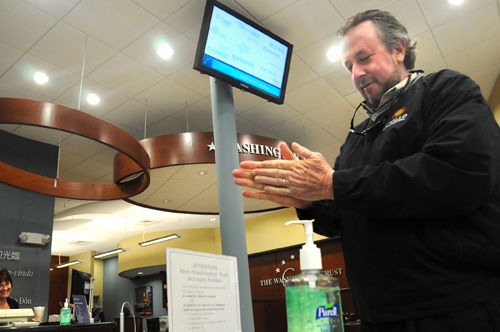
If you are doing business at a Washington Trust Co. branch anytime soon, don’t be offended if the bank manager doesn’t offer to shake your hand when you arrive.
It’s for your own protection – and the manager’s.
Handshakes have always been part of the process of creating the feel of personalized service for the customer. Stand, look them in the eye, use their name and shake their hand.
Now with the outbreak of swine flu – more technically known as H1N1 – it’s hands off until further notice at Washington Trust and other businesses.
“We thought it would be better not to do handshakes, for everybody’s personal safety,” said Elizabeth B. Eckel, senior vice president of marketing. “Maybe we can do what the Japanese do and just bow to each other.”
While the dangers of swine flu appear to be fading by the day – most health officials say the strain in the United States appears to be no more harmful than seasonal flu – at its height the threat provided a semi-serious test for some businesses’ disaster preparedness and continuity plans.
In recent weeks, companies have done everything from distributing anti-bacterial gel and discouraging handshakes to taking the temperatures of employees and quarantining workers – even those without symptoms – who recently traveled to Mexico, where it’s believed the virus originated.
At Johnston-based FM Global, travel to Mexico – where the international insurer has an office in Monterrey – has been prohibited for now. And employees returning from Mexico have been told to stay out of the office for at least 72 hours.
Steven Zenofsky, manager of public relations at FM Global, said taking such precautions is commonplace for the company, which has 900 employees in Rhode Island and 5,100 worldwide.
“We’re in the business of risk management and loss prevention,” Zenofsky said. “That’s in the DNA of the company.”
Other companies have taken similar measures, according to a survey conducted late last month by the Northeast Disaster Recovery Information X-change (NEDRIX), a Boston-based information network for continuity experts.
One unidentified company said in the survey that at the height of the flu scare, a company official was prepared to take the temperatures of employees. Anyone with a temperature greater than 100.4 degrees would be sent home and not allowed to return without a doctor’s note.
Most reactions have been more tempered.
Many firms said they have gone no farther than convening their crisis teams and monitoring the situation.
That’s what happened at Electric Boat, which employs about 2,000 workers at its Quonset Point plant in North Kingstown, where a possible case of swine flu was identified in late April.
Spokesman Robert Hamilton said company executives have been reviewing information released by the Centers for Disease Control and Prevention in Atlanta. “But this has not reached the point that it would start our emergency plan,” Hamilton said.
Others weren’t sure how best to handle the situation.
Lori Adamo, president and CEO of Code Red Business Continuity Services LLC in Cranston, said she had been fielding calls from businesses looking for assistance in dealing with the flu outbreak.
In response, Adamo already is planning workshops in June to discuss ways for businesses to prepare for a pandemic. “This is a minor virus, but it could develop into a more virulent strain,” Adamo said. “Businesses have got to be thinking about the possibility of a second wave.”
At Johnson & Wales University, officials were still recovering from the first wave last week.
The university’s pandemic plan – put in place after the SARS and bird flu outbreaks in 2003 and 2004 – was put to the test on May 1, when state health officials told the school that several students likely had swine flu.
At the recommendation of the R.I. Department of Health, Johnson & Wales canceled activities over that weekend, including a concert and a carnival at the Harborside campus. Classes on the following Monday also were called off.
Lisa Pelosi, the university’s director of communications, said school officials scrambled to get the word to students and faculty, through e-mail and computerized calls to their phones – a system put into place after the shootings at Virginia Tech in April 2007.
Pelosi said the crisis team of 10 administrators coordinated communications and steps such as handing out disinfectants to people on the local campuses.
Lifespan, the state’s largest health system, faced two concerns at the height of the flu scare: treating people with the swine flu and protecting employees at the hospitals.
Mary Cooper, chief quality officer at Lifespan, said administrators kept in constant contact with workers, through face-to-face discussion about the flu, through e-mail and through a special intranet site.
Earlier on, medical workers in the emergency rooms were issued respiratory masks. Later, other employees were fitted for masks, so the properly sized masks could be found and placed on at a moment’s notice. Cooper said even corporate employees are being fitted, too.
Lifespan executives also had a “robust discussion” about the human resources policy and how to ensure employees come to work in a crisis, Cooper said.
Studies of other emergencies indicate that medical workers are more likely to work when they feel their families are safe. While ultimately, the HR policy remained unchanged, Cooper said officials discussed the possibly of adding provisions that would allow for the families of employees to receive medicine and equipment in times of emergency.
“At the time, we didn’t know how many people were going to be walking into the hospitals with this,” Cooper said last week as the flu scare was petering out.
Back at Washington Trust, anti-bacterial gel has been placed at the check-writing desks in all the bank branches, as well as behind the teller windows. As an added precaution, tellers are offered the option of wearing rubber gloves while handling money.
But with the crisis apparently passing, Eckel said bank executives decided to use the opportunity to test their ability to operate under trying circumstances. In a meeting of senior managers, most of them participated through a conference call to test the phone system.
“We decided now was as good a time as any to do some testing,” said Eckel, adding that the meeting went smoothly.
It’s not that the bank hasn’t been through emergencies before, but it’s usually a snowstorm or hurricane. “It’s different this time,” Eckel said. “Those are power problems. [The flu outbreak] is more of a people crisis.” •