Navyn Salem’s journey into the world of malnourished children and large vats of fortified peanut butter started with a trip to Tanzania, her father’s homeland.
It was 2007. Salem followed a team from The Clinton Foundation that was distributing antiretroviral medication for people living with AIDS and HIV. It was a worthy cause, but she thought the foundation’s generosity was not countering the more fundamental problem faced by the Tanzanians. Many of them were starving.
“These people were so weak and so sick. They couldn’t go back to work. [An antiretroviral] drug is not going to get their strength up,” said Edesia founder Salem. “They needed food and nutrition.”
So Salem returned home to the United States, determined to find a solution to the problem, not that the answer to the situation is simple.
“The fact is, there are a billion people who are malnourished on our planet, and most people don’t seem to know a thing about it,” said Salem.
Before her 2007 trip, Salem had virtually no experience in starting nonprofits, building a work force or winning grant money. A Barrington mother of four daughters, she had previously worked at an ad agency.
Within a year of her trip to Tanzania, Salem launched her first nonprofit, called Industrial Revolution, an organization dedicated to establishing national guidelines for addressing child malnutrition and to building a factory in Dar es Salaam, Tanzania. The factory, in partnership with the French leader in ready-to-use supplements, Nutriset, will produce a peanut-based paste, called Plumpy’nut, specially developed to treat severe acute malnutrition at a rapid rate.
The factory in Tanzania is scheduled to start producing this September and will create 20 to 25 jobs for local residents. By year’s end, Salem hopes the factory will also be producing a product similar to Nutributter, a recipe designed specifically for Tanzania.
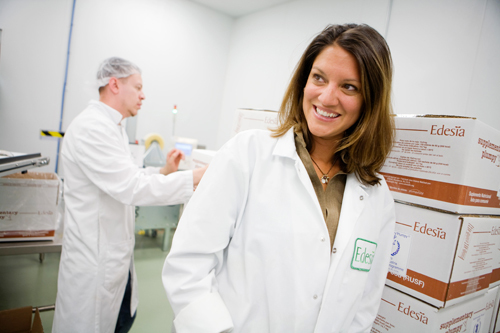
In March, Salem opened Edesia and began producing enough ready-to-use foods to feed more than 450,000 children annually in the developing world. The first assignment was 167 metric tons of Supplementary’Plumpy for the United Nations World Food Programme. The shipment will soon be sent to Haiti, where it will provide approximately 1.8 million doses of daily nutrition. The Rhode Island factory also produces Plumpy’nut, Plumpy’doz and Nutributter.
While most people would shutter at the idea of starting two nonprofits in the worst economy in decades, Salem said the situation was more of a catalyst than a deterrent.
“When I realized the terrible unemployment rates in Rhode Island, I thought I had to do something here,” she said.
Edesia will soon employ 25 workers. Salem admits that figure will not have much impact in a state facing a 12.6 percent unemployment rate. But for 25 families in the region, she said, it has made a difference.
Salem said her true calling is watching malnourished children positively respond to Plumpy’nut and the other ready-to-use products.
“Within a few weeks, you almost don’t recognize the child,” said Salem. “It’s a huge transformation, and when people can see that, it’s easy to get them on board.” •