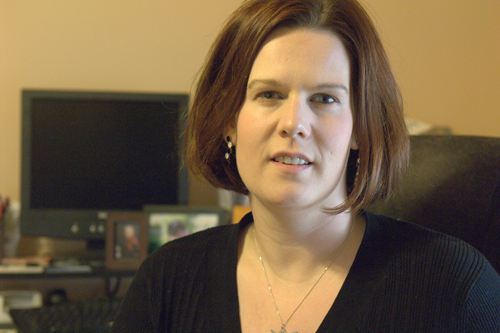
Deborah Obalil is a marketing consultant who works with arts businesses and nonprofits. She presented three workshops on “Marketing for the Independent Artist” at the 2009 National Arts Marketing Project Conference, held in Providence Oct. 30 – Nov. 2, sponsored by the Arts & Business Council of Americans for the Arts. Most recently, her company conducted research in Rhode Island and nearby Massachusetts for an arts consumer study that the Arts & Business Council of Rhode Island released in November. Obalil spoke with Providence Business News about the state of the arts in Providence and how arts organizations are coping with the recession.
PBN: Tell us what you do as a management consultant for nonprofits and arts businesses?
OBALIL: Mostly, what I do is come in with an objective view on the entire business, whether it be a small, for-profit, arts-related business or a nonprofit organization. I generally help them assess whatever their current business challenge is and then work with the leadership to design a plan to address that business problem.
Rhode Island's Market Has Changed. Developers, Builders, Investors and Sellers Must Change With It.
By Emilio DiSpirito IV License Partner | Engel & Völkers Oceanside Leader | The DiSpirito…
Learn More
PBN: How has the recession affected the revenue stream of arts businesses and nonprofits? PBN: How can an arts business or nonprofit with a small budget and limited resources market itself without spending a lot of money? PBN: The National Arts Marketing Project Conference recently was held in Providence for the first time. Can you give us your impressions of the event? PBN: Do you see any new business models emerging for nonprofits and arts businesses, such as social-enterprise ventures, mergers and partnerships? PBN: Providence has taken a lot of ribbing for calling itself “the creative capital.” How does it compare with other cities in the Northeast? INTERVIEW
OBALIL: Similar to most businesses, arts businesses obviously have seen a drop in a lot of their revenue streams. … A lot of the research out there, and what I can also attest to based on my own client base, shows that the drop has not been as significant as a lot of people were afraid it would be. A lot of consumers who already value having arts products in their lives have continued to prioritize that with their disposable income.
Nonprofits in the arts usually have a mix of both earned income and contributed revenue. … Where nonprofits are really seeing the hit is in the contributed-income side because, as foundations have seen drops in their endowments based on the recession, that impacts how much money they have to give away, making every bit of revenue that much more competitive.
OBALIL: The advent of technology marketing, whether it is through e-mail or social media or even simply having your own Web site, has really leveled the playing field for a lot of small businesses, especially for arts businesses, so they can reach a much wider audience through those tools. … But, as with all business, the best tip is to know your target market as well as you possibly can.
PBN: How do you find out what your target market is?
OBALIL: There is a lot that can be done through traditional market-research techniques. I like to tell my small-business clients that a lot can be learned by observing in a consistent way, simply by having conversations with their current customers, looking at who is interacting with their product and doing things like brief online surveys at the point of purchase. … Just having conversations with people … can help give a lot of insight into who it is that is most attracted to their product.
OBALIL: It was the first time that social media was really discussed very specifically in what it can do to grow consumer relationships for the arts and how arts organizations of all different sizes could be engaging in things like live-streaming of performances and video interviews with key artistic players, whether it be the director of a play or the choreographer of a dance, to give additional information to consumers and help build relationships with them. [Also discussed was] how to do it inexpensively, because if there is anything the arts are always really good at, it’s figuring out how to rub two pennies together.
OBALIL: I definitely think you are going to see an increase in partnerships, even the consideration of mergers, among arts organizations – especially on the nonprofit side – and collaborative marketing approaches for small businesses on the for-profit side. We have some of those already in Providence, such as Craftlands [on Westminster Street], which is now a year-round shop [and] is really a collaborative effort of a number of independent local craft artists looking to find a better way to distribute their work.
OBALIL: Definitely within the Northeast, Providence can make that claim proudly. … There is a tremendous amount of creativity and really savvy businesspeople working in the creative sector in Providence and a wide range of choices. You don’t see that wide range of choices in a lot of cities in the Northeast, everything from the kind of theater you want to see to the band you’re going to see perform on Friday night. •
Deborah Obalil
POSITION: Principal, Obalil & Associates, management-consulting firm for nonprofit organizations and arts businesses, based in Lincoln
BACKGROUND: Before she became a consultant about two years ago, Obalil was the executive director for six years of the Alliance of Artists Communities, a national organization based in Providence that represents artists’ residency programs.
EDUCATION: Bachelor’s degree in history and dance from Illinois Wesleyan University, 1995, Bloomington, Ill.,; executive certificate from the Stanford Graduate School of Business, Stanford University, Stanford, Calif.
FIRST JOB: She worked in client relations for a financial services firm in Schaumburg, Ill.
RESIDENCE: Lincoln
AGE: 36