Despite the educational efforts of local community groups and some banks, a large percentage of Rhode Island’s poor still do not have a traditional bank account, hindering their chances of reaching financial security.
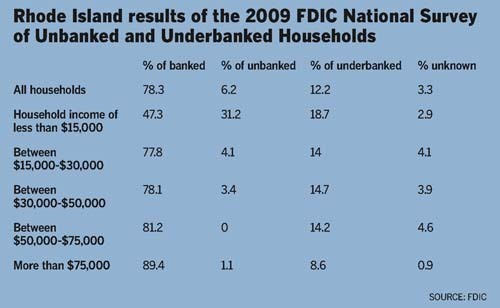
A survey issued recently by the Federal Deposit Insurance Corporation (FDIC) found that nearly one out of three Rhode Island residents with a household income of less than $15,000 does not have a savings or checking account.
Furthermore, the survey also showed that 6.2 percent of all Rhode Island households do not hold bank accounts, the highest rate among New England states.
Addressing the “unbanked” in Rhode Island and across the country has been a focus of community activists, governmental leaders and bankers for several years.
Financial institutions from Bank of America to Navigant Credit Union have organized financial literacy counseling sessions in collaboration with community groups, in hopes of informing people about the costs of avoiding the traditional banking system.
And it’s not just those who don’t have bank accounts, but those who may have an account but still rely on check-cashing stores, payday lenders and money transfer services. The FDIC survey said 12.2 percent of Ocean State households fall into that so-called “underbanked” category.
Experts say persuading people to use banks and credit unions regularly is crucial to assisting the poor.
“Everyone has financial transactions,” B. Michael Rauh Jr., The Washington Trust Co.’s vice president of sales, service and delivery, said in an e-mail. “Typically, banks charge much less for these basic services than nonbank providers. … If we could convince people to use banks for these services instead of nonbank alternatives, they could save money which could be used for other things.”
The national figure for “unbanked” residents is 7.7 percent, while another 17.9 percent are considered “underbanked.” In the South, the share of “unbanked” and “underbanked” is even higher, at 9.5 percent and 20.5 percent, respectively.
But Rhode Island’s rates don’t stack up too well with other New England states.
After the Ocean State’s 6.2 percent “unbanked” rate, Connecticut is next highest at 5.3 percent. Massachusetts’ rate is 4.1 percent, while New Hampshire is the lowest at 2.2 percent.
The survey results released in December came as Providence officials prepared to intensify their effort to increase poor people’s access to banks and credit unions.
“Bank on Providence,” a partnership between the city and financial institutions, will start in March with a marketing campaign to raise awareness about the cost of using check-cashing stores and payday lenders, according to Matt Stark, the city’s director of policy and legislative affairs.
“We have to get over their fears,” he said. “Some folks are skeptical. There may be a language barrier, or they feel they aren’t respected when they walk into a bank.”
The Bank on Providence program, part of a national effort by the nonprofit Pew Charitable Trusts, follows through with a recommendation of a city task force charged in 2007 with developing ways to help the poor climb the economic ladder.
In its “Pathways to Opportunity” report to Mayor David N. Cicilline, the Providence Poverty, Work and Opportunity Task Force determined that one out of five city households are “unbanked.”
Stark said Citizens Bank, Bank of America, Sovereign Bank, Washington Trust, Bank Rhode Island, Rhode Island Credit Union, Domestic Bank and Coastway Community Bank have agreed to help, initially providing information on fees, charges and minimum balance requirements.
“We need to reduce the barriers, whether real or perceived,” Stark said.
So far, the banks’ efforts have been piecemeal.
Washington Trust, Rhode Island’s largest independent bank, noted that it offers a free checking account with no minimum balance, no monthly fee and no requirement for direct deposit, debit transactions or online payments.
T.J. Crawford, a Bank of America spokesman, said the financial giant has been involved with “grassroots” programs locally – one session was held at the John Brown Settlement House, for instance – to educate the public on the importance of having a bank account.
Navigant Credit Union has established a branch inside Central Falls High School, not just to transform youngsters into members but adults, too.
The credit union encourages students to bring their parents to financial literacy sessions in Central Falls, a community with a high poverty rate. Many of the parents don’t regularly use the traditional banking system.
“It’s difficult to get people to change from doing what they’re used to,” said Robert Kimmitt, spokesman for the Credit Union Association of Rhode Island. •