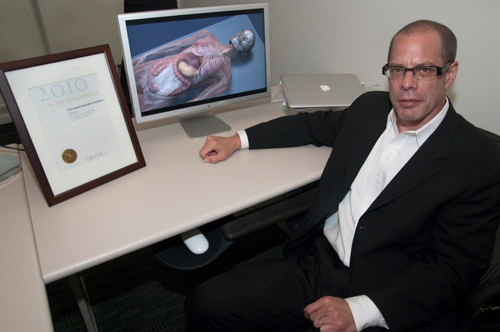
It is easy to feel overwhelmed by the amount of information coming at us, whether on computer monitors, in newspapers and magazines, or via television screens and smart phones. Organizing relevant information in a way that allows people to readily absorb it can be a challenge for many businesses.
Dynamic Diagrams Inc., located in the former Jewelry District of Providence, since 1990 has been working with clients – including some of the most successful organizations and corporations in the nation – to transform complex industry data into visually compelling formats that allow the viewer to get the point, sometimes with merely a glance.
According to Timothy Roy, president of Dynamic Diagrams Inc., a University of California study released in December 2009 found that the average American consumes 34 gigabytes of data per day from various sources.
“People are dealing with 100,000 words per day coming at them,” Roy said, “and they spend on average almost 12 hours consuming information every day and most of that takes place in front of screens, whether it’s a computer screen, a smart phone or a television set.
“We believe this is too much information coming at people and what we’re really trying to do is help folks simplify the story, take all of this data and transform it into knowledge,” he said.
For example, Dynamic Diagrams recently redesigned the Historic New England website, which can be found
at www.historicnewengland.org. The Boston-based nonprofit preservation society owns 36 historic properties in five states, with a collection of more than 110,000 historic objects and archives with more than 1 million items, including thousands of photographs, drawings, newspaper clippings, ephemera, maps and books.
“It is a good example of what we do in the sense that Historic New England has a fairly diverse user population,” Roy said, ranging from the novice looking for a place to take the family on a day trip to the history expert searching for a particular fact. “We worked to take this very large collection of information that Historic New England has, figure out a way to present that and optimize the experience for the various users, and then create a Web presence for the organization that would help tell their story.”
Dynamic Diagrams has won awards for work done for the J. Paul Getty Museum in Los Angeles, Roy said, including an online interactive piece on how mummies are created – one of the first electronic pieces to become part of the museum’s permanent collection. The YouTube version, Roy said, has almost 100,000 hits.
“When one goes to look at a mummified body, all you see is the mummy,” Roy said. “However, a lot of people are very curious about how that actually happened. What does it look like inside? So we created a video that actually shows the whole process starting from the body through all the steps.”
In a similar vein, visitors are never allowed to touch precious objects on display in a museum, such as an antique German cabinet also at the Getty. “We created a touch-screen kiosk system that allows you to interact with the cabinet,” Roy explained, “to turn it around, open the doors, open the drawers. So you can be looking at the piece of art and at the same time you can play with it in a virtual setting.”
Roy explained that his company is not a software or Web-development company and does not build the products it designs. “We build things primarily with clients that have their own internal technology resources to implement that which we plan and design for them,” he said. He compared his firm to an architect that designs a house versus the builder who actually constructs it. Typically, he said, “people come to us when they have information challenges that are too overwhelming or too much for the average ad agency or marketing firm.”
Founded by Paul Kahn, an information architect now working in Paris, and retired Rhode Island School of Design professor of graphic arts Krzysztof Lenk, Dynamic Diagrams has had such clients as the Smithsonian Institution, Oxford University Press, the Rockefeller Foundation, Hewlett-Packard, the World Health Organization, Textron and the U.S. Holocaust Memorial Museum. •
COMPANY PROFILE
Dynamic Diagrams Inc.
OWNER: Timothy Roy, president
TYPE OF BUSINESS: Consulting and design firm
LOCATION: 111 Chestnut St., Providence
EMPLOYEES: 7
YEAR ESTABLISHED: 1990
ANNUAL SALES: WND
Beyond Cash Donations: How New Forms of Giving Are Transforming Not-for-Profit Accounting
Evolving Funding Landscape for Not-for-Profits Not-for-profit organizations are being asked to do more with less,…
Learn More