WASHINGTON – The national savings rate widened last month as disposable personal income nationwide rose $600.3 billion, outpacing the increase in consumer spending, the U.S. Commerce Department’s Bureau of Economic Analysis said today.
Total personal consumption expenditures nationwide rose $77.4 billion, 0.8 percent, in May after rising 0.4 percent in April and 0.5 percent in May, in what the BEA said was the biggest increase since November. But inflation accounted for half of last month’s rise.
Cybersecurity Awareness Month: What to Do When Your Identity Is Stolen
In recognition of Cybersecurity Awareness Month, it is important to remember that identity theft affects…
Learn More
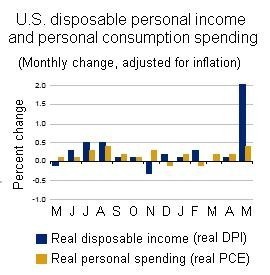
Real personal spending nationwide – PCE adjusted for inflation – edged up 0.4 percent in May after rising a revised 0.2 percent in both April and March.
The May increase was slightly above the 0.7-percent median forecast from a Bloomberg News survey of 72 economists. (Their projections for the PCE called for an increase of 0.1 percent to 1.0 percent.)
Purchases of non-durable goods rose 0.4 percent in May, the same as in April. Spending on services also rose 0.4 percent, accelerating from April’s 0.1-percent gain. But consumers continued to delay purchases of cars and other durable goods, which rose 0.1 percent in May after holding steady in April.
The PCE price index – a measure of prices paid by U.S. consumers – rose 0.4 percent in May, accelerating from gains of 0.2 percent in April and 0.3 percent in March. (READ MORE) The core PCE excluding food and energy rose 0.1 percent, the same as the month before.
Personal income grew by $225.7 billion, or 1.9 percent, accelerating from gains of 0.3 percent in April and March, and more than quadrupling the Bloomberg survey’s forecast of a 0.4-percent gain. Wages and salaries – the largest component of personal income – increased $15.9 billion in May, after rising $9.6 billion in April.
Disposable personal income nationwide increased $600.3 billion, or 5.7 percent, after rising a revised 0.4 percent in April and 0.3 percent in March.
Real DPI – disposable personal income adjusted for inflation – surged 5.3 percent in May, after edging up 0.1 percent in April and holding virtually unchanged in March, the BEA said.
The nation’s personal savings rate surged to 5.0 percent of DPI, from April’s revised 0.4 percent and a March rate of 0.7 percent of disposable personal income, exceeding the 12-month average of 0.4 percent. Total personal savings in May – DPI minus personal consumption expenditures and other outlays – rose to $55.7 billion last month from April’s $39.7 billion.
The BEA noted that, in the past two months, the DPI has been boosted by payments under the federal Economic Stimulus Act, which gave consumers $48.1 billion in May and $1.9 billion in April. “Consumers aren’t fooled – they know this is a temporary boost to their income,” Ellen Zentner, an economist at Bank of Tokyo-Mitsubishi UFJ Ltd. in New York, told Bloomberg Television. “If you strip out tax rebates, personal income probably rose about 0.3 percent.”
In fact, the BEA said, excluding those payments, the DPI last month rose $46.4 billion, or 0.4 percent, accelerating from an April increase of $16.6 billion, or 0.2 percent.
Additional information, including the 13-page Personal Income and Outlays news release, is available from the U.S. Commerce Department’s Bureau of Economic Analysis at www.bea.gov.