Providence-based Pilgrim Screw Corp. churns out about 60 million screws annually, and one way or another a growing number of them have been finding their way overseas recently.
Some of the specialized fasteners, largely used by the aerospace and defense industries, have been exported directly out of the country. Company President Geoff Grove says that segment of the business has expanded 10 to 15 percent annually in the last few years.
Others have been installed in airframes or weapons systems by other U.S. manufacturers, then those products have been shipped in increasing numbers to foreign buyers.
Whatever way the screws are going global doesn’t matter to Grove. Bottom line: Worldwide usage of Pilgrim products means bigger profits.
Pilgrim is one of many Rhode Island companies that are benefiting from the weakened U.S. dollar, which is making U.S.-made goods more affordable outside the country and spurring a bit of a foreign buying spree.
Yes, the local economic picture is looking gloomy right now, but state officials say global trade is one bright spot as Rhode Island-made goods – from specialized screws to custom-made yachts – are attracting their share of attention internationally.
For example, Astro-Med Inc., a West Warwick-based manufacturer of specialty printing systems and supplies, reports that while its overall sales have grown more than 10 percent a year over the last few years, international sales have grown 20 percent.
“The pricing has been an advantage; it certainly has been helpful for us,” said Joseph P. O’Connell, chief financial officer of Astro-Med. “And we think the export market will continue to be an excellent opportunity for the company to grow.”
The favorable currency exchange rate also gave Astro-Med a boost, adding $1.3 million to last year’s $72.37 million in sales.
At the very least, the soft dollar is persuading businesses that have traditionally focused on domestic markets – even small and medium-sized ones – to give European and Asian markets a try, according to Ray Fogarty, director of the John H. Chafee Center for International Business at Bryant University.
“It does open up the international market,” said Fogarty, whose center assists local companies in doing business internationally. “That is the one saving grace of our economy today. People are asking for our products that they wouldn’t even entertain before. It now makes us competitive around the world.”
Rhode Island exports have certainly increased.
According to figures from the World Institute for Strategic Economic Research, the value of products and commodities leaving Rhode Island through the Port of Providence jumped 20.7 percent in 2006 and another 7.53 percent in 2007, growing from $1.27 billion in 2005 to $1.65 billion in 2007. Nationally, exports grew 26.8 percent over the same time period.
This year’s numbers so far show that the growth is continuing. The $435.5 million worth of exports recorded in the first quarter is a 17.2 percent gain over the $371.72 million in exports for the same period a year ago.
What’s being shipped out of Rhode Island? Figures indicate that waste and scrap metals are the state’s biggest export at $395.5 million in 2007, followed by computer and electronic products ($214.22 million), manufactured commodities ($201.9 million), machinery ($179.02 million), chemicals ($164.46 million), and plastics and rubber products ($94.12 million).
Colin Kelly, spokesman for Schnitzer Steel Industries, the owner of Metals Recycling LLC, a Johnston auto shredder that also leases property at the Providence port, said the skyrocketing prices and demand for scrap metal in China and India are major reasons for the incredible increase in exported scrap metal. But, he added, the weak dollar is “definitely a driving force.”
The state’s export numbers don’t tell the full story, trade officials say.
Fogarty noted that Rhode Island doesn’t have a major exporting center, other than the Port of Providence. So products made in the state and sent to ports in Boston or New York aren’t counted as Rhode Island exports. “We lose some of those values,” he said. “That means we’re potentially doing even more than we get counted for.”
And another aspect missed in those export statistics: component parts that are installed into finished products somewhere in the United States before being shipped overseas.
The makers of those component parts are still benefiting from the favorable climate for global trade, Fogarty argued.
“Rhode Island has many, many examples of products we’re exporting all over the world, but it doesn’t even show up in our figures,” he said.
Nevertheless, sales related to the international trade have helped in some ways to prop up Rhode Island’s long-suffering manufacturing industry, Fogarty asserted.
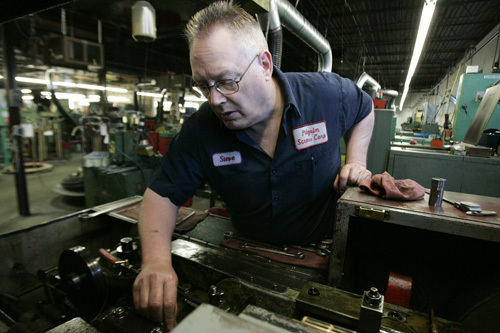
Take, for instance, Pilgrim Screw. Grove said the family-owned business employed as many as 46 people at its Providence plant in the late 1990s.
Then the Sept. 11, 2001 terrorist attacks crippled the aerospace industry, cutting Pilgrim’s sales by 40 percent and forcing layoffs. With growing demand both domestically and abroad, the work force was stabilized at 38 people in Providence. (Pilgrim employs another 26 workers at a plant in Arizona.)
There are downsides to the weak U.S. dollar when it comes to global trade.
Grove said the company purchases raw materials such as stainless steel thousands of pounds at a time from foreign companies. With the devalued dollar, it takes more money to buy the same amounts.
In 2004, Pilgrim was paying $1 a pound for stainless steel purchased in Italy. Now it’s about $4 a pound, with price continually rising.
So far, the increased business has made up for additional costs for raw materials, but that might not always be the case.
“It’s been extremely volatile and it’s definitely had a negative effect,” Grove said. “So there are two sides of the coin.” •