Anne Mosher, a manager at the national headquarters of United Natural Foods Inc. in Providence, was skeptical when the company, a food-distribution firm, announced its wellness program three years ago. The program was dubbed “Body and Mind.”
“When it was first launched, I was like a lot of employees,” Mosher explained. “There was some suspicion that it was a big-brother kind of thing, that the company was going to be involved in our overall health, almost like a penalty system for our health-insurance selections.”
Mosher’s attitude quickly changed. “It was different,” she said. “It was about me, and not so much about reducing health care costs. It made you aware of your own health and long-term goals.”
As part of the wellness program, run by the consulting firm Provant, based in East Greenwich, Mosher had a physical, and as part of that physical, a routine mammogram screening.
“They were able to identify a suspicious area, with the best prognosis, stage zero. Because of that early detection, there was no radiation, no chemotherapy,” she said.
Without a doubt in her mind, Mosher said, “the wellness program saved my life. I wouldn’t have gone for a routine mammogram for a couple of more years.”
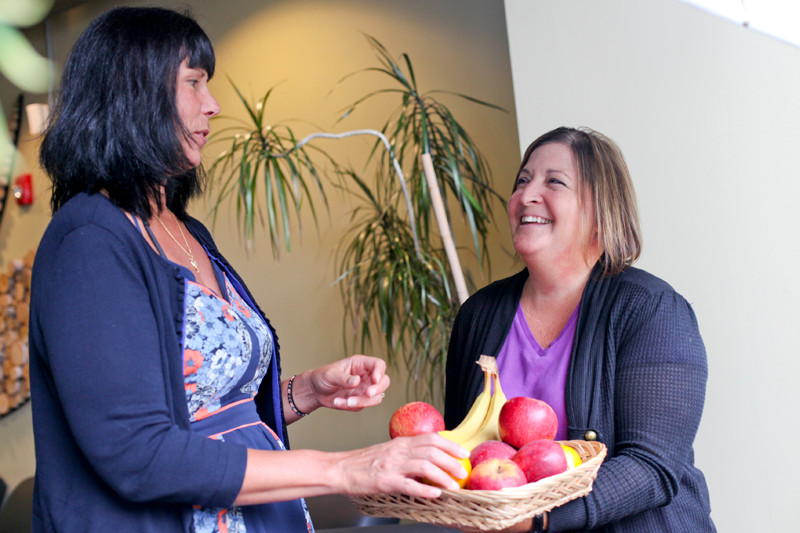
Mosher said that the wellness program has created a sense of community at the workplace, where about 400 of the company’s 7,000 employees work. “The smoking-cessation program, the attention to diet, free organic fruit in the break rooms,” she said. “Everyone around me is participating. There is a Weight Watchers program at lunch hour, once a week. All these people have gotten pretty skinny.”
The wellness program, she said with conviction, feels like an extension of the company’s core values. “It’s a great place to work. Your work life really reflects the company’s values, and the company’s values are not just words.”
Every year, the wellness program at United Natural Foods has become a little more involved with the lives of employees, according to Deirdre Mendenhall, the director of benefits and wellness at the company. In 2013, it took a major step forward by welcoming into the program the spouses and domestic partners of employees.
“We found, for someone to quit smoking without a support network at home was very difficult,” Mendenhall said. “So we decided to take the spouses down the same path in the wellness program.”
The participation rate has been very good so far – with about 85 percent of employees and about 50 percent of spouses participating, according Mendenhall. About 7,000 United Foods workers and spouses have completed a health-risk assessment.
The results of the wellness program have produced “exceptionally positive” numbers in the reduction of health risks: a 9 percent decrease in those at risk for waist circumference, from 46 percent to 37 percent; impressive improvements in lowering blood pressure; and a reduction in cardiac risk, according to Mendenhall.
The Body and Mind programs is not resting on its laurels, Mendenhall continued, but looking to the future. “The biggest piece for us this year was engaging with spouses,” she said. “The next step is to engage with folks not just to know their numbers (from biomedical screening and health-risk assessments). The next step is to move your numbers.”
One of the most important factors in changing behaviors in the wellness arena is the readiness for change, Mendenhall said. “You have to be ready to change your behaviors,” she said. “We look at the readiness for change metrics as part of our wellness program.”
As part of the company’s smoking-cessation efforts, Mendenhall said that the wellness program has created tools so that employees can be successful when they are ready to change – including an online and telephone-coaching program and a medical plan that covers smoking-cessation drugs.
“We try and remove the hurdles,” she said.
Thomas Dziki, chief human resource and sustainability officer at United Natural Foods, said one of the most important steps the company took was the move to shift the wellness program from voluntary to mandatory. “It’s the commitment,” he said. “We have the follow-through and the commitment. We started to hold people accountable, and to make it mandatory.”
The need for the wellness program was driven home when, during some initial health screenings, several workers went directly from the screening to local hospitals because of dangerously high blood pressure, according to Dziki.
And, Dziki’s spouse is participating in the wellness program. “I think, at first, she had trepidations,” Dziki said. “She had some concern that her information was somehow going to be shared. Everyone takes their own health very personally.”
Dziki said he reassured his spouse, telling her: “No, honey, you’re the only one who gets the numbers. No one else has access.” She went to the screenings, he added. “There was no pain involved.”
Dziki said he was surprised to learn the large percentage of the population that doesn’t go to annual physicals or see a primary-care doctor. These are people who are insured but not actively engaged in the health system.
“At the end of the day,” he said, “we’re all trying to look at the rising costs of medical expenses, and to help our associates take control and responsibility of their own health care – to do it for themselves and their family.” •