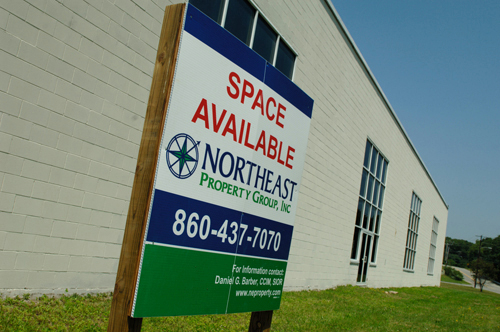
The town of Westerly is taking the initial steps in an economic-development effort that few Rhode Island municipalities have undertaken, although some in the business community say more should.
Westerly officials are asking owners of vacant commercial and industrial properties – or their real estate brokers – to notify the town so officials can compile a database of land and buildings that are available for lease or purchase.
The thinking is that such an inventory could be an invaluable tool in connecting property owners with companies interested in relocating or expanding operations in town.
Westerly, like most Rhode Island towns, has no dedicated economic-development director. So far, the effort has been limited to a notice on the town Web site.
But Town Planner Marilyn Shellman says things are just getting under way. There’s really no list to speak of yet, and it’s not like the phone is ringing off the hook with calls from relocating businesses, especially with the economy in the dumps.
“We’re just trying to be proactive,” said Shellman.
Surprisingly in this age of vast amounts of information available on the Web, Westerly is one of the first local communities to take steps to assemble a list of available properties as an economic-development tool.
While the state’s largest municipalities, such as Providence and Warwick, have economic-development staff members, most smaller towns don’t a have a full-time economic-development office, instead relying on local volunteer committees.
David R. Carlin III, coordinator of the Rhode Island Chamber of Commerce Coalition, a partnership of 13 chambers in Rhode Island, said developing a vacant-property database is a growing trend among small-town governments around the country as competition to attract business grows stiffer and that competition has spread to more rural communities.
Municipalities are looking for any edge.
“The goal is you are prepared ahead of time,” Carlin said. “That way you are all set and have a list for a potential company when they call. But it hasn’t been a widespread practice.”
In fact, Broadhead said the council is preparing to seek a grant that would cover the cost of compiling and updating an online listing for commercial and industrial property in each of the nine towns he represents.
Being online and up-to-date is crucial, Broadhead said, because many businesses looking to relocate turn to the Web to begin their search for a new location.
“We’re not willing to do it in an informal way because if it’s not updated regularly, it’s not going to be useful,” he said.
Most towns in South County have been slow to even begin putting a list of vacant properties together because in most of the towns, getting the information on a moment’s notice isn’t that difficult.
“The town planners usually have a good handle on what’s available,” Broadhead said. “And if they don’t, it usually takes just one or two steps to find something for [a company that’s interested in moving into town].”
In a more developed town such as Westerly, “it’s a little more complicated,” he added.
What’s for lease or sale may not be immediately clear. Not everything is listed with a broker, and some property owner might not be actively looking to sell. “But they’d be ready to sell if the right person came along,” Broadhead said.
In its notice to “owners, real estate agents and managers” of available commercial and industrial property, the town of Westerly said it would need plat and lots numbers, addresses, acreage of the land and square footage of existing buildings.
He said he was willing to submit information on a 21,747-square-foot manufacturing space that one of his clients was looking to lease out at 79B Tom Harvey Road in the Westerly Industry Park, but Barber sounded a skeptical note.
Echoing Broadhead, Barber said it would be critical that such an inventory be kept up to date. In addition, he questioned the necessity of the list, in part because of the proliferation of real estate listing sites on the Internet, and the dearth of locations for such sites in Westerly.
“It’s a proactive thing for sure, but you can probably keep the database on one piece of paper,” Barber said.
Shellman said the listing of storefronts would be a top priority, considering that some recent shopping-plaza developments in town have left some locations vacant.
Those empty stores have also spurred the town to pass an ordinance last year that would require property owners to register their vacant commercial property with the town. The ordinance also established fines for owners who do not maintain the property.
Lisa Konicki, executive director of the Greater Westerly-Pawcatuck Chamber of Commerce, supports assembling a roster of available business space, but she doesn’t envision it winning over some large, established company, at least not in a slow economy.
It’s more likely entrepreneurs would take advantage of the resource, Konicki said, or someone looking to open a franchise business.
Nevertheless, the town also is preparing for when the economy turns around, Konicki said.
“You have to make things as user-friendly as possible,” she said. “And I think the town is putting itself in a better position. It’s playing offense rather than defense.” •