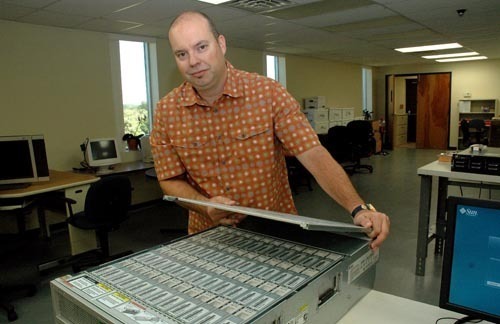
The most efficient data-storage system in the world – that’s the claim a new Westerly company is making for its debut product, which is being released this week.
The startup is called greenBytes, and Robert Petrocelli, the company’s co-founder and chief technology officer, says he and his 12 employees have found an innovative solution to an issue many companies are facing – how to deal with the exploding amount of data that gets stored on corporate servers.
The amount of power used by corporate data centers doubled from 2000 to 2006, according to the U.S. Environmental Protection Agency, and analysts at the International Data Corporation estimate companies now spend over $8 billion per year on electricity for data storage.
According to greenBytes’ research, about 80 percent of the data stored on a server never gets accessed again – think of old e-mails and spreadsheets created for dormant projects. The problem, Petrocelli said, is that most servers cannot keep most of their unused disks powered down to save energy – all the disks spin to maintain access to only a fraction of data. He compared it to a car that is always running in the garage, no matter how long it will be before it gets driven.
GreenBytes’ new system, Cypress, takes a storage server from the Silicon Valley giant Sun Microsystems – which is working with greenBytes on the new system – and adds proprietary software which engineers say will optimize the server to make it more efficient. According to greenBytes, Cypress uses 25-percent less energy and takes up one-seventh the space of comparable systems. The system is priced at $1 per gigabyte of storage.
Mark Peters, an analyst at Enterprise Strategy Group, a storage consulting firm based in Milford, Mass., said greenBytes is one of a number of companies looking for ways to reduce the energy consumed by data-storage systems.
“There are massive efficiencies that are [possible] in the storage business,” he said, and companies are seeking savings as their electricity bills continue to rise.
GreenBytes was founded by a number of former employees of HeartLab Inc., another Westerly-based software company, which was sold to a Belgian company in 2005. “It’s sort of the best and brightest from HeartLabs,” said Petrocelli, who was HeartLab’s CEO and co-founder.
There are two key innovations that make Cypress more efficient, he said. The first uses MAID (massive array of idle disks) technology to manage disks so that they power down when they’re not needed, cutting energy consumption.
The other innovation is real-time data “de-duplication,” a concept Petrocelli explained by using the example of a long PDF document that gets attached to an e-mail and sent to 100 colleagues.
Rather than save 100 separate copies of the large PDF, which would take up valuable space on the storage server, he said Cypress saves only one copy of the PDF, which can be accessed by all users in the same way they would have viewed a separate file. If the file is edited, Cypress saves the edits without creating another copy of the full PDF.
Petrocelli said the new software will rapidly analyze the tiny blocks that together make up a file in order to prevent duplications from getting saved on the server.
Peters said greenBytes is embracing some of the major options available for optimizing servers. MAID technology and de-duplication “are both very interesting and very powerful tools to provide efficiency in a disk storage system,” he said.
“However,” Peters continued, “neither of them is new or unique.” EMC Corp., the Hopkinton, Mass.-based information storage giant, has introduced both in its CLARiiON line, he said. “They’re not standard yet, but they’re certainly moving in that direction,” he added.
Noemi Greyzdorf, an analyst at the International Data Corporation, a research firm, thinks there will be interest in Cypress. “The challenge for them is going to be establishing a channel and establishing, of course, a brand,” she said. •