With more than one-quarter of the state’s agricultural output coming from sod production, anyone with a half-acre lot seems to stand a chance to make a little spending money. But as simple as growing – and harvesting – grass would seem to be, the industry has seen technology disrupt the old business models, just as it has in so many other industries.
The Ocean State’s sod farms total about 4,000 acres, and because of demand largely driven by home and golf course construction in New England, about 2,453 of them are harvested every year. Turnover that high demands that the farms operate as efficiently as possible; and that is exactly what they are doing.
ISO 9001:2026: A Practical Opportunity to Build for What’s Next
For Rhode Island manufacturers, ISO 9001 has been much more than a certificate on the…
Learn More
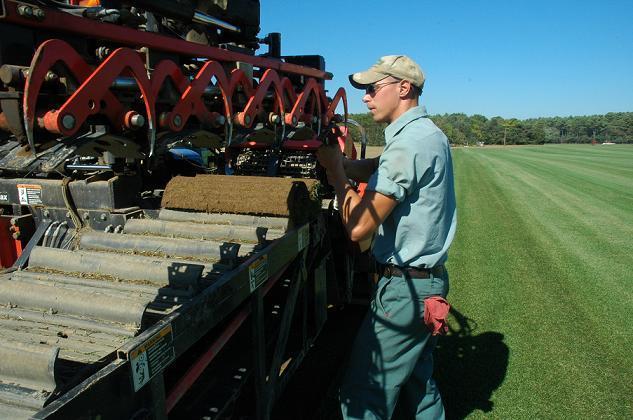
One farm, Sodco Inc., in North Kingstown, with about 500 acres, made the jump last week to fully automated harvesting.
The company started employee training on a Trebro AutoStack, an 11.5-foot by 35-foot automated harvester that requires a single operator. That purchase, at more than $300,000, will revolutionize the way Sodco operates.
With it just one worker can stack about 500 square feet of turf in 90 seconds. Manually, that would have taken about seven minutes, said owner Linda Tucker.
Tucker said that although the new stacker will cut down on the number of Sodco employees – there are now about 15 – the stacker is a move toward better cut and stacked turf.
“We’re hoping for increased yield from our fields because of the technological advances. And it’s less manual labor,” said Tucker. “So it’s the increased production and a better-quality cut.”
(After the AutoStack arrived, Sodco laid off four workers. But those cuts were unrelated to work force changes that the AutoStack will bring about, said Tucker. New hires will take the places of those who were laid off.)
I wasn’t always this way. Southern Rhode Island has been a leading producer of turf since the early 1970s. Currently, there are about 15 turf farms in South County. Labor through the years has been, by and large, based on strong backs. At Washington County Turf Farms Inc., in the West Kingston section of South Kingstown, owner Darrell Bouchard said his 300 acres are harvested by about 15 skilled employees.
“When you get a kid in to stack, you’re hiring somebody strong. As they learn the job, do other things and stack, they become a valuable employee,” said Bouchard. “Unfortunately, when they get in the mid-30s to 40s, they don’t want to stack any longer.”
As a result, Bouchard’s crew does do some mechanized roll-cutting and stacking. But “all that’s done for us is made it possible to maintain our labor force,” he said.
Like any other agricultural enterprise, turf farming is not impervious to weather and global market conditions.
“I know one grower, in the month of August, spent about $12,000 just on gas to run his irrigation pumps. That’s because we had this incredibly dry August,” said Nathaniel Mitkowki, a turf pathologist at the University of Rhode Island. “More than anything else, though, I think their biggest expense this year has been water.”
The numbers can add up pretty quickly. Sod, nurseries, greenhouses and floriculture in Rhode Island account for about $37,593,000 in annual sales, which is 67.7 percent of Rhode Island’s total agricultural output. A 1999 URI study estimated that $16 million comes from sod production.
Rhode Island ranks fourth in the United States for agricultural acreage production value, with a $1,095 average per acre, according to the R.I. Department of Environmental Management Division of Agriculture.
And turf, said Mitkowski, is “probably at this point the biggest agricultural enterprise in Rhode Island.”
But turf hasn’t always been a big market in Rhode Island. Until the early 1970s, almost all of South County’s turf farms were potato farms. But the market for potatoes couldn’t sustain all those farms, so turf took over, Mitkowski said.
Bouchard’s Washington County Turf Farms Inc. was one of those farms.
“One was a major loss of money and the other was highly profitable,” said Bouchard. “It didn’t take any rocket scientist.”
Much of the turf harvested in Rhode Island doesn’t stay here. Most farms said that more than 50 percent of what they produce is trucked to either Massachusetts or Connecticut. But with a housing boom during the 1980s and a high density of golf courses, centrally located Rhode Island was a natural for the farms, said Mitkowski.
“It’s really, more than anything else, just a matter of location,” he said. “I mean, you can go out in the middle of Kansas. Kansas is just as good for growing grass, but there’s nobody willing to buy it. We have a market here that is just unparalleled with the density of people and suburban environment.”
Turf Inc. in Exeter, owns about 220 acres of turf and operates another 80 acres in South County. Alane Carter, co-founder and vice president, estimated that about 70 percent of Turf’s product heads to southern and western Massachusetts.
“Massachusetts is predominantly where we go,” said Carter. “We don’t go too far into Connecticut because along the Connecticut River Valley there are turf farms – we don’t conflict in their territory.”
At New England Turf Inc., in West Kingston, about 500 acres are farmed by about 20 employees. Much of that sod heads to Cape Cod or farther north to Portland, Maine.
“Usually you want to try to stay within about 150- to 200-mile radius of where you want to send your product, because otherwise your shipping costs get to get prohibitive on what your profit margins would be,” said Glenn Chappell, sales and credit manager. “You can see geographically where you can leave this area and cover pretty much all of New England on a daily basis.”
While mechanization has grown on Rhode Island turf farms, types of grass haven’t changed much during the years. URI’s Mitkowski said grass on Rhode Island turf farms is largely Kentucky bluegrass, which has been the New England standard for decades. But a lessening of chemical use – many farms now use recycled Boston sewage for fertilizer – and an increase in grass blends are also improving Rhode Island’s market.
“Just like the technology of equipment has improved, the genetics of the grass has itself improved,” said Chappell. “You might have places where you put in grass and look for a mixture of grasses. You might find blue grass with fescue grass, which is for low-maintenance or shady areas.” •