Four days a week, Latinos across Rhode Island tune in 88.1FM to listen to “Nuestra Salud” – “Our Health” – an hour-long program hosted by Dr. Pablo Rodriguez, a Pawtucket-based ob/gyn and a prominent figure both in women’s health and in the Latino community.
The show reaches a broad audience: 75,000 people, Rodriguez said, a huge number for a Spanish-language broadcast in such a small state.
It draws listeners in with a combination of meaty health care news, a lively and accessible format, and plenty of audience interaction. And every morning, it teaches them something, expanding the health care literacy of a population that faces particularly great challenges.
Now, in partnership with Women & Infants Hospital, Rodriguez is taking the educational aspect of his show to a new level.
Last month, the hospital and Latino Public Radio, a station that Rodriguez co-founded three years ago and that now produces seven shows, announced they have received a $138,000 National Institutes of Health grant to develop a 10-week educational series and measure its effectiveness in increasing Latinos’ health and science literacy.
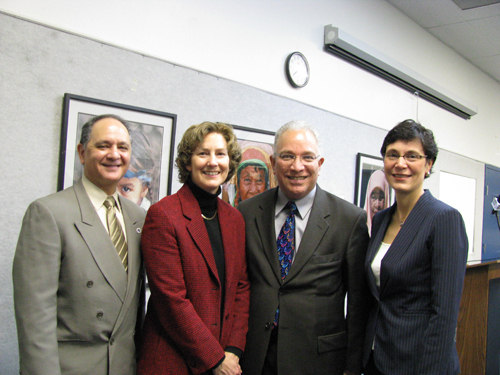
“This is historic,” Rodriguez said at a Jan. 21 event at the International Institute in Providence. “This is the first time a Spanish radio station [has gotten] involved in this kind of program.”
Health care policy experts and industry leaders have grown increasingly concerned about health literacy in recent years as studies have linked it to people’s overall health, treatment outcomes, use of services and spending.
At the event, Rodriguez noted that it can be tough even for well-educated, native English-speaking patients to understand the complex language and concepts involved in health care. But if you don’t understand the directions on your pill bottles, you may not take your pills right. If you don’t grasp why you need a certain test, you may delay or skip it. And if you don’t know how to monitor your own health, you may miss warning signs of diabetes or cancer.
Studies have linked low health literacy to higher cancer rates and higher rates of complications from diabetes, such as blindness, Rodriguez said. Add the challenges of not speaking English – or not speaking it well – and cultural differences, and the risks to Latinos are substantial. “This is a very, very serious problem,” he said.
For the new study, titled ESCUCHE (“listen” in Spanish), Rodriguez will work with Dr. Maureen Phipps, director of the Division of Research at Women & Infants and associate professor of obstetrics and gynecology and community health at the Warren Alpert Medical School of Brown University (Rodriguez is also affiliated with the hospital and Brown).
The first step, which began last month, involves hosting three community meetings to find out what health topics are of particular concern to Latinos, and also to identify topics the audience may not mention, but should probably know about.
A community advisory group has also been assembled, including health care providers as well as Latinos in leadership positions in the community. One of the new group’s members, Ramon Martinez, executive director of Progreso Latino, said the project will be empowering to the community, and it will also forge valuable connections between Latinos and the health care and academic worlds.
Once the researchers have developed a strong sense of what topics they want to address, they will develop a curriculum and tailor it to a talk radio format. The shows will then air on Latino Public Radio and, like all LPR programs, also be posted online at www.lprri.org.
To measure the series’ effectiveness, the study will enlist a group of 50 to 75 volunteers, Phipps said, who will take a Web-based health literacy assessment before the series begins and then another at the end of the 10 weeks. •