Rhode Island’s high unemployment could have an unintended consequence: a decrease in workers’ compensation filings. When times are tough, claims often dip as employees worry that time away from work may make management more likely to add them into the next round of layoffs.
Michael St. Pierre, an attorney specializing in workers’ compensation cases, said people fear anything that could put them in a bad light with management. They also worry about the slimmer paycheck that comes with being on workers’ compensation, which typically pays three-quarters of the worker’s net pay.
“You have people who have obligations that are trying to do anything and everything they can to stay in the job,” he said.
Fewer employees also translate to fewer people able to file claims and could also explain the shorter court calendars and the whispers among lawyers preparing for a drop in cases.
Some of the first people to anticipate a drop in workers’ compensation claims are those in the Providence office of the Occupational Health and Safety Administration. The office’s director, Patrick Griffin, knows from 25 years on the job that the number of recorded work-related injuries goes down during economic recessions.
“We do find that in economic downturns people are afraid to lose their job so they take some risks [by failing to file injury claims] which they would not normally do in prosperous times,” said Patrick Griffin area director for Providence Area OSHA office.
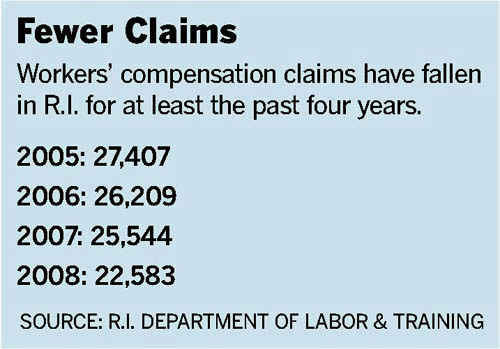
Workers’ compensation claims filed with the state have been on a downward trend for at least four years, to 22,583 in 2008, according to the R.I. Department of Labor and Training.
Fewer claims may help keep premiums low for businesses. But the decision not to report the injury could haunt the worker and the employer months down the road, said Steven Minicucci, chairman of the Rhode Island Association for Justices’ Workers’ Compensation Litigation Group.
“What we [workers compensation lawyers] feel is going to happen is you’re going to see an influx of injury claims that are difficult to say the least,” Minicucci said.
Rhode Island historically sees more reports of on-the-job injuries per capita than most other states. A report by the California-based Work Loss Data Institute used OSHA reports from 2006 to conclude Rhode Island companies filed two injury reports for every 100 full-time workers. Only Puerto Rico (2.9), Hawaii (2.6), West Virginia (2.5) and Washington state (2.2) ranked higher. The average injured worker in Rhode Island spent 10 days out of work in 2006, compared to a nationwide average of seven days, according to the institute.
The institute report argues that the high incidence rates led to a relatively high rate of workers’ compensation claims in Rhode Island compared to other states. The institute, which sells policy guidelines for how to treat injured workers, blamed it on poor regulations that allow workers to stay home longer than medically recommended.
“We don’t know for sure why you guys aren’t doing so well,” he said.
Minicucci and St. Pierre sharply dispute the notion that the Rhode Island workers’ compensation system is broken. In fact, they said, the state is a national model for workers’ compensation after reforms during the 1990s cleaned up a disaster of a system.
Minicucci said the data presented by the institute also seems counter to the notion that the state is plagued with runaway claims. The number of OSHA incidents in the state has decreased 26 percent from 2000 to 2006, according to the study’s own data. That would seem to suggest there would be fewer, not more, workers’ compensation cases.
St. Pierre, who is chairman of the New England Bar Association, said the rules governing workers’ compensation in Rhode Island resemble those in other New England states and are not unusually favorable toward workers.
And Ron Washburn, a legal studies professor at Bryant University, said the relatively high number of incidents and claims in Rhode Island could point to a well-run system and not one plagued by problems – as the Work Loss Data Institute suggests.
Workers in heavily unionized Rhode Island may feel more comfortable filing a claim knowing they have the support of a union, Washburn said. And a well-policed system keeps companies on their toes. Plus, Washburn said, large companies have standard operating procedures that trigger swift reporting. •