On the occasion of the newspaper’s 25th anniversary, Providence Business News invited Rhode Island’s seven current and former governors to discuss the state’s economy and their tenures in the chief executive office.
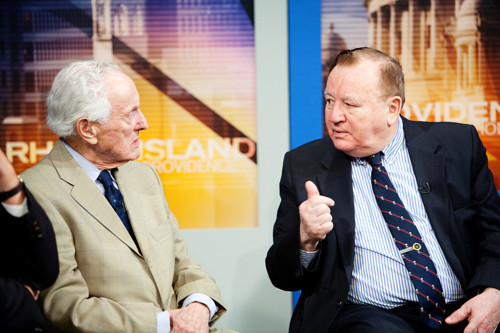
PBN Editor Mark S. Murphy and WJAR-TV NBC 10 news anchor Frank Coletta hosted five of the governors – former Govs. J. Joseph Garrahy, Edward D. DiPrete, Bruce Sundlun, Donald L. Carcieri and current Gov. Lincoln D. Chafee, with only Govs. Philip W. Noel and Lincoln C. Almond unable to attend – for an hour-long conversation at WJAR’s studios in Cranston.
MURPHY: I’d like to start out with a question for everyone here, looking at the world from your unique perspective. What was the single best decision that any governor made with regard to the economy in recent memory?
Seifert Systems Invests in Energy Efficiency to Strengthen Operations
For manufacturers, energy is more than just another operating expense. It plays a critical role…
Learn More
GARRAHY: Well, I’d have to go back and give you a little bit of history, I suppose. I think it happened really while I was lieutenant governor and Phil Noel was the governor.
And as we all know, the U.S. Navy left in 1973 or thereabouts, and it was a devastating blow to the economy in Rhode Island at that time. The Navy was the largest employer in the state, had about 12,000 Navy personnel here, about 5,000 civilians.
SUNDLUN: John H. Chafee – your father Gov. Chafee – was unable to convince the Nixon administration to prevent the Navy from leaving.
CHAFEE: My dad had left [his position as secretary of the Navy] in 1971, and this was a couple years later.
COLETTA: My memory is dim, but I suspect he tried his best even out of office.
GARRAHY: Well, I think what Gov. Sundlun is saying is correct. It was [President Richard M.] Nixon who really closed it down. That was before they had a base closure process at all. And Phil Noel was governor at the time, and he had asked me to chair an economic renewal council, which looked at the Rhode Island economy.
We tried to change some tax structures and make it more business friendly. [Noel] got Electric Boat to locate at Quonset Point, and they became the largest employer in the state. I think at one time they had 4,000 people working at Electric Boat, and I think they still have a few thousand workers down there. So I think, in my mind, that was one of the turning points after that downturn, if you will.
I later purchased Quonset Point back for the state of Rhode Island, which is a major [business] park now.
COLETTA: I can remember back in that decade, it was major to a lot of the people, and my father was one of the many, many people who were laid off from the civilian jobs and stayed out of work until Electric Boat came in with a welding program.
In his case, he was an aircraft-engine mechanic. He was taught the skills to be a welder and joined a big work force that helped revive the economy in that decade.
GARRAHY: Actually, the state joined with Electric Boat in setting up a training program, and I think we actually trained thousands of welders for Electric Boat at that time and it still of course maintains a big presence in Rhode Island; it is an important part of the state.
CARCIERI: That’s their most efficient productive facility that electric boat has. John Casey, who is Electric Boat’s president, will talk about that and say that it is the most productive facility they have. They’re thrilled with it.
MURPHY: So Gov. Carcieri, what do you think the best decision a governor made was?
CARCIERI: In the context for the business community, I really give Gov. Sundlun – I’ll toss him a bouquet, because I think [T.F. Green Airport] was one of those pieces of infrastructure that was key.
[When I was in the private sector], I used to bring customers in years ago at the old airport. It was a disgrace. We used to put people in there, kind of take them through quickly.
And you look at what [Sundlun] started and what it’s become, because we’ve continued – the state’s continued to invest in that. I think infrastructure is key to a good business climate and a good business environment, and, you know, I think an airport is a critical piece of that.
There’s no question in my mind that that was a good addition to our state’s infrastructure, that it aided the business community.
COLETTA: We want to get the opinion of the other three governors. Gov. Sundlun?
SUNDLUN: Well, I think all of us here in office and before us, our predecessors, really worked to improve the business climate.
COLETTA: And what of the decisions in the past 25 years by a governor? Your colleague Gov. Carcieri has already mentioned the airport you helped expand.
SUNDLUN: That’s the nicest thing he’s ever said about me.
[laughter]
SUNDLUN: I think a governor is in the position of doing what’s been mentioned, and that’s introducing capital improvements, building projects.
Yes, we built the terminal. The terminal was built three months ahead of schedule, $10 million below bid cost, and today it produces $2.8 billion each and every year. That’s what T.F. Green pays into the economy. …
And then you add to that the expense and all the jobs that went into building that terminal, and now the connector to the railroad station, the bricks and mortar jobs that are attached to the expense of making capital improvements, put the state into new businesses.
We built the R.I. Convention Center, because somebody started getting entertainment into the state, the Providence Performing Arts Center. And then we built the convention center, and then we found out we don’t have any place for the people to stay, and we built The Westin Providence.
And so these construction projects are, to me, a tool that any governor can use to put people to work and to enlarge the economy of the state.
DIPRETE: Going back to that, if I could, that whole process of the convention center went about as smoothly as any major project in the state, keeping in mind the legislation was crafty.
The mayor of Providence named four people. The governor named four people to the Convention Center Authority and Mayor Joseph Paolino and I had to jointly agree on who the chairman [and] who the final member would be, and we discussed it.
He gave one name, and then he said, “What do you think of Richard Oster?”
Took us about 10 seconds to agree on putting Richard Oster on the Convention Center Authority, and he showed excellent leadership and moved it right along.
COLETTA: Every governor has to handle a crisis or two within his administration. Gov. Carcieri, your crisis, of course, was the Station Nightclub fire. Gov. Garrahy, your crisis was the Blizzard of 1978, which struck beginning on the day of Feb. 6. And you became famous, sort of, governor, with that famous flannel shirt, which ended up in a picture-frame somewhere.
GARRAHY: I’m sure. It’s unbelievable.
COLETTA: And no sooner did we pull out of the Navy crisis that this struck. That was a temporary economic problem, but something governors always have to be ready for.
GARRAHY: Well, we were still coming out of a recession. The Navy pulled out. There was a slight recession in ’79. We had double-digit unemployment at that time, also.
So we were not only dealing with a recession and the Navy pull out and the blizzard that came upon us. But, you know, Rhode Island kind of grew right after that and ended up with a pretty strong economy for a number of years.
COLETTA: In the midst of a strong economy, gentlemen, came the Greenhouse Compact. I think all of you will remember or were involved. In 1983, it was unveiled as kind of a way to improve the Rhode Island economy. There was a proposal set up by a number of businesspeople. First outlined in October 1983, it called for the formation of four “greenhouses,” and today we would call those things incubators, I think. It was designed to get the state ready, I guess even in those early days, for the high-tech industries that we’re so interested in seeking today.
But the voters said no to it because it would set up, in their minds, too much of a bureaucracy, and I guess they didn’t want the possible additional taxes they’d have to pay to pay for these. Should we have adopted the Greenhouse Compact?
GARRAHY: Well, I think we should have adopted [the compact] and some parts have been adopted over the years. But it was a massive undertaking, by the way, in the business community and labor community in Rhode Island. They had about 70 people in this state, business leaders, labor leaders and average citizens participating in that, and Terry Murray, the head of Fleet Bank, was the chairman of that group.
When they adopted that plan, every college president, every newspaper in the state endorsed it, and unfortunately, there was some delay in getting it to a special election, where it was defeated. Only about 30 percent of the population showed up to vote on that, and they voted it down.
It was a bold experiment, and unfortunately, in my own view, if we had adopted some of that, we wouldn’t be in the economic conditions we’re in today.
That’s kind of a forecast and an optimistic one, but it was certainly an experiment, and I would suggest that economic-development officials and people interested in economic development read the Greenhouse Compact. It’s valuable information.
COLETTA: Did any of the successors to Gov. Garrahy look at that document, Gov. DiPrete or Gov. Carcieri?
CARCIERI: He sent it to me. I remember having a conversation with Joe, and he still had it. I think a lot of the elements to that, we have been trying to advance. I mean, the technology, you know, is a big part of all of that.
DIPRETE: I think with the help of universities, with Lifespan, for instance, those links – I think there’s an official kind of agency that does that, am I right? Someone put in after [me], I think. And that’s been a valuable addition, I think, for the state.
COLETTA: And Gov. Chafee, you were visiting other parts of the country recently, in February, for example, with the idea of learning what they have, at least to some degree, in what we’re now calling the Knowledge District.
CHAFEE: So similar to the Greenhouse Compact, we’re trying to – like a nursery – grow business and learn from other states.
We were down in Houston, as you said. We were in Baltimore looking at their medical center, because of the nexus of the new Brown University medical school and the moving of [Interstate] 195. So the opportunity is there to learn from other states, what’s working for them and what has not worked, and move forward.
MURPHY: Do you find that right now the challenge is going to be attracting capital? Everyone says the buzzword is public-private partnership. How do you get the private sector to jump in and be a true partner to the public sector here?
CHAFEE: I think we can tell them we have the land. We have 20 acres of land, and that’s what we have. And we’ve spent, as far as capital, goes, $640 million to open up that land. Taxpayers have already well-invested in this project.
COLETTA: Is it realistic to assume we can accomplish at least to some degree what these other states have accomplished, be it the Knowledge District or elsewhere? Gov. DiPrete?
DIPRETE: Well, yeah, it is. I think a lot depends on the effectiveness and the people – by whatever it’s called in the various states – R.I. Department of Economic Development when I was governor. And I was very fortunate to have a former prominent businessman head it up, Lou Pagano. And Lou kept on top of everything.
He knew which companies were thinking of expanding, what they needed and he knew how to make a presentation.
We went out to the Greater Boston area at one point and talked to a firm and got down to two locations they were thinking of. And Lou made an absolutely great presentation, and he knew … I remember his quote. He stopped, said, “Do we have a sale?”
There’s an axiom in salesmanship, sometimes you talk yourself into a sale, [but if] you keep talking you talk yourself out. Lou would lay everything out, and they were great.
And he did the same thing – we went out to Japan to see the top officials there, and they had a plan. They were going to bring in a few hundred people initially and then bring in a few hundred more and a few hundred more. They didn’t ask for a dime for a tax break, [Toray Plastics (America)]. And we knew that was a major company.
And the only thing they asked – this was the chairman of the board and the top exec – they had the plan of Quonset, they said, see this railroad track over here, would it be any problem to extend it 500 feet or 1,000 feet, whatever it was?
That was a very minor concession to get a company like Toray to come, and Lou was very candid. He even told them about the possibility of a so-called solid-waste incinerator, and Joe Garrahy worked on that for quite a few years, and he explained to people what it was, [and they said] that wouldn’t bother us.
CARCIERI: All the pieces are there. They really are. You’ve got the higher education community that’s invested in that area right now. You’ve got the University of Rhode Island. One of the things that I think will be on Gov. Chafee’s [agenda] is the whole business of a nursing school, something that [my administration] talked about. URI wanted one. Rhode Island College, too. Build one state of the art program, put it right down next to the medical school.
Once you’ve got all those pieces in place, everything else will start to fill in. I think we’ve got an unprecedented opportunity there.
GARRAHY: Yeah, just to add to what Gov. Chafee and Gov. Cacieri talked about, the [Brown University] medical school under construction over there. It’s a major development over in that Knowledge District. The new health care law – and I’ve followed some of that – is going to require in the next 20 years or so 25,000 new general practitioners of medicine, all the allied professions that go with that. There will be thousands in for training. That could also lend itself here to be a major training segment of the health-training programs there, which would really develop into our major knowledge district.
SUNDLUN: Education has been probably the most successful subject that’s shown real, consistent glue. We’ve got nine universities now.
None of them are short on money, and they’re all expanding, and they’re going to use up the land that’s available, and they’re going to take some of the buildings, including probably some of the school buildings that have been closed, and they’ll be converted to educational use.
COLETTA: The governor makes a good point that there’s been a lot of progress at the college level in Rhode Island.
I have to tell you, though, when I host the business segment of the “Sunrise Show” weekday mornings here on Channel 10, one of the most consistent complaints I get from members of the business community is about high school-level education and how in many, many cases the schools are not preparing the students for the jobs of today. I imagine this has been a priority in all of your administrations.
SUNDLUN: I know Gov. Carcieri has done a lot on that.
CARCIERI: And Gov. Sundlun is making a great point. One of the things I’ve said is, higher education is a growth industry for us. It’s a wealth generator, because the vast majority of the kids come from other places, bringing their money here, their parents’ money here, and invest it in our state. It’s one of the real success stories.
The whole K through 12 system is a huge issue nationally. Not just in Rhode Island. I mean, we’ve made it a major focus and I, you know, put a big effort into the whole Race to the Top, and we were successful, won $75 million.
And when you look at the issue of K through 12 performance, it’s like suburban and rural areas are doing OK. They need to do a lot better.
The urban schools are so far behind, Frank. And it’s an enormous issue. There’s a whole set of issues around urban education that are so difficult.
I have great sympathy for teachers. My wife is a teacher. I taught in those urban settings. But we’ve got to lift these kids’ skill levels. They’re not gonna be successful in life unless we do that.
COLETTA: And Race to the Top money is helping in that area and some teacher unions, Gov. Chafee, are cooperating more than others in this regard with you and the Education Commissioner Deborah Gist.
CHAFEE: We’re getting there. As [Gov. Carcieri] said, the suburban and rural schools are doing fine. Smithfield, Scituate, Warwick. It’s the inner urban core where we really need to work.
MURPHY: How soon will the Race to the Top funding find its way into schools? How long does that process take?
CHAFEE: It’s going on every day.
MURPHY: So the money’s already here?
CHAFEE: Yes. Oh, yeah.
COLETTA: You want to say something, Gov. DiPrete?
DIPRETE: When I was chairman of the Cranston School Committee in the early to mid-’70s, one of my pet peeves was that the schools have gotten away from so-called basic skills. I said, “Some of these kids can’t count their change from a $5 bill.”
COLETTA: There is, in fact, some effort now to improve financial literacy at that level. Wow. This is a very interesting program.
MURPHY: Governors, obviously, to a certain degree control the state’s purse strings. Obviously the legislature has a lot to say about that but, the first billion-dollar budget in Rhode Island was signed by Gov. DiPrete. We’re now, in terms of general revenue, more than $3 billion, how do you compare the times then with what’s going on now, the challenges, the opportunities?
DIPRETE: Well, the economy locally and nationally was strong at the time I took office, in fact Gov. Garrahy, my predecessor, helped me through the transition, I remember his last words of advice or comment as we departed he said, “Ed, let me just tell you one thing: It’s a lot more fun being governor when there’s money around than when there’s no money around.” We were able to accomplish a lot and I took a little razzing – [I had] the first billion-dollar budget, but it’s now what, triple? From … when I presented the budget in 1985 a billion dollars [had] tripled.
CARCIERI: General revenue, he’s talking the general revenue
MURPHY: One of the interesting things is I think that we’re seeing this happen all across the country. States are trying to come to grips with their future commitments. … Gov. Carcieri obviously had a number of knockdown, dragouts with some of the state employee unions, but it’s more than that. I mean it’s the state coming to grips with what it can do and what it can afford to deliver. I think that’s one of the big challenges for you, Gov. Chafee. Right now, it’s sort of going forward. I mean, you were put in an unenviable position of having to put forth a fiscal 2012 budget a few weeks into your administration and it hasn’t been fun.
CHAFEE: No, but as I said in the campaign you have to look ahead and take our assets and what we have in Rhode Island and what other states don’t have. And that’s … [the 195 land], we’ve got Quonset, we’ve got the new [intermodal facility at InterLink at T.F. Green], we’ve got the [combined sewer overflow] projects that [use] hundreds of millions of dollars to protect Narragansett Bay – no other state has anything like Narragansett Bay. So we have to prepare for the future and part of that is having a good budget and so we have to … take our cod liver oil, get well and our economy will prosper. I saw [then-President Bill Clinton] put it in the ’90s when he came into the office. [He said], “Let’s address the deficits.” And it was revenue and it was some taxes, it was tough to take, but what happened? The economy took off. So my experience is if you address your revenue and your deficits, businesses will have confidence. They’re saying “Yes, we see a state that’s addressing their deficits.” And I saw it happen nationally and as soon as the deficits came back, the economy crashed and everything good happens when the economy is prospering. That’s when schools are good, that’s when you invest in roads and bridges, and so you have to prepare for the future.
COLETTA: We’ve got a panel of experts here, Gov. Chafee, who are no strangers to assuming the governor’s office in critical times. Gov. Sundlun, of course, had to deal with the credit union crisis just as soon as he took office in 1991, and Gov. Carcieri you had to deal with the state-worker furlough situation just two years ago in a way kind of similar to what Gov. Sundlun had to deal with in the early 1990s. … You were at the podium, Gov. Carcieri trying to explain the necessity of the furloughs.
CARCIERI: When you compare [the state to] the federal situation, it’s very different. Because the reality is as a state, as a governor, you’re competing with other states. When you’re trying to create a business environment, you’re trying to keep businesses here growing and [also] attract others. It’s always the competitive environment. When I came into office, Rhode Island’s total tax burden – that’s [both] state and local – was fourth-highest in the nation. … I haven’t seen the 2010 numbers, we [but I think] had pushed it down to 10th or 12th, but Massachusetts was 26th. And New Hampshire – they’ve got low unemployment, growing population and so forth – they were 50th in total tax burden, state and local. So the reality is for governors, you’re competing against all the other states, particularly you’re neighboring states. I think Rhode Island for too long has been uncompetitive from a standpoint of its tax climate overall. It relates to the … amount of spending and it’s going on nationally now. You see it everywhere – the whole issue of pensions, health care, retiree health care benefits, co-shares … because health care costs are rising.
CHAFEE: If we want to be competitive with our neighboring states, our two neighboring states just addressed the revenue side; both Gov. Deval L. Patrick [in Massachusetts] and Gov. Daniel P. Malloy in Connecticut have addressed the revenue side, so that’s what we have to do.
CARCIERI: If we stay where we are we get more competitive.
CHAFEE: We’ll eventually get there.
CARCIERI: You want to gain in that, not lose ground.
COLETTA: I brought up the situation about the controversy with the worker furloughs and Gov. Sundlun’s problems with payless paydays for state workers, because the state employee unions are very strong. Can you former governors offer any advice to the current governor about how to deal with a very, very strong union movement in the state, especially at the state-government level?
DIPRETE: Well I think the [Laborers’ International Union of North America Local 1033] in Providence just showed an outstanding example negotiating with the city. That particular union agreed to some pretty strong concessions in order to keep their people working. They recognize that like any business you can’t have more money going out than is coming in and they were willing to say OK we will take, and I don’t know what the percentage was, we will take a certain percentage less total package than what we would like to have and do have in order to keep our people working. That kind of thing done throughout city and state government will lower the cost of government and that over a period of time would be a tremendous savings.
COLETTA: Another example is the Rhode Island Federation of Teachers working with governments, to some degree, more than the other teachers unions.
SUNDLUN: The other thing is to cut out where we’ve made big mistakes and do something about it. I’ll give you two, I created [RIte Care]. It was created because we wanted to stop infant mortality, we had too many single women having babies and the kids weren’t being fed and they were dying. We cleared that up almost like that, but now what have you got? You’ve got $300 million worth of fathers who have jumped onto [RIte Care], something that was never contemplated.
COLETTA: And what was the second example you wanted to give?
SUNDLUN: The second – we need 39 school districts like [we need] a hole in the head. We’ve got five counties, that’s the historic arrangement for the state of Rhode Island. Alright, so have five school districts.
COLETTA: The business community agrees with you on that too Governor Sundlun.
SUNDLUN: What are you doing about it?
COLETTA: Exactly, this is a problem I’ve been reporting on at NBC 10 since the 1970s, when they first started talking about regionalization. I know everyone of you on the panel has, I think, embraced this in some way. I think, Gov. Chafee, there is some realization about this and there is some effort to get regionalization under way in some places.
CHAFEE: Don’t forget that Nick Gorham, the state representative who proposed it, was defeated. That was his big campaign issue to consolidate Foster and Coventry and the voters threw him out.
COLETTA: There’s a lot of resistance to regionalization in this fine state of ours – we’re a real parochial state. Allen Hassenfield from Hasbro said recently “If Noah had to build an arc during the great flood in Rhode Island, he’d have to build 39 arcs” because nobody wants to give up the authority or the autonomy within the boundaries of each of our 39 cities and towns. Gov. Garrahy, you addressed this problem even before, I think, you were governor.
GARRAHY: Yes, I did. When I was lieutenant governor, I actually sponsored the bill that consolidated all the health services in Rhode Island. We had 39 health departments in the state and there were not uniform sanitary conditions as a result of that. Some cities and towns didn’t even have an M.D. as their health officer. One town in particular had a dog officer who was the health officer. We now have one health department and that’s worked out very well for us and there are some services that you can regionalize and become more effective.
MURPHY: There has been academic study on regionalization, and I remember being at a presentation at Bryant University where the academics said, “sometimes the savings aren’t clear.” Something has to be done. The key is to figure out where the savings are. Gov. Carcieri, what’s your sense of where the savings could come out from fire districts, from school districts, from police departments?
CARCIERI: One of the messages I was trying to get across the last couple of years is that everybody focuses on the state budget. Three billion dollars, let’s call it, in round numbers. A billion of that, slightly less, is money that the state just passes to the cities and towns. If you look at the amount the cities and towns raise in assessments of property taxes, it’s $2 billion. So the truth is the 39 cities and towns spent $3 billion, the billion they get from the state – I’m rounding here – and the $2 billion they get from property taxes. So you cannot get to the structural balance, if you will, and [get] the state under control unless you get [to] deal with the $3 billion. You can’t balance the whole state’s budget and put it structurally on a sound basis on $2 billion of state [funding], which is essentially all the services the state provides – RIte Care – that [Gov. Sundlun] talked about – the state police, the prisons, all of that. That’s the struggle that Gov. Chafee’s got right now.
You look at what’s in that budget, you can’t balance it without somehow incorporating the municipalities in that.
COLETTA: The economy is in such a dangerous situation now with the state and municipalities worrying about how they’re going to pay for pensions for retirees going forward. If we can’t convince the communities to do regionalization, what do we do?
SUNDLUN: The communities are doing it. We’ve got three of them down in the Westerly area, you’ve got two in the north, you’ve got Warren and Bristol, which, have been tied together for 10 years.
COLETTA: How do we convince the other communities to implement this, as well as more regionalization of services within the state?
DIPRETE: I can tell you at least part of that from personal experience. Cranston public schools in 1970 had roughly 15,000 students [in the] public system. When I became mayor in January 1979, that 15,000 was down to 10,000. People were having smaller families. I looked around, we’ve got the same number of schools if not more for 5,000 fewer kids. And under the Cranston charter, and I think this is true in most cities and towns, the mayor not the council, can directly tell the school committee how to spend the money. You can control the bottom line appropriation.
I talked to the school officials, talked to … the business manager at the time and the other members of the school committee and I said our per-pupil costs in Cranston are now just about the same as it is in the upscale, private schools around the state, and that’s because we haven’t consolidated. I said I’m going to go by the per-pupil costs – I don’t want to hear that the schools only want 5 percent more than last year – I said the issue on the table is the per-pupil cost increase and your appropriation is going to require you consolidate schools. And they ended up closing over a period of time some six or eight schools.
COLETTA: Is the answer somehow to convince members of the General Assembly, and I guess this is a tall order, to loosen the collective-bargaining restrictions so that management everywhere in government can actually have more of a say in the budgets as they’re put together?
DIPRETE: Yes, absolutely, because as mayor, we received, from the city’s point of a view, a very unfavorable decision on binding arbitration. I remember calling the city attorneys in, [and signing], what can we do about it? Can we appeal to the state Supreme Court or to anybody this, what we thought, was a very unreasonable decision? The only grounds for appeal are fraud or irrationality. We filed an appeal based on irrationality, and I thought we had a good case. The R.I. Supreme Court at that time wouldn’t hear us.
MURPHY: Does the governor have an opportunity from his pulpit to bring together the municipalities? Go directly – bypass the General Assembly – to the towns and cities and say we need to work together here?
CHAFEE: Well, I inherited the deficit that everyone knew for fiscal year 2012 across the country was going to be the bad year. Everybody knew that. No federal stimulus money. It is a matter of working with the towns and [Gov.] DiPrete, he’s the last governor to come from the municipal side. Before him Gov. Noel came in from the municipal side. That experience is important because it is a big part of our budget. … The pensions are, of course, a huge issue, and make the cuts you can. Having been a mayor, I know how to do that. In my view, the more confrontational you are with the union, the less concessions you’re going to get. And [Mayor Scott] Avedisian is proving that in Warwick. They have a $5 million surplus because they have labor peace – businesses like that – and when it comes time for concessions, he gets [them]. So, we’re in a bit of a crisis here with the economy being in bad shape across the country and the deficit. But it’s methodical, good decision-making that will get us out of it.
COLETTA: Fine line gentlemen, in terms of what Gov. Chafee’s talking about, about not being too aggressive.
CARCIERI: I think you’re seeing it across the country. What I learned in my eight years is the unions don’t want to give anything. … The alternative is – we’ve got to save the money – you’re going to have layoffs. [As] Gov. DiPrete indicated, [the unions] don’t like that. … They’ll all say nice things and, “We’ve got to resolve this,” but at the end of the day, concessions are not something that union leadership are used to doing. Unless they believe you are really serious and you’ve got no alternatives – and I don’t think we have any alternatives, frankly, as a state. So that was the approach. We got the concessions. We got the eight unpaid days. We got the co-shares. When I came in, state employees were paying nothing, zero, toward their health care. It went up to 20 percent for most of them. Some 25, a few at 15. It takes time, Frank, and I think everybody has a different approach to it and, I think, different timing. Right now, you see it happening [nationally]. The issue is, as Gov. Sundlun said, we’ve got to control the spending. The government has gotten too large. It’s too much of a burden on our citizens, frankly, from my standpoint. But I come from the private sector.
COLETTA: Part of the reason we look to the past and review it with the experts who were there is to determine how we can better make the future and look ahead. Let’s end our town meeting with that exercise, Mark.
MURPHY: Business leaders often look at situations at companies using a SWOT analysis: strengths, weaknesses, opportunities and threats. I’d like each of you in the sort of lightning round we have here to give one of those things. What’s a strength? What’s a weakness? What are the opportunities, really is the key here going forward for Rhode Island.
GARRAHY: Well, I think we did talk about the strengths of the infrastructure and the colleges and universities. URI has recently built a new biotech building. They built a new chemistry building. [There are] prospects for a new nursing program. Tying a lot of that together offers tremendous opportunity for Rhode Island in the biotech-industry research, development. If we train a lot of health personnel, that’s the key to the future, I think.
CARCIERI: I agree with everything that Gov. Garrahy said. This is a great state. It’s a beautiful place to live. But we have become uncompetitive because the cost of government is too large. It’s too much of a burden and we’ve got the image of being a difficult place to do business and a high cost. And we’ve got to change that. All of these pieces you can invest in. We’ve been investing. But we’ve got to convince the business community in the outside world that we’re serious and that we can run ourselves at less of a burden on our citizens, and I think we can.
COLETTA: Gov. Sundlun, What advice can you offer?
SUNDLUN: I want to cut those fathers out of … RIte Care. And I want to bring the school districts closer to the major cities – Westerly, Newport.
COLETTA: The regionalization that you were talking about.
SUNDLUN: Right.
COLETTA: Thank you, governor. Gov. DiPrete?
DIPRETE: You’ve got to bring down the cost of state government. And we’ve got to do it, I believe, in the spirit of cooperation with the unions. In my days in both Cranston City Hall and the Statehouse, I had good communications and I found that was necessary. The General Assembly, as we know, is heavily Democratic. I was a Republican. We had excellent communications. I went to their office, they would come to mine. I would say “Look, we’re in this together. Here’s the problem.” We’ve got to do that with unions in state government.
CHAFEE: It’s the best state in the country bar none, and I think we’re right there on the threshold. I believe that. I think we’re ready to go. We’ve gone through so much in the transition of the old economy, the industrial economy. We’re right there. We’ve made the investments in moving 195 and attaching the train station to the airport, in Quonset, and in saving the bay with the tunnels under the bay. These are hundreds of millions of dollars we’ve invested in the state. So, we’re right there ready. We’re right on the threshold.