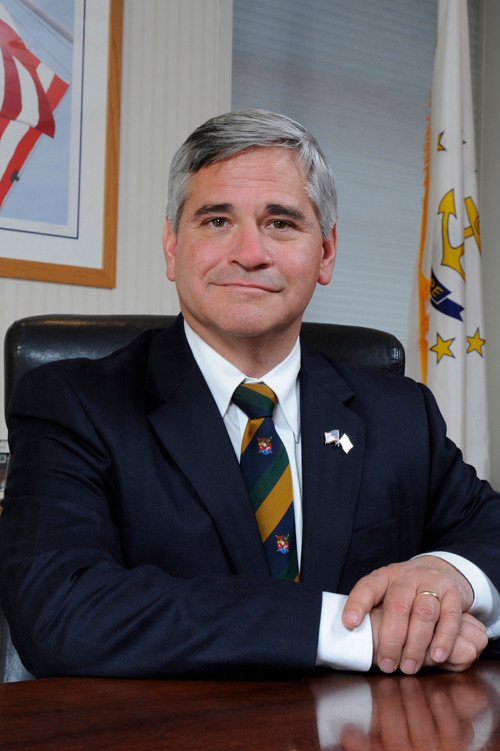
Can the R.I. attorney general’s office be used to assist in the state’s economic-development efforts?
In some ways it can, according to Peter F. Kilmartin, who was elected Rhode Island’s attorney general in November.
For that reason, the former Pawtucket police officer and longtime state legislator says he is looking to get the business community more involved in the development of the attorney general’s policies. He recently spoke to Providence Business News about that and the controversial Secure Communities program in which he recently enrolled Rhode Island.
PBN: The Secure Communities program – an effort to identify illegal immigrants among those arrested for crimes – has drawn some attention in recent weeks. How do you respond to people who say local police shouldn’t be enforcing immigration law, and those who fear it will be misused?
KILMARTIN: It’s an after-the-fact program. It’s post-arrest. You need to have probable cause and a reason to arrest someone. It’s only in the booking process after the arrest that this program starts to get implemented. It’s not state or local law enforcement enforcing federal statutes. It’s just a communications mechanism between state and federal law enforcement.
Frankly, I think some folks are [raising concerns] just for the sake of doing it, to scare and create controversy without knowing all the facts of the program. That does a disservice to immigrant communities because [objectors to the program] perpetuate a fear that should be nonexistent. If you stay out of trouble, even if you’re here illegally, this program will never affect you.
Seifert Systems Invests in Energy Efficiency to Strengthen Operations
For manufacturers, energy is more than just another operating expense. It plays a critical role…
Learn More
PBN: So witnesses to a crime, victims or anyone other than people arrested for a crime won’t be run through the Secure Communities program? PBN: Did it surprise you that Providence wanted to opt out? PBN: Have you talked with anyone from the business community on the issue? Or about any other business-related issues? PBN: What sort of topics do you foresee this advisory council addressing? PBN: Are there cases where you feel they’re not equally enforced? PBN: So we’ll see a more active role in business by the attorney general’s office? INTERVIEW
KILMARTIN: Witnesses don’t get fingerprinted. That’s the point. [Objectors] try to create a perception that witnesses and victims to crimes, they’re going to be in the Secure Communities program. No, they won’t because we don’t arrest and fingerprint witnesses, and that’s the only mechanism that gets you into the system.
KILMARTIN: I was disappointed they wanted to. They asked for the opt-out even before I provided a seminar given by [federal immigration officials] on the program, which they did attend. I think that seminar answered a lot of questions that even law enforcement had as far as implementation, who it applies to, what they have to do. They don’t have to proactively do anything. They just do the job as they do, and the fingerprints just go to another agency.
KILMARTIN: I’ve talked with individual businessmen and businesswomen who have expressed support for [Secure Communities].
I have a list here of folks I’m going to approach to be part of a business advisory council for the Office of Attorney General to see how we can better interact with the business community. Not only what the business community can do to enhance this office but what this office do to enhance the business community. I think that’s a dialogue that historically hasn’t taken place, but now given the economic climate we’re in, no better time to start such a dialogue.
KILMARTIN: For instance, what would the business community’s opinion be on the Secure Communities program? Obviously, at the end of the day the attorney general’s office and the attorney general guide the policy of the office. But I think getting guidance as to where others think that policy should go, for me to evaluate and weigh in on and implement or not, is good for the office. I think these folks may have a lot of concerns, [such as] the equal application of statutes as far as business [laws] are enforced.
KILMARTIN: Well, that’s the point. I think every businessperson I’ve ever met has always said as long as there’s a level playing field, we’re willing to play. [They want us to] make sure there is a level playing field, that someone isn’t bypassing whatever requirements necessary to do business in this state. When someone is trying to short-circuit that for their own gain and at the expense of another legitimate business, that’s something we need to enforce.
KILMARTIN: That’s my goal. Some of this came during the campaign because a lot of people said to me, “What are you going to do to help the economy? What are you going to do to help business?” That’s by virtue of the recession we’re in. People are looking for answers. While the AG’s office isn’t traditionally in that position, there may be unexplored areas that we can move into to help the business community and the economic climate. One thing I think that would help that is traditionally part of our purview is fighting white-collar crime and corruption. There is a unit now, but it’s at the whim of the attorney general, but by making the policy statement [as recommended by legislation before the General Assembly drafted by Kilmartin] that every attorney general henceforth will have this unit helps create the perception that we take it seriously.
People want confidence in their government and general officers, and I think that this would help engender that confidence. •
Peter F. Kilmartin
POSITION: R.I. attorney general
BACKGROUND: Kilmartin joined the Pawtucket police force in 1984 and retired as a captain in 2007. He also started operating a private law practice in 1999. Kilmartin was first elected as a state representative in 1990 and served until he was elected attorney general in November.
EDUCATION: Bachelor’s degree in criminal justice, 1988, Roger Williams University; law degree, 1998, Roger Williams University
FIRST JOB: Worked as a soda jerk at PH Barry’s Pharmacy on Broadway in Pawtucket at age 14
RESIDENCE:
Pawtucket
AGE: 49