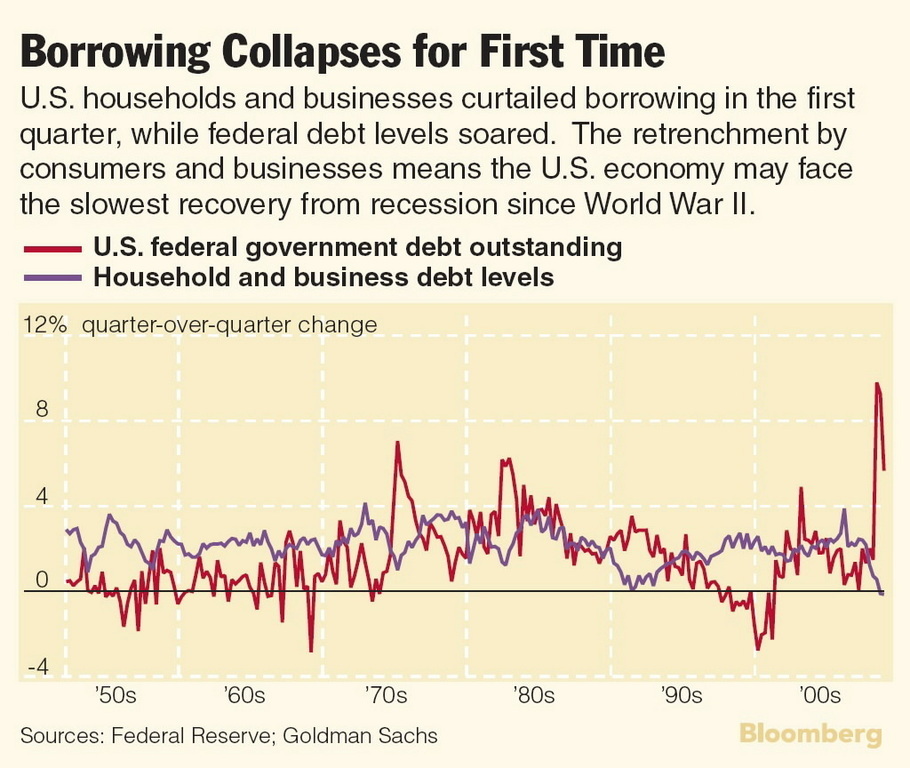
 Click here to view a larger version.) / " title="Consumer and non-financial business indebtedness reached the lowest levels since the government began keeping records in 1952 during the first quarter, even as outstanding federal debt reached a record level.
(Click here to view a larger version.) /"/>
Click here to view a larger version.) / " title="Consumer and non-financial business indebtedness reached the lowest levels since the government began keeping records in 1952 during the first quarter, even as outstanding federal debt reached a record level.
(Click here to view a larger version.) /"/>WASHINGTON – Americans are paying back their debts for the first time since Harry S. Truman was president, a trend that may hold down inflation but also hold back economic recovery, Bloomberg News reported today.
Household borrowing in the U.S. fell to 128 percent of the average American family’s after-tax income in the first quarter, down from the record high of 133 percent recorded in the same period a year earlier, according to Bloomberg.
Rhode Island's Market Has Changed. Developers, Builders, Investors and Sellers Must Change With It.
By Emilio DiSpirito IV License Partner | Engel & Völkers Oceanside Leader | The DiSpirito…
Learn More
The savings rate rose to 6.9 percent in May, its highest level in 16 years, as the unemployment rate reached 9.4 percent in the U.S. and 12.1 percent in Rhode Island.
Goldman Sachs estimates that the total debt of individuals, non-financial companies and federal, state and local governments grew at a rate of 4.3 percent in the first quarter – less than half the 9.9 percent pace recorded when quarterly increases peaked in late 2005.
“We’ve never seen a pullback like this,” Goldman’s chief U.S. economist, Jan Hatzius, told Bloomberg. “We are seeing an adjustment, and it’s very painful and there’s a lot of collateral damage.”
Hatzius said the first quarter marked the first time household and non-financial corporate debt has decreased since the federal government began keeping records in 1952 during Truman’s presidency. And, he added, it is probably just getting started.
“If you look at various measures of debt in the system, they suggest what we’re doing is getting started on this adjustment; we still have several years to go,” he said. “We’re going to be at saving levels that are much, much higher than they were in 2006 and, in many cases, permanently.”
Consumer credit fell at a 1.6 percent annual rate in May to $2.52 trillion, according to the Federal Reserve. That could slow the world’s recovery from the current recession because U.S. consumers account for 17 percent of global gross domestic product, Sara Johnson, a managing director at IHS Global Insight in Lexington, Mass., told Bloomberg.
The sudden thriftiness of American consumers is likely to shrink the U.S. economy’s annual growth to an average rate closer to 2 percent than the 3.5 percent that had been customary in recent decades, argues Bill Gross, co-chief investment officer at Pacific Investment Management Co., which manages the world’s largest bond fund.
On the other hand, loan-scarred banks are using their customers’ growing deposits to buy super-safe U.S. treasury bonds rather than make new loans, which should help the government hold down interest rates as it sells record amounts of debt to make up for growing budget shortfalls, Bloomberg reported.