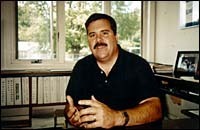
Arnold Lumber Company.
(H. Johnson)
Name: Bruce A. Charleson
Position: President, Arnold Lumber Company, the first non-family member
to hold the position since the company’s founding 90 years ago.
Background: Accountant at Kahn Litwin before joining Arnold Lumber in 1990.
He become a vice-president and remained until 1998, returning to Arnold Lumber
in January this year as president.
Education: Bachelor’s, University of Rhode Island, MBA, Bryant College.
Age: 39
Family: Married, three children.
Residence: South Kingstown
PBN: How many employees?
CHARLESON: Roughly 150.
Rhode Island's Market Has Changed. Developers, Builders, Investors and Sellers Must Change With It.
By Emilio DiSpirito IV License Partner | Engel & Völkers Oceanside Leader | The DiSpirito…
Learn More
This company has been around a long time.
Ninety years, 1911. Actually started with a sawmill operation, close by. Art and
Betty Arnold are the current owners of the company. Art’s father started the retail
store up here in the 1950s. Art came back from the Army and took it over in the
1970s. It was really a small little business, and he was really responsible for
making it into what it is today.
You are the first non-family member to hold the position of president?
That’s correct.
Is that a change of philosophy?
He’s got three daughters, one who is currently active in the business. Two are
not active in the business. I look at my role as the caretaker’s role. If at some
point one of the three want — one is a manager now — whatever happens, happens.
I’m just here to take care of the company in the interim.
You first came to this business in 1990, how have you seen it evolve?
I started 15 days before the credit unions failed. Obviously at that point we
just started a recession, the credit unions failed, with probably about 40 percent
of our receivables tied up in credit union funds, the economy was in a tough situation.
We were not centrally organized. We had to reorganize. We had three divisions
at the time. And we really had to make a lot of changes in a relatively short
time. We had to go through layoffs and pay cuts and a lot of tough decisions that
had to be made especially in that first year. It was probably one of the best
learning years I ever had in my career. Out of that one year of just trying to
figure out how to survive and how to make everything work and keep all the employees
happy and keep the business running. It had always been successful, but that was
the first year where we were starting to see some real rough times.
I think Art and I worked well together in coming up with a plan on how to go out
and get business. So we didn’t have to start worrying about what was going on
in the economy anymore. We felt there was enough room for a company — at that
time we were a much smaller company — that we could grow and be able to take
care of our own people and take care of our own business. I guess it just made
us realize that you can go out and make things happen.
You don’t have to sit around and wait to see what happens with the economy or with outside forces that you can’t control. And we did. Between ’92 and ’94 we doubled our company sales. We went from about a $13 million company to about $28 million by the end of ’94. We really felt proud we could make things happen and I think it also stimulates all the employees. They now feel there is something to look forward to, more opportunities coming up. We started to expand into different areas. There’s a great learning situation. I didn’t like going through it, but it does make you stronger.
How do you think this kind of business is a reflection of the economy?
It’s kind of funny. We’ve seen it very slow. When the economy starts to take off,
we’ve seen how long it takes for the real estate side of the business to catch
up to the economy. But with all the news reports we see about the economy faltering,
you don’t see it really in the construction side of the business. Maybe it’s that
tail end that takes a little longer to kind of settle down. Builders still have
a very strong backlog of business. I talk to builders on a daily basis, and there’s
plenty of work out here. The biggest problem we’re having is labor shortages.
When you talk about labor shortages, what kind of labor?
Skilled labor out in the field. We have customers that could easily take on more
work if they could get more skilled labor. We’re not seeing a lot of skilled laborers
come into the construction trades and in a lot of cases, a lot of these skilled
workers could make some very good money. I think in the future they’re going to
make some very strong money because there’s going to be a shortfall of skilled
laborers. It’s already driven the cost of housing up considerably in the last
few years. We look at the cost of construction per square foot and nice houses
you could have built as little as three years ago for $100 a foot, now are running
$125 to $135 a foot. A lot of that is in the trades. The lumber prices have been
fairly static the last three or four years. In fact we had a 10-year low this
past spring, so lumber has been maybe a small part of that inflation, but a lot
of that has been the rising cost of subs (substitutes) because of the shortage
of available subs.
Where do these people get trained?
Most of it’s on the job. There are some schools that specialize, voke-tech programs,
but it just seems that most of the kids when they get done with high school they
just end up in the trades out in the fields.
Why do you think it’s not attractive now to kids coming out of school?
A lot of kids are being pushed to get into college education and jobs that they’re
kind of expected, their families are putting pressure on them go get an education,
go get a good job. I still believe there are some good jobs out there in the construction
trades. Not just in the roofing and framing, that part of the business, there
are a lot of trades that actually financially will be doing pretty well in the
next few years. We have to work as an industry as well as with the Rhode Island
Builders Association and the other construction trades to try and encourage people
to come into this business as well. We have to take a more proactive approach
to bringing people into this business. Otherwise construction costs are just going
to continue to go up.
What about your own employee situation, do you have a hard time finding skilled
labor here?
We’ve had some growth spurts where we might need a few more people. There have
been times when it gets a little difficult but by and large most of the employees
have been here for quite a while. We’ve had some people leave and come back. We
have a relatively stable work force, probably through 80 percent of the company.
But you always have that transition.
What is it that you do to maintain a stable work force?
I think the reputation the company has always had of being pretty open to employees,
friendly to employees. We’ve always had good benefit packages. There’s always
been a policy of treating people very fairly. The Arnolds have set a trend of
having always been giving to employees. We have good bonuses at the end of the
year. We’ve always believed in sharing our profits every year. At Christmas time
we’ll look at our whole year and look at what our profits are and generally give
back 15 to 20 percent profits to the employees at the end of the year.
Is Arnold Lumber now number one in its field in Rhode Island?
We’re the largest independent pro-oriented dealer, contractor oriented dealer.
That’s basically excluding Home Depot or Loews.
What impact has Home Depot had on your business?
The Home Depot is really geared toward the do it yourself at home, the consumer
side of the business. It’s really not a part of the business we really focus on.
We focus pretty clearly, in going back to the early ’90s, in dealing with the
pros and staying away from the retail sector. Contractors have tried Home Depot
in the past and found they really don’t have the services to support them. I think
the services that are important are fast turnaround on delivery, whether it’s
same day delivery that we do all the time. I think personnel are very important.
They want to have continuity with whomever they are dealing with on a regular
basis. Contractors like calling our salesmen or inside support person and getting
answers, knowing whom they are talking to. They know these people personally.
A lot of it has to do with their overall satisfaction as to who they want to deal
with. It’s also costly to them to have any delays on the job site, so they have
to get answers quickly. You have to be able to get materials q uickly. They have
to push the project along because the shortage of subs won’t allow them not to
have – they can’t sit around and wait for a delivery for three or four days.
Have you used technology for things like inventory control?
From our side, we couldn’t live without the computers at this point. Everything
we do is completely automated. All the orders are sent and processed. We have
a central distribution area down in the southern part of our yard. We have another
location in Wakefield. Everything gets sent over. Even from an ordering standpoint,
a lot of the salespeople, we used to have them get on the phones and call the
vendors. We’ve automated a lot of that. A lot of that gets sent down to centralized
buyers who have greater relationships and have better resources to find out where
to find products. Technology allows us to do that.
You just bought C.J. Coutu Lumber of West Warwick?
Yes. They are a hundred-year-old yard similar to ours, but they focus on the commercial
and industrial side of the business. It’s a part of the business we’ve never really
focused on. And it’s dealing with some of the major projects that are going up,
as well as supplying hospitals, municipalities, universities with some of their
smaller needs on an ongoing and daily basis. But the products they use are totally
different from the products used by residential builders on a day to day basis.
We’ve kind of avoided that because we’ve never really had the people who had the
expertise to bring us into that area. Well Carl Coutu and his key people have
done that for a number of years now. They’re going to come in here and start that
division for us. I think it’s a great fit. We get along real well. We’ve known
each other for a long time. I think the personalities are just as important when
you put people together.
How many folks will that add?
They’re bringing down between four and six people.
The operation in West Warwick will close?
Yes. Coutu Lumber is not really going away, they’re just coming down here, carrying
on what they’ve already started.
If you look out in terms of this business, and residential construction in
Rhode Island, how vibrant is it?
It actually is as vibrant as it’s been in a long time, even though building permits
have come down since ’98-’99. We’ve been running around 2,000 to 2,300 building
permits since the beginning of the 1990’s. It went up to 2,500 to 2,600 in ’98
– ’99. It dropped off last year to 2,200 and change and we’ll probably see about
the same number. But I don’t think we should be looking at building permits as
the only benchmark of this business, because the value of those building permits
has gone up quite a bit. As I said, construction costs have gone up probably 35
percent in just the last few years. If you look at the projects that are being
built, the houses are much larger. There’s a lot more money coming in from out
of state. People investing in real estate. People from Connecticut, New York look
at our real estate as being a relative bargain compared to what they’re used to.
The building costs are a lot cheaper than what they are being quoted back at home.
We’re seeing a lot more outside money coming into this state in terms of construction.
People who want a second home. We see more of it down here because we’re in South
County.
The other thing that is affecting this business right now is the cost of land. Land has gone up incredibly in the last few years. A town like South Kingstown, where maybe five or six years ago houses that you could build for $120,000 – $130,000. Those houses don’t exist anymore in terms of your being able to build them. Those houses now – the land alone might be running $70,000 to $100,000 for a lot. So those houses now are in the upper 100s or low 200s. Overall there’s been a squeeze, especially down here on the lower priced houses on new construction. There’s certainly been a major increase in the number of houses that are being built in the upper threes, fours and $500,000 range. Not to mention the 800, 900 and million plus range.
What does the high cost of new housing, and low inventory for resale say to
the first time buyer? Rent?
They have a tough time. It’s unfortunate. It’s going to be that much more difficult
for our kids to be able to afford a house in these communities.
Where do you see the major thrust in terms of building?
South County is one of the biggest. It has been for a number of years. We’re seeing
fairly high growth rates, even though the numbers are not as high, in Exeter and
West Greenwich, compared to what they’ve been used to. People seem to be getting
out of the urban areas, going out to where there’s more land. We’re also seeing
some pretty good growth in the northern part of the state.
Arnold Lumber a few years ago was involved in some exporting. Are you still
as heavily involved in exporting?
We haven’t done as much with exporting lumber products. We tried a few projects.
There just hasn’t been that much demand for us. What we have done is we’ve diversified
some of our business as well. We have a casual furniture business, we actually
manufacture casual furniture and distribute all over the country. We’re trying
to diversify some of our business units, so that if the residential construction
takes a little dip, the commercial and industrial won’t be affected the same way.
You have facilities here and in Wakefield. Any plans for further expansion?
We’re looking at now real estate in the northern part of the state, as well as
southern Massachusetts, as well as the East Bay area.
One or three?
The Northern part of the state and Southern Massachusetts would be one area, the
East Bay another area. We’re looking at two areas. We clearly wold like to put
one up as soon as we find the right location, hopefully within the next year.
What do you see for potential revenue growth?
We do a little over $40 million right now. I believe the commercial division will
be a pretty successful division in the next few years, a $5 million business by
itself. It clearly could be more than that over time. Another lumberyard could
generate $5 to $15 million in sales. We also may be interested in acquiring another
lumberyard if we find the right opportunity. I believe that this company could
be a $75 million company in the next few years. It’s going to take a little bit
of work, a little bit of effort.