Bristol County Savings Bank cut the ribbon on its new full-service branch at 5 Exchange St. in downtown Providence in March, placing another community bank directly into downtown’s tight cluster of financial institutions.
The move comes as U.S. banks continue to scale back physical footprints, with Federal Deposit Insurance Corp. data showing a net decline of about 1,100 branches nationally in 2024, while downtowns such has the one in Providence continue to navigate post-pandemic recovery in office and retail activity.
While Bristol County Savings is based in Taunton, opening a branch in downtown Providence had become a clear need because of the bank’s sizable book of business in Rhode Island and its strategy for the future, according to Timothy Chaves, executive vice president and chief revenue officer.
“We really felt the time was right,” Chaves said. “A third of our loan portfolio resides in Rhode Island, and the state has been great to us.”
BCSB isn’t the only financial institution that has been setting up downtown, in sort of a reversal of the flight to the suburbs that banks and their customers had made for decades. The most visible example of that shift was when Bank of America Corp. moved out of the “Superman” building in 2014.
Now, across downtown, several other banks are either opening new branches or repositioning existing offices as they lean more heavily into in-person advisory services alongside digital banking.
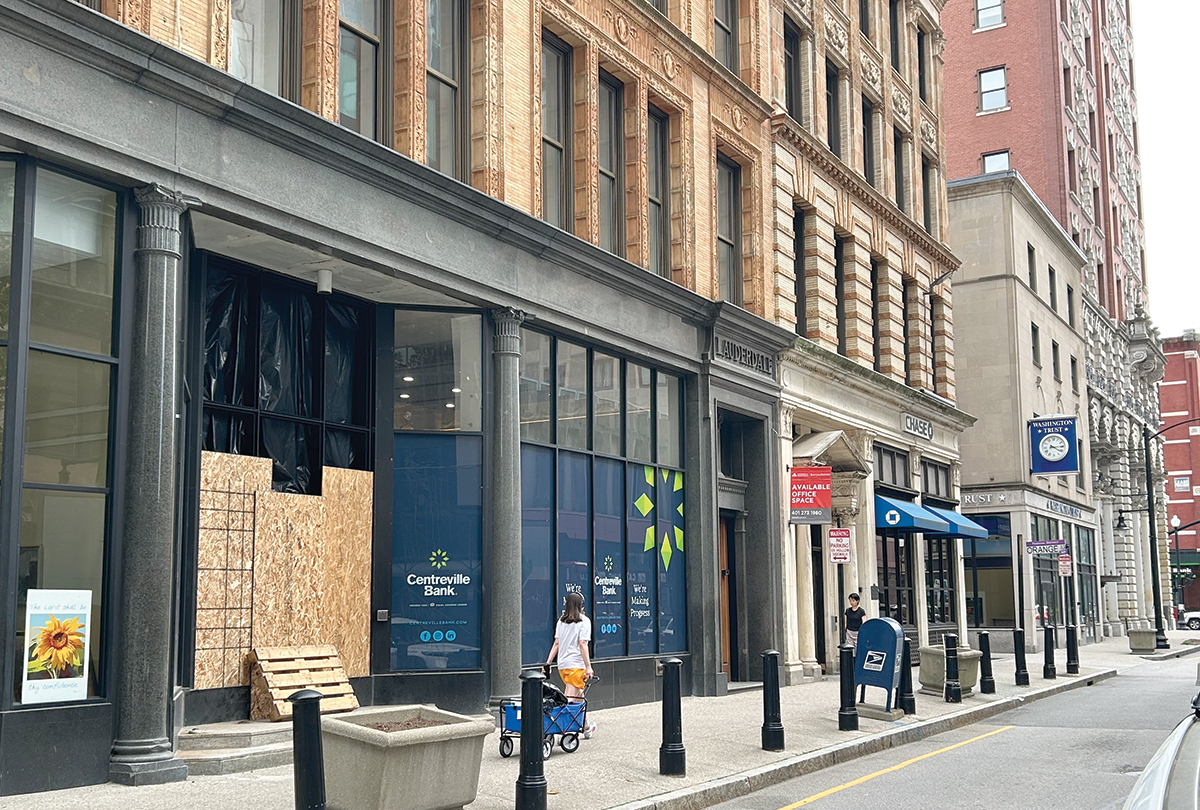
The city core isn’t nearly as bustling as it once was, and even less so since the COVID-19 shutdown led to a proliferation of remote and hybrid workplaces. Still, there are at least 10 bank branches within just a few blocks, with Centreville Bank announcing in April that it will add a branch later this year at 142 Westminster St.
TD Bank and BankNewport are neighbors at the corner of Dorrance and Westminster streets, with BayCoast Bank, The Washington Trust Co. and Chase Bank within sight of their front doors.
Centreville Chairman, CEO and President Harold M. Horvat said the move reflects revival in the city’s core and the concentration of business and residential activity around the capital.
“It’s really the economic center of the state,” Horvat said. “We want to be part of that and continue increasing our visibility as that momentum builds.”
The West Warwick-based mutual bank opened a branch in Olneyville earlier this year, marking a broader push into Providence’s neighborhoods alongside its downtown expansion.
Horvat pointed to increasing business activity, recent residential growth and continued community investment, including financing tied to local development projects, along with the return of in-person work and daily foot traffic downtown. The nearby I-195 Redevelopment District has also been a steady source of residential and commercial activity.
“We see it as a real opportunity to expand both our commercial and consumer business in Providence as activity continues to build across the city,” Horvat said.
Chaves said Bristol County Savings Bank’s new downtown branch is part of a strategy of placing bankers closer to where clients already live and work across a tightly connected regional economy spanning Rhode Island and southeastern Massachusetts.
“This is about strengthening our presence in a region where our business is already deeply rooted,” he said. “And downtown Providence is a natural extension of that as we continue to grow these commercial relationships.”
Parking remains a challenge for downtown branches, but bank executives said accessibility factored into site selection.
Bristol County Savings Bank’s Exchange Street branch offers valet service through an adjacent hotel property, while Centreville Bank said its Westminster Street location – a storefront in the Lauderdale Building once occupied by longtime men’s clothing shop Franklin Rogers Ltd. – includes access to private customer parking behind the building.
Other banks, such as Massachusetts-based BayCoast, have opted to reposition existing downtown locations into full-service branches. The bank opened a commercial loan production office in downtown Providence in 2014 before expanding into a full-service branch at 78 Dorrance St. in 2021.
While Centreville and Bristol County Savings are only now entering the downtown market, Washington Trust has maintained a branch in the district since 2008.
Michelle L. Kile, Washington Trust’s executive vice president and chief retail banking officer, said branches in urban cores such as Providence have increasingly shifted away from routine transactions as digital banking absorbs day-to-day activity, and toward more advisory, relationship-based needs.
“We’ve seen a real shift from transactional banking to relationship banking,” Kile said. “People may not come in for everyday transactions anymore, but they still want someone to talk to when there’s a problem or a more complex need.”
In Providence, the downtown branch sees a heavier mix of business customers, she noted, reflecting the city’s concentration of small firms, professional services and commercial activity that still occupy the city’s financial district, even if in lesser numbers.
“Downtown gives us proximity,” Kile said. “It’s where conversations happen – lending, business planning and long-term relationships.”
For newer entrants such as Centreville and BCSB, that emphasis on visibility and relationship-building is part of the strategy behind a downtown presence.
Horvat said Centreville’s downtown push is meant to complement, rather than replace, its neighborhood expansion.
“We’re trying to be where the activity is,” Horvat said, pointing to the overlap between downtown business growth, nearby residential development and daily commuter flow into the city. “That’s where we need to be.”
At Bristol County Savings Bank, Chaves said the downtown Providence branch serves a similar purpose, anchoring the bank more firmly within a regional economy that stretches across Rhode Island and southeastern Massachusetts while deepening its commercial relationships in the city itself.
“The goal is really about proximity and presence,” Chaves said. “It’s about making sure we’re accessible where our customers are already doing business.”