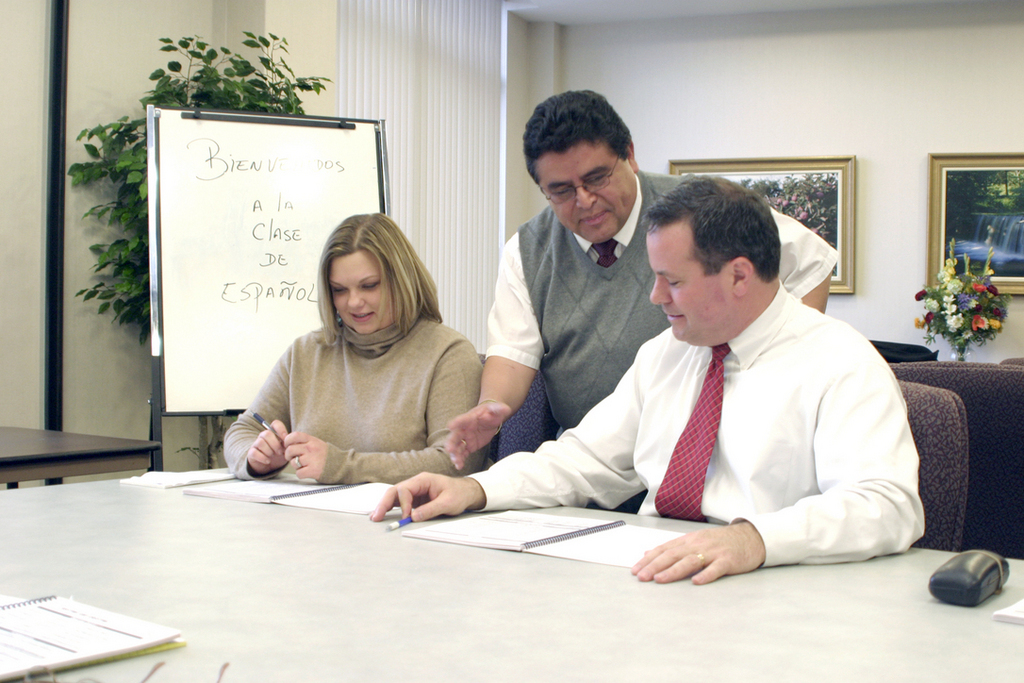
The cleaning lady has been laughing at Chris Harkness’ attempts at Spanish. That’s fine by Harkness – he’s finally getting more comfortable with a language he hasn’t studied since high school. And though she ribs him, she probably appreciates the effort.
Harkness, assistant vice president of business development at Navigant Credit Union, has been making many more attempts at Spanish since taking part in the Community College of Rhode Island’s Workplace Spanish program – a kind of survival course that helps professionals break down the communication barriers that separate them from their Spanish-speaking customers and employees.
“It really allows companies to speak more effectively with the Spanish-speaking population,” said Suzanne D’Onofrio, director of training and corporate education at CCRI’s Division of Lifelong Learning. “It really doesn’t allow you to get into grammar; it’s more of a conversational-Spanish type program. You’re certainly not going to be an expert at Spanish, but you’re going to come away knowing a lot more.”
For three years, CCRI has conducted its Workplace Spanish program on site at businesses and organizations that include Sovereign Bank, Herff Jones, Ocean State Harley-Davidson, Blue Cross & Blue Shield of Rhode Island, AIPSO, Rhode Island Hospital, Women & Infants Hospital, Bradley Hospital, Plan USA, the Newport Housing Authority and the Central Falls Fire Department.
The 10-week, 20-hour class meets twice weekly, training employees to speak and understand Spanish phrases for transactions and encounters they experience every day in their jobs. As part of the course, students get CDs they can listen to while driving to refresh their memory, D’Onofrio said.
For example, a floor supervisor in a factory will learn to say things such as, “Please wear your safety goggles when operating that machine.” An emergency room nurse will learn to say, “Where does it hurt? How long have you had this pain?”
The course was developed by Georgia-based Workplace Spanish Inc., which publishes manuals for teaching rudimentary Spanish to employees in a variety of fields, including banking, health care, government, real estate, manufacturing, landscaping, customer service and hospitality, among others.
CCRI further tailors the course to serve the needs of employees working in specific jobs at the workplaces where they train, often developing lesson plans directly from the quality sheets for daily operations, D’Onofrio said.
At the request of Lifespan, CCRI has developed its own training program for speaking basic Portuguese in health care settings. CCRI will launch the program at Rhode Island Hospital in June, and D’Onofrio said she hopes to get the manuals she developed in partnership with CCRI’s foreign language department published for use by others.
The benefit of being able to communicate basic information in Spanish is obvious for nurses, firefighters and others who work in emergency or human service jobs. But training employees in the private sector to start bridging the communication gap is also a sound strategy for businesses that operate in Rhode Island communities with rapidly growing Spanish-speaking populations, D’Onofrio said.
Navigant Credit Union (previously Credit Union Central Falls) has participated twice in CCRI’s Workplace Spanish program as part of a Latin American outreach initiative the credit union recently launched at its Pawtucket and Central Falls branches, said Jeff Almeida, training coordinator in Navigant’s human resources department.
Tellers, customer service representatives and upper management all have taken the class, learning to conduct basic banking transactions in Spanish, Almeida said.
“It’s being able to say things like ‘checking account’ and ‘deposit slip’ – things like that; being able to say, ‘Would you like to open a home equity loan?’ ” he said.
Harkness, the assistant vice president of business development, said that rather than hoping to make employees fluent in Spanish, the goal is to help them feel more comfortable with trying to speak Spanish, regardless of how well they do.
Employees who can meet Spanish-speaking customers halfway and establish a human connection will begin to build relationships with them despite the language barrier – a critical piece of the puzzle as the credit union seeks to expand in those markets, he said.
“When I walk into the Central Falls branch and see people in the lobby, I can smile and walk by or I can attempt to have a conversation,” Harkness said. “And I feel better about attempting to have the conversation, even if it’s just asking if they can be helped. Whether I’m saying it exactly the right way is not important, I think, sometimes. It’s the attempt that you made.”