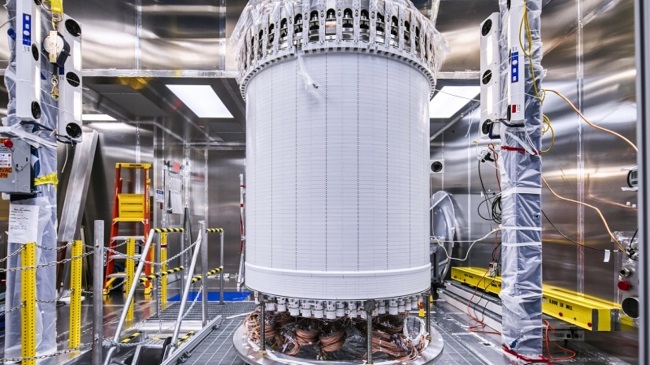
PROVIDENCE – Though it composes an estimated 85% of all mass in the universe, much of humanity’s understanding of dark matter remains hazy. In fact, no technology has ever detected these particles.
A team of researchers and students at Brown University are pitching in on an international effort to change that.
Building a Strong Data Foundation in the Age of AI
Artificial intelligence (AI) has become a key priority in the boardroom and across management —…
Learn More
A dark matter detector located in an underground research facility in South Dakota hasn’t made this discovery yet, but its initial results are promising, said Richard Gaitskell, a physics professor at Brown and director of the Center for the Fundamental Physics of the Universe.
“It’s an exciting time,” Gaitskell said in a statement. “We’re ready to make history.”
The team has yet to see a signal suggesting dark matter, he added, but “already, the results are more sensitive than the world’s best results by a significant factor.”
Gaitskell continued, “With the [experiment] going on to run for 1,000 days, the next results will explore many new models for particle dark matter. We believe we are in a strong position to discover the universe’s missing mass.”
The Brown team has so far built, tested and integrated more than 14,000 components for the detector arrays, Gaitskell said.
Jacquelyn Voghel is a PBN staff writer. You may reach her at Voghel@PBN.com.