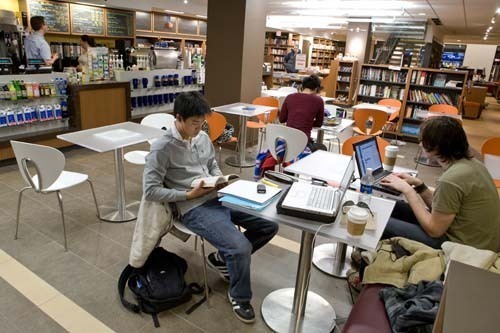
As the Brown University Bookstore put the finishing touches on a $3.5 million renovation earlier this month, the school’s students were not the only ones pleased to see the store spruced up and sporting a new look.
Kenneth Dulgarian, who has owned property in the Thayer Street neighborhood for more than 30 years, said he was glad to see the university making the investment, particularly in a recession – and despite the fact that he used to own the competing College Hill Bookstore, which closed in 2004.
“Brown bookstore is a coveted merchant to Thayer Street, as an anchor would be to a shopping plaza,” said Dulgarian, Avon Cinema owner and former chairman of the Thayer Street District Management Authority.
“Today, everybody’s tightening their belts,” he said. “But … the Brown bookstore [is] spending a lot of money and doing a beautiful job. And that will draw more pedestrian traffic, more vehicular traffic, and that will be good for the area.”
Renovations, which were preceded by some campus controversy, include the construction of a large customer service and checkout counter in the store’s center, as well as the relocating of the textbook section to the basement and the technology department to the third floor.
In 2006, there was uproar after a Brown committee recommended that the university explore outsourcing the bookstore’s operations to a corporate vendor like Barnes and Noble College Booksellers or the Follett Higher Education Group, which run many of the nation’s campus bookstores.
The suggestion evoked a storm of protest. Students organized a Save the Bookstore Coalition, which held a rally, distributed “Save the Bookstore” buttons and gathered signatures. University officials quickly backtracked, leaving Brown as one of only two Ivy League schools with a campus bookstore that is still independently owned and operated.
“While the committee feels both models are viable, the committee also believes Brown’s values, culture and customers can be best represented and successfully served at this time in a self-operated store,” Elizabeth Huidekoper, the university’s executive vice president for finance and administration, said at the time.
Still, that did not take away from the need to renovate a bookstore that Huidekoper herself described as not particularly “browser-friendly.” The bookstore moved to its current location, at 244 Thayer St., in 1970, and was renovated in 1993.
The recent renovations began last August. They were supposed to have been completed last October, but were delayed because of financial and safety concerns.
The most noticeable change is the opening of the College Hill Café, a first at the bookstore. The café is being operated by Blue State Coffee, the progressive-minded espresso company that has its own location just three blocks away from the bookstore.
Alex Payson, Blue State’s general manager and a Brown graduate himself, said he was not concerned about competition between the two cafés, noting that his other location has limited space and that the bookstore has built-in traffic from students and the university’s administrative offices in the same building’s upper floors.
Payson also said the company will retain its commitment to sustainability and local food at the bookstore. He is particularly proud of one coup: a contract with Pastiche, the Federal Hill pastry shop, making the café the first retailer to sell the shop’s desserts. The restaurant Local 121 is also set to provide sandwiches and salads.
The bookstore’s renovation is just a small part of the university’s much larger “Building Brown” initiative, a series of infrastructure projects set out in a 2006 master plan that called for 250,000 square feet of renovations and 125,000 square feet of new construction, all funded through the university’s $1.4 billion Boldly Brown capital campaign.
“We needed to make sure we had a very long view of how we are going to accommodate that growth, and how we are going to … make the campus better and make the neighborhood better,” said Michael McCormick, Brown’s assistant vice president for planning, design and construction.
Apart from the bookstore, the most noticeable elements of the master plan are The Walk, a green space that connects Brown’s Pembroke campus to the main campus, and a commitment to locating a portion of the college’s operations in a planned mixed-use development in the city’s Jewelry District.
Another project, the relocation of the Peter Green House, won an award earlier this month from the Providence Preservation Society. The full list is available at www.brown.edu/Facilities/Building_Brown/. •