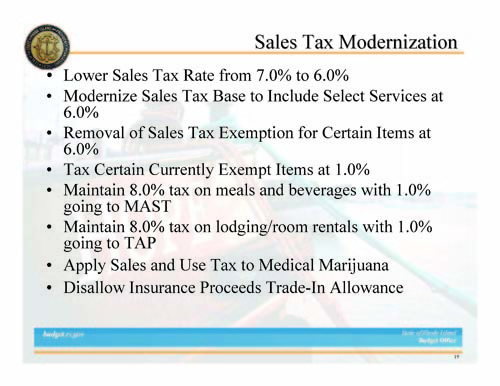
Joe Parella was pleasantly surprised last week when he heard that Gov. Lincoln D. Chafee’s $7.66 billion state budget proposal contained a plan to cut the sales tax to 6 percent.
Yes, Chafee also wants to tax dozens of goods and services that have not been taxed before. But for years, Gil’s Appliances in Bristol, where Parella is sales manager, has competed against stores in Massachusetts that had a built-in advantage: a lower sales tax.
Under Chafee’s plan, that advantage would shift across the state border. The Bay State’s sales tax rate stands at 6.25 percent.
“It certainly was a positive step,” Parella said after Chafee’s budget proposal was unveiled March 8. “I was expecting him to go and raise everything. But lowering is always good.”
For many others, it remains to be seen whether the governor’s sweeping tax and spending plan for fiscal 2012 is good or bad, or somewhere in between.
Local car dealers, for instance, weren’t sure what to think last week.
A lower sales tax would be beneficial, they said. But the Chafee administration also wanted to tax for the first time the value of car trade-ins and car repairs, among other things.
“We’re still trying to understand the impact of it all, and whether it makes us more competitive or not,” said Jack Perkins, executive vice president of the Rhode Island Automobile Dealers Association.
Among business-advocacy groups, too, Chafee’s proposal poses a dilemma in developing a legislative lobbying strategy. Some member companies stand to gain; others are sure to end up on the losing end.
So, while some Rhode Island-based retailers such as Parella are pleased, many aren’t so enamored with the state tax overhaul that included taxing for the first time items and services ranging from nonprescription drugs to newspapers, haircuts and movie tickets.
The plan also calls for other previously exempted goods and services to be taxed at 1 percent, such as clothing, heating fuels and boats.
Laurie White, president of the Greater Providence Chamber of Commerce, said her group’s tax advisory committee is preparing to delve into the 445-page budget proposal to “determine the overall impact on tax competitiveness.”
“It’s difficult to build a consensus when there are winners and losers,” said White. “And I think in the legislative process more and more winners and losers will be either exempted or added to the mix.”
Groups of businesses were already organizing their opposition last week. Just days after Chafee outlined his budget plan, Some hair-salon owners had launched a Facebook campaign to rally against taxing salon services.
The governor’s spending recommendation is just the first step in the budget process as Chafee, an independent, and the Democrat-controlled General Assembly grapple with fiscal 2012’s project deficit of more than $331 million.
At it stands now, the fiscal 2012 budget package – Chafee’s first as governor – strikes a balance between spending cuts and tax-and-fee increases.
The sales tax changes alone would increase revenue by an estimated $164.88 million next fiscal year, budget writers said. Meanwhile, the administration said the budget plan also contained $153.45 million in “expenditure adjustments,” including a $23 million cut in personnel and operating expenses at cabinet-level agencies, as well as in the legislature and judiciary. Administration officials also noted a $60.5 million reduction in human services that “does not impact eligibility for programs.”
The plan addressed longer-term issues, too, proposing that state employees and teachers contribute more to their pension plans in order to lower the state’s $5 billion unfunded pension liability and recommending the state drop its corporate tax from 9 percent to 7.5 percent over three years.
Businesses would also see a restructuring of the $500 minimum tax so it would be based on gross receipts, which would drop state revenue by about $6 million per year. At the same time, the administration wants to phase out the Jobs Development Act, a program that handed out corporate tax breaks for creating jobs. One of the largest beneficiaries of the act was CVS Caremark Corp., which has added jobs in Rhode Island as it has grown.
Reactions to the proposal were mixed.
Kate Brewster, executive director of the Poverty Institute, last week praised the governor’s “balanced approach. His proposals to close corporate loopholes through combined reporting and bringing our sales tax into the 21st century are responsible tax policies,” she said in a statement.
But Gary Sasse, former director of administration and revenue under Republican Gov. Donald L. Carcieri, questioned whether the Chafee administration had relied too heavily on the sales tax changes to close the budget shortfall instead of making more spending cuts.
Sasse noted that a similar sales tax proposal considered by the Carcieri administration a few years ago would not have raised additional tax money.
“Did they do everything they could to balance the budget before raising the revenue?” Sasse said.
David R. Carlin III, vice president of government affairs for the Northern Rhode Island Chamber of Commerce and lobbyist for a coalition of a dozen chambers in the state, said he liked many elements of Chafee’s plan, but certainly not all of it.
Business leaders universally applauded the reduction of the corporate tax. But some also expressed opposition to the elimination of the Jobs Development Act and the restructuring of the minimum corporate tax because many small businesses would pay more. Most business advocates also opposed switching to combined reporting.
To address the financial struggles of cities and towns, the administration is proposing a special fund to provide aid to municipalities – starting in fiscal 2013 – that make their full annually required pension plan contribution as well as follow other “fiscally prudent practices.”
Another 1 percent from that tax would be directed to a “tourism-asset protection” fund to provide money for construction or preservation projects related to the tourism industry. If approved, the first $2.6 million in the fund would be earmarked for improvements at Fort Adams State Park in Newport.
The sales tax proposal will likely garner the most attention in the coming weeks and months.
Administration officials argue a “modernized” sales tax is needed, because people are spending much more on services than goods compared with decades ago.
Sasse, however, expressed several concerns.
He argued that the 1 percent sales tax plan would violate a multistate agreement on taxes called the Streamlined Sales and Use Tax Agreement that makes it easier for multistate companies to abide by various sales tax systems.
Sasse also noted Massachusetts does not apply a sales tax to most of the services the Chafee administration is looking to tax, which he said would make Rhode Island an “outlier.”
And he questioned whether some the goods and services that the Chafee administration is looking to tax would set up “pyramiding,” where business-to-business transactions are taxed at several levels, and then passed on to the consumer.
Carlin, whose coalition of chambers is opposing the broadening of the sales tax, said it’s not just the tax that has businesspeople worried. Some businesses would be required to collect taxes on their services and goods for the first time.
“This would be a dramatic change to the way business is done,” Carlin said. “You’re talking about [businesses] collecting and remitting the tax. There’s a certain amount of cost to administering that.” •