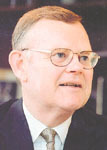
Robert Gormley took a leap of faith when he left an executive vice president
job at Fleet Bank in 1993 to join the small but rapidly growing Citizens Financial
Group in his hometown.
Citizens’ $5 billion in assets at the time paled in comparison to the $40 billion at Fleet.
“Larry (Fish, Citizens chairman, president and CEO) talked about his vision for expansion for Citizens. I was intrigued by the growth story, his plans to acquire lots of banks, and the opportunity for me to build its commercial lending program,” said Gormley, who grew up on Providence’s South Side.
Rhode Island's Market Has Changed. Developers, Builders, Investors and Sellers Must Change With It.
By Emilio DiSpirito IV License Partner | Engel & Völkers Oceanside Leader | The DiSpirito…
Learn More
Fish’s vision was on the mark. Citizens today has $130 billion in assets with its recent acquisition of 600 Charter One branches. Earlier this month, Gormley was promoted from group executive vice president of risk management to vice chairman of risk management.
He oversees credit transactions, portfolio administration, real estate management, corporate security, asset-liability management, credit review, compliance and operational risk – a big job in the midst of an acquisition that adds $43 billion in assets, 616 retail branches and 8,400 employees to Citizens.
Combined with its New England and mid-Atlantic franchises, Citizens will grow to $128.8 billion in assets, more than 24,000 colleagues and more than 1,400 branches into the Midwest and Northeast, adding major markets in Ohio, Michigan, New York, Illinois, Vermont and Indiana. It will also expand and strengthen Citizens’ business in western Massachusetts, Connecticut and Pennsylvania, a Royal Bank of Scotland Group press release reports.
The transaction is expected to close in the fourth quarter of this year, subject to regulatory approval.
Gormley, who graduated from Providence College with a degree in finance and accounting in 1970, got his start in banking as a management trainee for Fleet Bank when it was still called Industrial National Bank. He worked in various positions in different branches and finally ended up in a commercial credit training program, a sort of banking “boot camp,” that he “took well to.”
When Fleet opened a branch in Hartford, Conn., in 1988, the company asked him to run the commercial lending program there. The long commute became unbearable, so he packed up his wife and two children and moved from his home state of Rhode Island to Avon, Conn. – a move, he said, his family didn’t like.
As the bank grew and continued to acquire more and more branches, Gormley said he felt the company lost its personality and focus on customers. In 1993, he left as executive vice president and senior loan officer at Fleet and took the executive vice president and senior lending officer position at Citizens Bank.
“At that time, I knew my career at Fleet would never bring me back to Rhode Island. They were talking about sending me to Buffalo,” said the 56-year-old Warwick resident. “I feel fortunate to have made that decision 11 years ago.”
From 1996 to 1999, Gormley served as chairman, president and CEO of Citizens Bank New Hampshire. From October 1999 to July 2001, he was president and CEO of Citizens Bank of Rhode Island and Citizens Bank of Connecticut.
With the acquisition of Charter One, Citizens will be the seventh-largest U.S. bank by assets and deposits. Though the enormity of Fleet is what turned Gormley away from that bank, he said the customer focus that first attracted him to Citizens has been maintained through previous acquisitions; and though it may be more difficult to focus on as the bank continues to grow, he said that focus will be maintained.
“We run the bank like a smaller company – we think big but act small. It will become more challenging as we continue to grow, but we talk about values a lot and we were able to keep our customer focus during the Mellon (Financial Corp.) acquisition (in 2001).”
Though the bank has no immediate plans for new acquisitions, growth has always been the goal of Citizens Financial Group’s parent company Royal Bank of Scotland, the fifth-largest bank in the world, so more acquisitions are inevitable.
“The United States has more opportunity for growth for Royal than western Europe does … the banks there are large and there aren’t the acquisition opportunities that there are here,” Gormley said.
Because RBS relies on Citizens for U.S. growth – the bank represents about 20 percent of RBS earnings – Citizens won’t be on the opposite end of an acquisition, he said.
“There is no chance of us getting acquired. If we were acquired, Royal would lose its opportunity for growth in the U.S. If we are bought, our shareholders would get that one-time windfall, but they would lose the opportunity for continuous returns,” he said.
Gormley’s risk management position seems heavier than ever now that the bank has nearly doubled its branches, but the bank has increased its risk management team and is sending some of the team members to new branches to make sure the tradition of “conservative” risk policies are maintained.
“As we continue to grow, we make a lot of investments in risk management. We look at ourselves against the top 20 banks in the country, and we have the best assets and our growth looks good.”