Maguire Group heads much of I-195 relocation
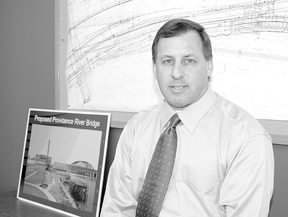
Thomas P. Donald
Position: Vice president and manager of the transportation unit for
the Maguire Group.
ISO 9001:2026: A Practical Opportunity to Build for What’s Next
For Rhode Island manufacturers, ISO 9001 has been much more than a certificate on the…
Learn More
Background: Donald spent 21 years working for consulting engineering
firms in the Boston area, mainly in transportation projects for public agencies
in New England. He started out as a junior engineer doing bridge inspections
and design on the Southwest Corridor Project for the MBTA, then worked on other
MBTA bridge projects, as well as the Connecticut Emergency Bridge Program.
While at one firm, doing primarily bridge design, he was promoted to project manager and eventually structural department manager. Since he was hired at Maguire two years ago, he’s worked on the design of two central artery/tunnel projects, buildings and waterfront structures.
Education: Bachelor’s degree in engineering from Syracuse University
in 1980
Age: 45
Residence: Medfield, Mass.
The Maguire Group, founded in 1938, is considered one of the nation’s leading
architectural, engineering and planning and construction management firms. It
has locations in 12 offices throughout the Northeast and the U.S. Virgin Islands,
with a local office at 225 Chapman St. in Providence.
The Maguire Group has done projects from the Big Dig in Boston to the river relocation in Providence, which earned the company its second Presidential Award for Design Excellence – one of only two firms in the nation to receive the award twice.
The company is leading the Interstate 195 relocation project and is involved in all aspects, including road and bridge design, marine and geo-technical engineering and right-of-way procurement. Thomas P. Donald is overseeing the highway project for the Maguire Group. Senior Project Manager David Freeman and bridge department Manager Patricia D. Steere are working closely with him.
The planning concept for relocating the highway began in 1990. All phases of construction will be in motion by the end of 2005.
Q. What were the major design flaws with the original I-195?
A. Traffic, in a word. Also the bridge conditions are very bad.
Q. So the new design is going to alleviate traffic for commuters and people will get to work faster in the morning. When will people start noticing a difference?
A. Well, we are separating the weaving areas by adding an extra lane on both sides of the highway and increasing the distance between exits and on-ramps. Commuters will start seeing traffic alleviation in 2007 when, hopefully, people will be using the new bridge.
Q. And there should be many fewer accidents?
A. Yes, and we are taking the curves out of the road so that should help too.
Q. Speaking of bad curves, any work on the Thurbers Avenue curve or is that going to remain an infamous roadway?
A. No, we aren’t fixing that. Not yet.
Q. OK, I hate when I’m driving and I’m suddenly trapped in an ‘exit-only’ lane. Are you doing anything about that?
A. Right. We are eliminating that problem, and there will be the extra lane so there won’t be any exit-only lanes.
Q. What is the biggest challenge of this project?
A. Mostly keeping traffic moving while there is so much construction going on.
Q. What phase is the project in now?
A. It’s actually broken up into a number of different construction contracts. There are four going on now. There are 15 contracts in all. We are designing six, eight and nine right now and they’ll start work on those next year. Three, four, five and seven are being (constructed) now, and by the end of next year, all of them will be in motion. The Providence River Bridge should be an interesting one. It’s 400-feet from end to end, and we are going to float it from Quonset Point to where it is supposed to be in 2006. Get your seats reserved now.
Q. Will people be alerted before an exit is closing or when a major construction project is about to happen beforehand?
A. The Department of Transportation is very cognizant of what’s going on and there is a lot of other construction going on in Providence, so they try to coordinate what’s happening with all the various projects and come up with a campaign to make the public aware. They have various ways of doing it.
Q. How has designing highway systems changed over the years, when you look at the way transportation systems were designed back in the 1960s compared to today?
A. In design, from the structural perspective, we are much more concerned with durability and the life span of a project, and safety is a huge factor. We always consider the environment we are building in.
Q. What about aesthetically? The city of Providence is very concerned with having a beautiful downtown. How did it affect the project?
A. Aesthetics were a huge consideration with this project. The Providence River Bridge, which is under construction now, the DOT actually formed a committee with various neighborhoods and downtown groups and they chose the colors of the bridge. The style was predetermined, but communities have much more say in how a project looks than they did in the ’60s when we would just throw up a nice big green bridge.
Q. So much goes in to designing a highway. What elements do you have to consider when you are designing something like this?
A. How to maintain traffic movement while you’re improving it. You can’t decide to put a roadway through the middle of a neighborhood, so you have to consider the community, all the environmental effects and the impact, and the process makes the roadway better, oh, and the costs are a little important. There’s going to be a certain amount of pain to getting there, but we’ve done all we can to minimize it. Our decision looks good on paper, but there is always going to be an impact. Everyone works hard to minimize the problems and in the end, you hope the major changes will really benefit the entire area.