Mary Kay Talbot has twice lived through the anguish of having a child in the neonatal intensive care unit. Her firstborn, Lucas, spent the full two weeks of his life there, struggling to recover from seizures. Her second son, Connor, now 7, was in the NICU for six days.
Both times, Talbot says, the Women & Infants Hospital team was extraordinarily kind and caring. When Lucas was dying and she wanted him to experience the sun on his skin, a nurse made it happen. Visitors were kindly accommodated. Other parents were supportive.
But the noise – a seemingly endless cacophony of beeps, plus all the activity around dozens of babies crowded in a small room – “it was sometimes deafening,” she recalled recently. There was no privacy to breastfeed, and only a rocking chair to sit and sleep in.
“You got used to it after a while,” she said, “but I can’t imagine that it wasn’t over-stimulating for the babies.” And the space was “really, really tight,” like an egg crate filled with cribs.
Visit the NICU today, and you’ll find the description still fits. If anything, with 1,300 babies now treated each year, it’s gotten even more crowded. On a recent day, 78 newborns were in the NICU, which was built for 41 and, just four years ago, averaged about 65 per day.
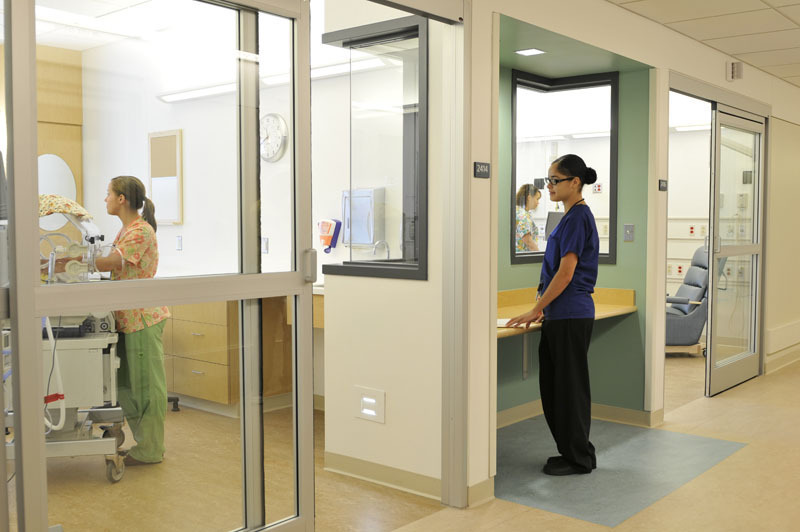
As of next week, however, Women & Infants will have a new, radically different NICU: a 50,000-square-foot space – five times as large as the current unit – with all-private rooms for 80 babies, including twin and triplet rooms, with sofa beds and many amenities for parents.
The NICU is the heart of the $76.8 million South Pavilion that is opening on Sept. 14, and it embodies “the next epic in neonatology,” said Dr. James F. Padbury, chief of pediatrics at Women & Infants and a leader in the design of the new facility.
Medicine has made tremendous strides in the last several decades in the treatment of frail newborns, Padbury noted, developing specialized NICUs with cutting-edge technology and drugs that save even very premature, underweight babies who never stood a chance before.
Yet while preemies can now survive even at 23 weeks, and at 25 weeks more than 80 percent make it, they still need months in the NICU to stabilize and grow strong. And while they get top-notch care, he said, it’s undermined by the setup.
“This is a great nursery, but we can do better than this,” he said. Despite the staff’s best efforts, the babies are now in a “crazy, loud, noisy, chaotic” environment. “It’s disruptive to their developmental outcomes.”
Having private rooms, by itself, is expected to make a major impact on many levels.
For starters, it will be much quieter: Babies won’t be crowded together, so there won’t be a cacophony of beeps from all the surrounding machines, or noise from people gathering around other babies. And when they sleep, the room can be made nice and dark.
Parents will also be much more comfortable. They can stay as long as they want – even sleep there for days, weeks or months. Mothers can breastfeed in complete privacy. They can decorate the room as they wish. They can receive visitors there or in a nearby lounge.
But the changes aren’t just physical. With the new NICU, Padbury said, Women & Infants also expects to be able to step up its efforts to deliver “family-centered care.” Already, the doctors and nurses encourage parents to hold their babies, stimulate their senses, and do little things like change diapers to start building their bond. In the new setting, educating and supporting families will be much easier, he said, because there will be more time and space.
To deal with the one potential downside of the new setup – the potential for parents to feel isolated – the hospital is also creating new support programs, so families will get a chance to interact with one another and share stories and advice.
Before designing the NICU, Women & Infants sent Padbury and others to several hospitals that already had private-room NICUs, so they could see what worked and what didn’t. Parents, including Talbot, also traveled with them, and they provided their own feedback.
Based on conversations with those hospitals’ staff and on medical studies, Padbury said, Women & Infants expects to see a drop in infections, heart problems and other serious complications, better development and weight gain, and shorter stays. But nobody has ever done a comprehensive study to gauge the full impact of switching to private rooms.
That’s where Dr. Barry Lester, a professor at Brown University’s Warren Alpert Medical School and director of the Brown Center for the Study of Children at Risk at Women & Infants, comes in.
When the new NICU opens, the study will shut down for three months to allow the staff to get acclimated, Padbury said. Then a second, two-year phase will begin, gathering the same data about a comparable cohort of patients, for a total of about 180 babies in each setting.
“We’re being as rigorous as state-of-the-art science permits,” said Lester. “We are using state-of-the-art measurement techniques … and we’re not only measuring how the environment changes and what the babies are like, but [also] the kinds of things that may make a difference.”
It may turn out, for example, that it’s the extra focus on parent-centered care that makes the biggest impact, or the amount of time babies spend with their mothers, and breastfeed and get skin-to-skin contact. Or a happier, less-stressed staff could make a big difference.
Lester, who is nationally respected for his research on the impact of mothers’ drug use on babies, has created a system to predict children’s future development based on specific factors at an early age, and that system will be used in this study as well. In addition, the babies’ actual development will be tracked for about two years, he said.
The goal of the study, Lester and Padbury said, is to provide solid data that other hospitals can learn from, so they can use Women & Infants as a model to revamp their own NICUs.
“I think whatever comes out of this study will have a substantial impact on the care of [fragile newborns], because this will be the largest single-room NICU in the country,” Lester said.
Women & Infants is also a perfect site for this kind of study, Padbury said, because its NICU serves a very diverse population – about 1,300 babies per year from all across the state and nearby Connecticut and Massachusetts, rich and poor, from all kinds of backgrounds.
“This is a once-in-a-lifetime chance,” he said. “We’re the only NICU in southern New England. If you did this study in Boston, you would get a different result [at each hospital] … because health care is segregated in this country. … But we take care of everybody.” •