Taunton-based Mechanics Cooperative Bank says it had plenty of cash to lend out before.
But when Massachusetts in May announced a new initiative to make more capital available to community banks in the Bay State so they could in turn lend it to small businesses, Mechanics Cooperative Bank didn’t hesitate to sign on.
The idea of getting additional liquidity fit in well with the bank’s strategic plans to place more of an emphasis on growing the small-business loan portfolio in the coming year.
“We know there is going to be a need for those funds,” said Joseph T. Baptista Jr., Mechanics Cooperative president and CEO. “The demand is there.”
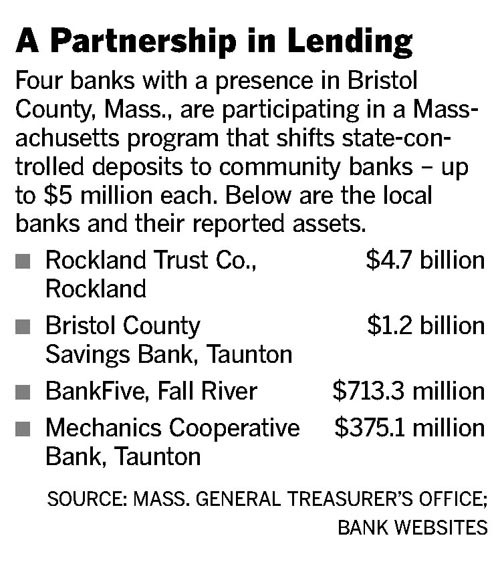
Mechanics Cooperative was one of the first Massachusetts banks to take advantage of the Small Business Banking Partnership, an effort by Mass. General Treasurer Steven Grossman to shift millions of dollars of the state’s cash reserves from large financial institutions located outside the state – and sometime overseas – to small, community banks within the Bay State.
Then those fresh deposits can be directed to loans for small businesses.
“If a bank is in the position where they see more opportunities to make more creditworthy loans than they have capital for, this is where this program comes in,” said Jon Carlisle, spokesman for the treasurer.
So far, about a dozen Massachusetts banks have received the maximum amount, $5 million each, as part of the partnership. Another 40 banks are going through the approval process.
There are a few strings attached: The banks must agree to ensure the taxpayer money is insured or collateralized, and they must pay interest rates comparable to what the state would have earned elsewhere, about a quarter of a percentage point interest rate, according to the treasurer’s office.
At this point, state officials are ready only to commit about $200 million of the state’s cash reserves.
“It’s pretty cheap money for the banks, but the risk exposure is not there for taxpayers,” Carlisle said. “And we didn’t want [the program] to tie up too much of the state’s obligations.”
The effectiveness of the Small Business Banking Partnership remains to be seen.
Bankers acknowledged that most institutions have plenty of money to lend right now. Finding quality borrowers has been the challenge in the wake of a recession. And many businesses are still skittish about adding to their debt with the economy still sputtering.
It’s also not clear how much impact $5 million will have on some banks, such as the $4.6 billion Rockland Trust Co., at the large end of the community-bank scale. Rockland is a subsidiary of publicly traded Independent Bank Corp., based in Rockland, Mass.
Yes, $5 million isn’t going to change the lending picture for Rockland Trust, said Ralph Valente, the bank’s director of marketing.
“But it won’t hurt, either,” he said.
Rockland Trust is going through the approval process to receive the $5 million deposit infusion. Valente said it is important that Rockland Trust take a “leadership position” in regional small-business lending by participating in Treasurer Grossman’s initiative.
Such “linked deposit” programs are not uncommon nationwide, according to Kevin Johnson, communications manager for the National Association of State Treasurers. Often, he said, a state will purchase certificate of deposits at a reduced interest rate and expect that rate to be passed to small businesses in the form of low-interest loans.
Ohio has a similar program, called Ag-LINK, designed to provide low-interest rates for farm loans.
There is no linked deposit program in Rhode Island. A spokeswoman for R.I. General Treasurer Gina Raimondo did not immediately return a message seeking comment.
To protect taxpayer money, Massachusetts’ Small Business Banking Partnership requires bank insurance and banks agree to pay interest no lower than the prevailing London InterBank Offered Rate or Massachusetts Municipal Deposit Trust overnight rate.
And officials in the treasurer’s office say there are no restrictions on using the money for loans outside the state.
“The whole premise is to get the banks to increase their loan portfolios to small business, but we didn’t want them to be subject to paperwork and requirements that would make it unattractive,” Carlisle said. “The idea is not to micromanage.”
That said, participating banks are encouraged to ensure the so-called “gateway cities” – a group of former industrial mill cities such as New Bedford, Fall River and Taunton – are “fairly represented. And regulators will ask banks to outline plans to include minority-owned businesses in the program.
Patrick Murray Jr., executive vice president and chief operating officer at Taunton-based Bristol County Savings Bank, thinks the timing is good.
Murray said the bank has lots of cash available to loan, but loan demand has been slack. Now he sees that changing as companies appear to be more open to making investments.
“We’re starting to see signs that thing are starting to turn around a little bit,” Murray said. “The cash is building on [businesses’] balance sheets.”
Mechanics Cooperative Bank’s Baptista said the bank has already made one loan assisted by the $5 million cash infusion – a deal providing a commercial mortgage and working capital for a service-related business.
Baptista said it isn’t just about the dollars and cents from the Small Business Banking Partnership; he is hoping that just the existence of the program will give small-business owners a confidence boost.
“There’s a positive vibe that comes from the program,” he said. •