
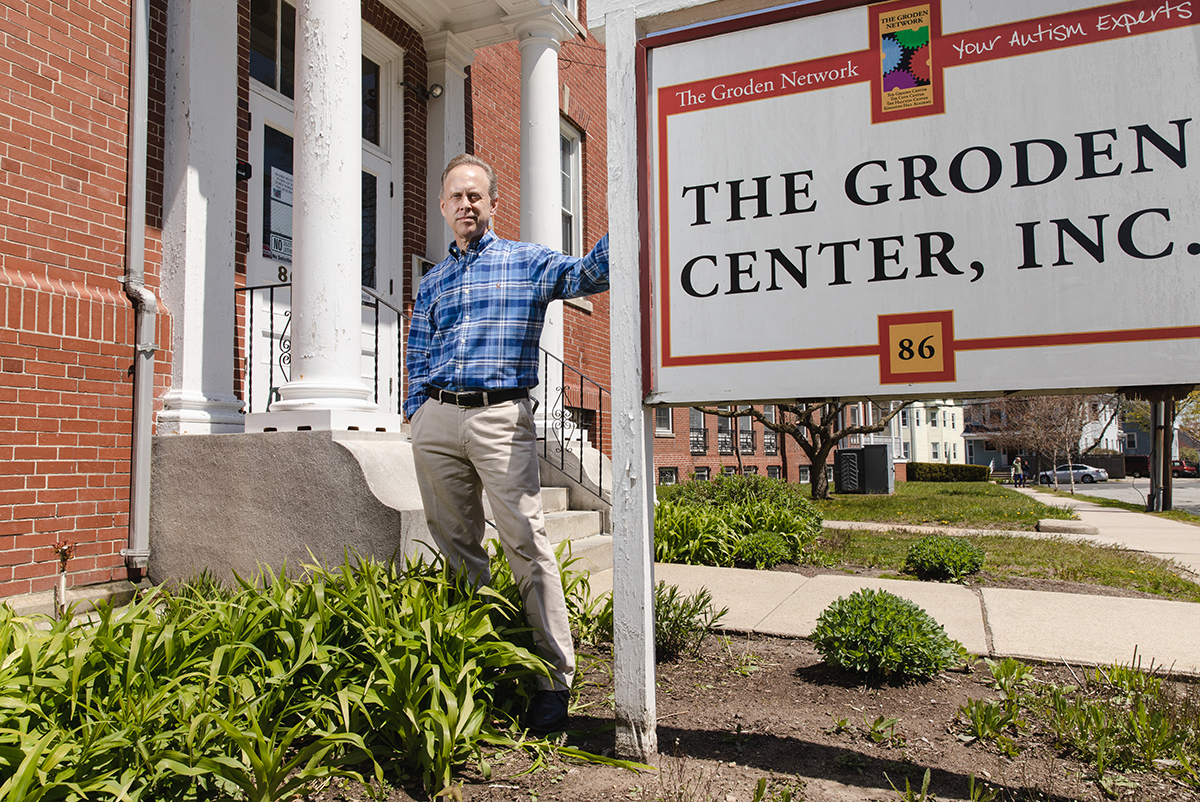
Cooper Woodard is the chief clinical officer for Providence-based nonprofit The Groden Network. The organization provides educational services for individuals who are on the autism spectrum.
Woodard talks to Providence Business News about how Groden adjusted operations during the COVID-19 pandemic, how it helped clients cope with the pandemic and what digital services are now being offered.
ISO 9001:2026: A Practical Opportunity to Build for What’s Next
For Rhode Island manufacturers, ISO 9001 has been much more than a certificate on the…
Learn More
PBN: How has Groden Network adjusted its operations and services during the pandemic?
WOODARD: The pandemic has impacted virtually everything we do at Groden because our services are tailored to each individual client and “wrap-around,” meaning that we try to address all aspects of a person’s functioning. This means that we not only work to improve academic and functional skills but we are also working on vocational skills, positive traits, family functioning and a host of other areas. This type of approach necessitates a close working relationship with families, schools and other involved agencies, and close, often 1-to-1, interaction with the client. The pandemic made all of this more difficult, so we had to be creative in how we delivered services.
Fortunately, the team at all of our locations, COVE, Halcyon, The Groden Center, our Treatment Foster Care, home-based services, outpatient and residential services, are a creative group of people who actively addressed this new challenge. We took each service individually and adapted our approach. For example, in our home-based treatment services, we limited our clinicians to visiting one home only. At our outpatient services, all sessions, including our group social skills sessions, moved to 100% teletherapy. At our residential program, we limited the staff who could work in any given home, limited visitation and depended on our terrific staff to keep all the residents happy and occupied. We are grateful for the Governor’s Workforce stabilization program that allowed us to give our direct care staff working in our group homes hazard pay during the height of the crisis.
And at our school, we developed a 20-page plan that addressed everything from who was in which classroom, to how we were going to purify the air, to how many people could be on the playground at one time. We used our specialized cognitive picture rehearsal and relaxation tools, developed by … June and Gerry Groden, to help the children become comfortable with wearing masks and coming to school only a few days per week; and for distance learning, we reached out to each child and family regularly so that all the great progress students have made could be maintained. Each of our many programs did everything possible to maintain services in a safe and effective manner.
PBN: What has been the biggest challenge Groden has faced thus far during the crisis?
WOODARD: Ensuring we have done everything possible to keep our clients and families as safe as possible and maintaining consistent and up-to-date communications across the organization with the clients and families we support. Because we were learning more and more about this virus every day, guidance was changing regularly, and all of our many departments needed to keep in regular contact with each other. It was essential that everyone have direct access to our nursing department, [which was] working closely with the R.I. Department of Health, and many times, one person had a challenge or a terrific idea that we could use in other areas of the agency. For example, while we had initial challenges in obtaining personal protective equipment, as did everyone, we worked closely with our state agencies [R.I. Department of Children, Youth and Families; R.I. Department of Behavioral Healthcare, Developmental Disabilities and Hospitals; and R.I. Department of Health] to supply our staff with sufficient PPE to protect our clients and staff.
One of the biggest communication changes that we see going forward from a business perspective is how we use videoconferencing and telehealth to communicate internally and externally. We hold group Zoom or Teams calls with our management team that is spread across Rhode Island and southern Massachusetts. More importantly, we have seen our home- and community-based clients, as well as our outpatient clients, become more comfortable with telehealth. This has been a game-changer. While this can never replace the face time with clients, it gives us another tool in the service delivery toolbox. Using this technology, we set up a weekly meeting for the heads of all parts of the organization and created safety coordination teams so that information could be disseminated effectively. We sent our regular updates to our families and organized group meetings online so that our clients and families didn’t feel so isolated.
Often, because we wanted to be as conservative as possible, we adopted policies and procedures that were very limiting in terms of parents visiting, staff working in multiple locations and clients engaging with the larger community. While this was difficult, everyone understood that it was for the best, was temporary and in the best interest of the clients and families we supported. But remaining in contact using all sorts of videoconferencing and related tools helped us tremendously.
PBN: Has the pandemic resulted in some clients not returning to Groden?
WOODARD: On the contrary. We have recently reopened the school on a partial basis, and 100% of the students continue to be enrolled. We also have a long list of referrals because people know that the services offered at Groden are [of the] highest quality, based on research, and derived from individualized and innovative ideas created by June and Gerry Groden. We have had a number of requests to assist other agencies in supporting their clients and are working actively to meet these needs.
PBN: How has Groden helped ASD clients cope with the pandemic, given that in some cases those who are on the autism spectrum have difficulty adjusting to changes in certain situations and seeing their routines disrupted?
WOODARD: Change and disruption in routine are stressors for everyone and can be particularly difficult for the people we support. It is important to know the individual strengths and challenges of each person and then design ways to improve coping skills, so the impact of the stressor is lessened. We do this in a number of ways, such as preparing schedules and discussing the plan for the day with each client.
But one of the most powerful sets of tools we use are progressive relaxation and cognitive picture rehearsal. Each client in our program practices relaxation protocols that are based on adapted techniques designed by … June Groden and, in concert with these practices, has individualized cognitive picture rehearsal “scenes.” Each day or multiple times each day, our clients read through these scenes – pictures and statements in a flipbook – that guide him or her through the presentation of a stressor: “Today I am going to ride the bus to school but I don’t do this every day.” And then present a positive way of perceiving this set of events: “I like going to school one day, and then doing something fun with my family on another day.” Each set of scenes end with a positive thought or event, and with a good amount of repetition, new thinking supports new and adaptive behavior.
PBN: Explain the new program that was developed to help make distance learning more engaging for clients. Will this be a permanent option moving forward?
WOODARD: When the pandemic first began, we were sending home materials so that parents could work with students on those materials. Our special education teachers, board-certified behavior therapists, psychologists, speech/language therapists, occupational therapists and our adapted physical education teacher all contacted parents in a variety of ways, but as time passed we knew that there must be a better way to provide services.
One of our psychologists … Shareen Holly and an intern working at the center, Maggie Vieira, found ways to digitize and make virtual in an interactive way many of the programs that our students work on. This allowed teachers to have real-time presentation of materials and real-time responses from our students, even if they were not in the same location.
The teachers are also able to adapt the learning sequence depending on the responses of the student. We are working hard on getting these options up and running and will certainly use these tools in the future if they are needed. We are hoping, though, to be as in-person as possible as soon as possible.
James Bessette is the PBN special projects editor, and also covers the nonprofit and education sectors. You may reach him at Bessette@PBN.com. You may also follow him on Twitter at @James_Bessette.



