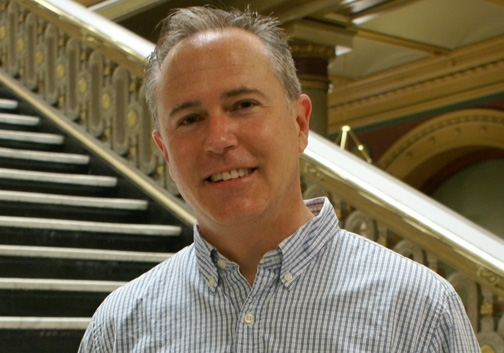
Last month, Providence Mayor David N. Cicilline announced the launch of Bank On Providence, a program designed to get individuals and families that don’t usually use bank services to sign up for free or low-cost checking and savings accounts with participating banks and credit unions. Officials such as Garry Bliss, director of compliance and monitoring for the city’s Department of Planning and Development, have been working on the program for more than a year. Bliss answered five questions about it.
PBN: What are the statistics on unbanked and underbanked families in Providence? How widespread is the problem and why?
BLISS: An estimated 12,000 Providence households have no checking or savings account. This forces families to rely on high-cost, predatory financial services like check cashers to conduct basic financial transactions.
Without a bank account, the average person will spend 5 percent of their income at check cashers each year just to access their own wages. This is money that families could be using to meet their basic needs, pay down debt, or save for the future. Having a checking or savings account is also safer than keeping cash on hand or in your home. As we learned from Hurricane Katrina, having a bank account also makes it easier to access needed funds in the event of a natural disaster. Without a bank account, you are at greater risk for losing your money through theft. Finally, studies indicate that families with checking or savings accounts are more likely to have a savings plan and save some money from each pay check. When cash is on hand, people are more likely to use it.
The reasons for being unbanked are many. Some people do not feel comfortable in a bank or credit union. Some may have had a past, negative experience with an account. Some may feel a bank or credit union is not interested in them as a customer. Bank on Providence is designed to address all of these real and perceived barriers.
Rhode Island's Market Has Changed. Developers, Builders, Investors and Sellers Must Change With It.
By Emilio DiSpirito IV License Partner | Engel & Völkers Oceanside Leader | The DiSpirito…
Learn More
PBN: Was it difficult to get the banks and the credit union to participate? Are there some who would not do join in?
BLISS: All the banks and credit union responded enthusiastically to Mayor Cicilline’s invitation to create and launch Bank on Providence. They were very open to developing a partnership – public sector, private sector, community-based organizations – dedicated to reaching out to non-traditional customers, to those who are currently unbanked. We always told the banks and credit union we wanted this to be, and it should be, a business decision for them. We were able to connect our local institutions with bankers in other cities who have had great success with Bank On initiatives. Experience shows efforts like this yield more customers, more quickly and more easily than the financial institutions forecast.
PBN: What exactly are the participating banks offering people who traditionally do not use bank services?
BLISS: Each participating institution has identified a checking account that will be their designated Bank on Providence product. Accounts have to be low- or no-cost, with low or no opening or continuing deposit requirements. Over the course of developing Bank on Providence, we worked with participating institutions to achieve some real change in the identification required for opening a new account, with institutions more open to non-U.S. government forms of ID.
PBN: What is the extent and cost of the campaign? And who is paying for it?
BLISS: The cost for the launch campaign is less than $10,000. In addition to generous support from the Annie E. Casey Foundation, the United Way of Rhode Island and a grant from the U.S. Conference of Mayors, our partners have supported this project with generous donations such as translation services for the website and grants to support market research. We have also benefited from access to marketing materials developed for other cities, provided through our membership in Cities for Financial Empowerment.
We have a bilingual website that walks people through the process of selecting and opening an account. We have a brochure, in Spanish and English, to raise awareness and steer people to the website. We will soon have ads on RIPTA buses raising awareness, and there will be Bank on Providence decals in the windows or all participating institutions.
We will also be working with community-based organizations to get the word out. We have been efficient and frugal, but we think interested families will know about Bank on Providence and where to go for information.
PBN: What is the goal at the end of Bank on Providence?
BLISS: All of the Bank on Providence partners share the same goal: 2,000 new accounts in two years. I know we will reach that goal. Our success in meeting that goal will provide the ideal foundation for developing other financial products and services that meet the needs of families turning to high-cost, predatory alternatives such as pay-day loans or refund anticipation loans.