The town of Norton is making the switch that many homeowners have been making – it’s going fiber.
Jason Benjamin, the executive director of the Norton Cable Access Corporation, the quasi-public agency that oversees public-access television in the town, spoke with Providence Business News about why the town is investing in the switch and what it hopes to accomplish.
PBN: What gave the town the idea to switch its phone service from the 30 individual copper lines to three fiber-optic lines?
Building a Strong Data Foundation in the Age of AI
Artificial intelligence (AI) has become a key priority in the boardroom and across management —…
Learn More
BENJAMIN: The analog lines were being maintained by analog amplifiers that functioned inconsistently and did not give us the bandwidth or throughput we needed for town data exchange.
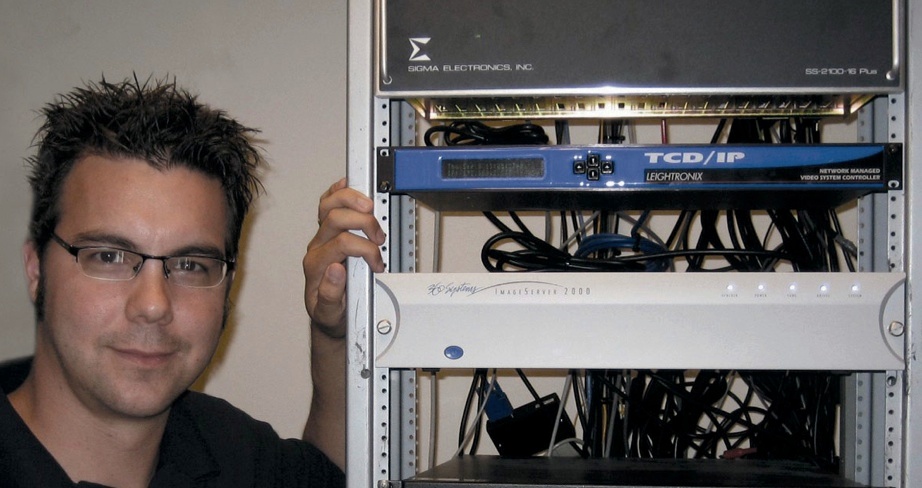
We were running on a 25-year-old infrastructure that couldn’t keep up with the data demands of the municipality. We are now on a high-bandwidth loop that can easily parse the needs of each department and have extra speed available for future expansion. We have added VOIP and Video Over IP functionality that we were seeking as project outcomes.
Speed is always a paramount concern for any network. With a fiber infrastructure there is suddenly a world of new features available. Each department in town is incorporating the fiber to address their own unique purposes. Our cable access board uses the fiber to send high-quality uncompressed video over optical transceivers for the weekly live broadcast of municipal board meetings.
Our emergency officials can now remotely trigger emergency messaging over the network that overlays onto all three of our public, educational and government channels simultaneously. This puts the power to inform the public during catastrophic circumstances directly in the hands of first-responders.
PBN: Were there other advantages to making the switch to fiber optics?
BENJAMIN: We are still on expensive Centrex lines, which can be customized to meet the town’s needs. But these lines are leased and must be paid for individually at a monthly recurring cost to the town. Fiber enables us to route the same traffic through our own line using cheap VOIP solutions that save the town thousands of dollars each year.
We can also now take advantage of server virtualization technology to save money on group software licensing costs and avoid unnecessary capitalization of extra hardware.
PBN: Are the new fiber lines the first in many upgrades you see in the town’s infrastructure? What do you plan to tackle next?
BENJAMIN: One priority is to explore updating the town-wide phone system.
PBN: What is the function of the Norton Cable Access Corporation? How does it reflect the wishes of the town’s residents?
BENJAMIN: The function of NCAC is to maintain an accessible studio environment where subscribers can produce their own digital video content and have it distributed through one of our three channels on the Comcast cable network. In addition, we also host video on our website, www.nortontv.org where users can view meetings and rebroadcasts of local sporting events, concerts, etc., 24/7 through a Web browser.
PBN: Can you explain how much the project cost, how it is being paid for and what the projected savings are for the town?
BENJAMIN: The project is being funded by the NCAC. This project cost $118,000, which included aerial installation, termination and a 12-strand Corning line with a single attachment to the pole. The annualized cost savings are too early to accurately assess, but we are projecting a savings in the tens of thousands of dollars on VOIP alone.