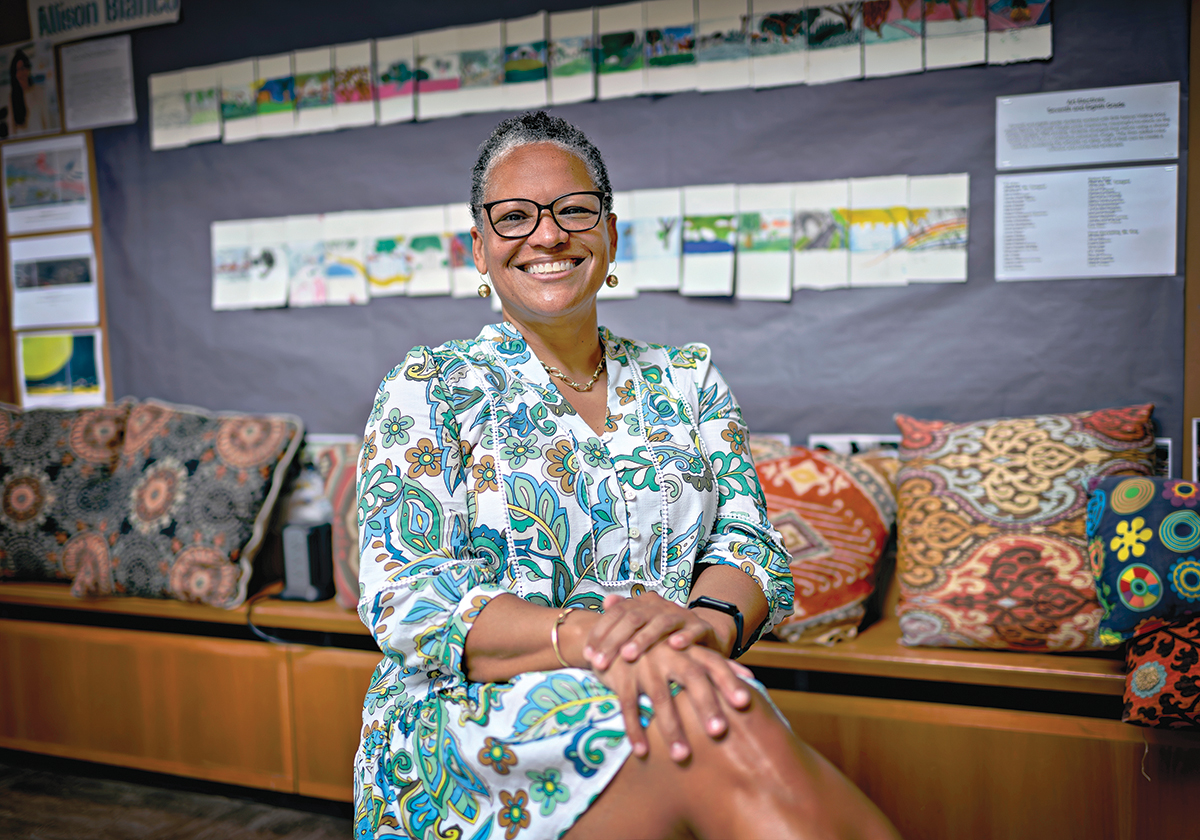
5Q: Meredith J. deChabert |
Head of school, The Gordon School
1. You started as head of school in July. What drew you to The Gordon School, an independent nursery-through-grade-eight school in East Providence, and how did its mission align with your values? In 2008, I heard Ralph Wales, who was leading Gordon at the time, talk about Gordon’s multicultural curriculum and the ways in which the school was using inclusivity and diversity to enrich the experience of every student and family. Starting that day, Gordon stood as a model for me of how a school could serve its students by seeking to truly understand each one of them.
2. You’ve held a range of leadership positions at Rye Country Day School in New York over nearly two decades. How have those experiences prepared you for leading a progressive school such as Gordon? My career has shown me, time and time again, that the best schools thrive on that complexity of progressive education, where learning is active and self-directed; full of discovery and wonder; inclusive and designed to leverage each child’s strengths; grounded in real-world challenges; interdisciplinary; and dedicated to advocacy.
3. Gordon is nationally known for its commitment to diversity, equity and inclusion. What does it mean to lead a school where those principles are deeply embedded? Leading a school that has justice, inclusion and belonging at its foundation frees me from needing to justify the work and allows me to focus on deepening it. … My parents reinforced for me that all people should be treated with dignity and respect, and they sacrificed mightily to send my siblings and me to a school that brought together students and teachers from many different races and ethnicities, cultures, religions, family backgrounds and places – just like Gordon does.
4. Gordon emphasizes the intersection of academic excellence with social and emotional learning and social justice. How do you balance these priorities? Progressive education asks us to present students with challenging, inquiry-based lessons in an environment that fosters wellness, connection and a sense of purpose. Studies in mind, brain and education have been highlighting the importance of these connections for at least two decades, and the pandemic underscored it: students learn best when they feel seen, safe and valued; face-to-face relationships are prerequisites for deep scholarship; and a focus on social justice gives students a sense of purpose.
5. What are some early goals or priorities you hope to focus on in your first year?My most important goal this first year is to listen and learn intentionally from the members of the Gordon community, including students, families, faculty and staff, alumni, trustees and the many members of the extended Gordon family so that I can celebrate the Gordon story with authenticity.