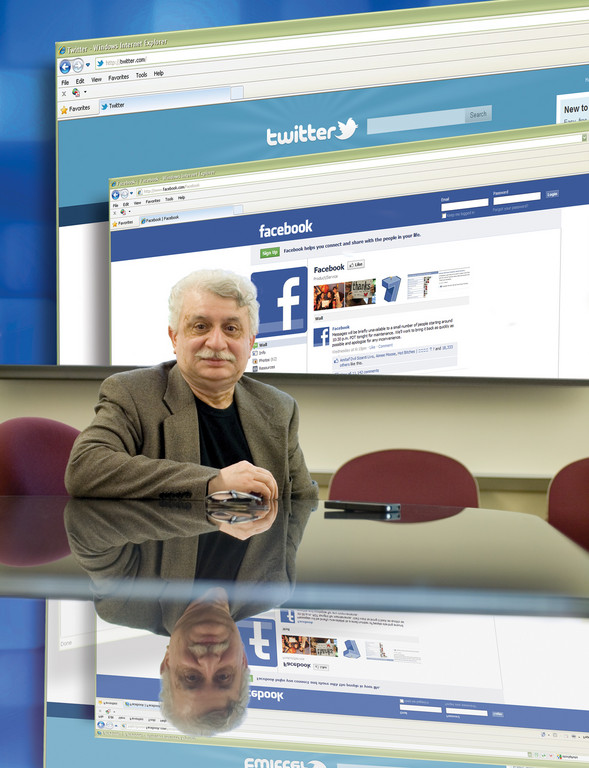
Nikhilesh “Nik” Dholakia is a professor of marketing and international business at the University of Rhode Island.
His research deals with globalization, technology, innovation, market processes and consumer culture; his work includes several books on new technologies and their implications for business, including: “Worldwide E-Commerce” and “Online Marketing: Watching the Evolution.”
Beyond Cash Donations: How New Forms of Giving Are Transforming Not-for-Profit Accounting
Evolving Funding Landscape for Not-for-Profits Not-for-profit organizations are being asked to do more with less,…
Learn More
He and his wife, Ruby Roy Dholakia, helped create the Research Institute for Telecommunications and Information Marketing (RITIM) at URI’s College of Business Administration.
His work was recently profiled in URI’s 2011 edition of Research & Innovation, “The Big Business of Social Networking,” focusing on the doctoral dissertations he is overseeing.
PBN: It seems like a lot of people are talking about how social media are this huge business, but – much like the relationships on Facebook and Twitter themselves – it seems almost unreal.
Facebook took a long time to incorporate ads, Twitter has just started its “promoted” tweets…What’s the tangible value of these companies? There’s a lot of potential but how are these companies really making money?
DHOLAKIA: The “Mother of All Competitive Battles” of the next few years will be between Google and Facebook. Google has access to an increasing range of content and a busload of applications and services. Its ability to zero-in on “content relevance” and to serve ads accordingly is amazing. But Facebook has personal relevance and stickiness. On Facebook, content is created, catalogued and curated by people.
People have to go to Google, to look up stuff, but people want to go to Facebook – out of sheer curiosity. It’s like eating peas versus potato chips. You’ve got to eat peas because they’re good for you, but you can’t stop eating those darned potato chips – it’s pure indulgence. To me, Facebook represents the top of the pyramid of “indulgent media”. Google took away business from Newspaper Classifieds and other B2B ad media. Facebook, if it can boost its indulgence level, will take ads away from TV and magazines. Let’s try another analogy – IBM is doing well because it is businesslike, and Apple is doing well because it is fun. I think Google and Facebook can coexist, but most likely Google will become more businesslike with the passing of time and Facebook will have to boost its fun factor continuously.
PBN: Moving onto the social aspects of these networks, some of your research deals with the anthropological, psychological, and sociological contexts. What views do you have about the impact social media has on these factors?
DHOLAKIA: For their most avid users, social media are becoming a new plane of existence. You live in Narragansett, and work in Providence – that’s the physical plane. But your life on Facebook and other platforms keeps unfolding almost seamlessly whether you are at home in Narragansett, at work in Providence, on a business trip to Los Angeles, or on vacation in the Bahamas. As the social media become more and more adept at porting from one device to another, and become more able to sense your location and mood, they can begin to influence your life in subtle and even scary ways. A senior government official in Germany, for example, is so concerned that she is trying to ban the use of social media in her department, and is urging people to avoid such media in their personal lives. But, because these are indulgent media, that’s like trying to ban potato chips…
PBN: You’re also overseeing a project on how social media are stimulating consumer creativity and what that means for business. What are the real-world examples of this?
DHOLAKIA: Some years ago, Lego found that people were unpacking its big boxes and buckets of Lego blocks and bricks, repackaging them into new types of kits that Lego did not have in its product line, and then selling such customized kits on eBay. At first, Lego tried to sue these creative consumer entrepreneurs. But that got nowhere. Now Lego has created the Lego Ambassadors program where it is selecting its most creative consumers to become partners in developing new kits. These Lego Ambassadors go and recruit their own network of creative people. Lego thus gets an enormous boost in the number of creative types working for it – and it rewards them with some amount of profit sharing. Lego is from Denmark, but in the United States, an entrepreneurial startup called Quirky is tapping into consumer creativity in a big way. People propose new ideas on the Quirky site: “How about a hat that has a built in umbrella?” Users vote on such ideas, and then independent designers get to work and create such a hat. Quirky makes the product available for sale on its site, and there is a system of sharing profits across the network.
PBN: What other projects are you working on during the next year?
DHOLAKIA: We have a newly started project at URI on Virtual Goods – virtual stuff that you buy in virtual settings such as Farmville or World-of-Warcraft games. For example, people can buy virtual tractors on Farmville. Interestingly, China’s economy is only one-third the size of the U.S. economy but China already has a virtual goods market five times larger than that of the United States. We are studying the factors that are driving the growth of virtual goods. Our special focus is on China but we are going to compare the rise of virtual goods in China with five advanced countries (including the United States) and four emerging economies similar to China.
PBN: As one of the creators of RITIM, you must have an opinion on the potential AT&T – T-Mobile merger. What kind of implications does it have from the consumer perspective? For small businesses?
DHOLAKIA: All over the world, telecom service providers have been transforming from regulated entities to deregulated ones. AT&T emerged from the break-up and then reconsolidation of Ma Bell. Germany’s T-Mobile emerged from that country’s old PTT – the government entity responsible for postal services and telecommunications. Because of such history of regulation, in many countries such as the U.S., UK, Germany, Japan and China the leading telecom service companies are still rooted in the regulated past of these countries. Global competition is still very limited in the telecom sectors of these countries.
Such is not the case in the telecom sectors of smaller nations, and of even large emerging nations like India – where telecom competition has become a global competitive tussle. As a result, in those countries – the ones with globally competitive telecom sectors – often the range of services available is larger and better, and prices are usually lower. In the U.S., globalization of the telecom service sector so far has been a backdoor process – for example, London-based Vodafone has a substantial equity stake in our Verizon. The proposed AT&T merger with T-Mobile would be the first full scale assault of globalization on our telecom service sector. I expect consumers to benefit if the merger goes through. Prices should come down, the lock-in one and two-year contracts should eventually vanish, and international roaming should become cheaper for Americans traveling abroad. Small businesses should also benefit, with a wider range of less expensive and more flexible services.
The race is on to create the Coke, McDonald’s or Starbucks of the telecom sector – and I see this merger as one of the several forthcoming shots aimed at creating a global telecom brand.