Infrastructure improvements needed to host America’s Cup preliminary races would center on Fort Adams State Park in Newport and could be financed through an array of public and private funding sources, similar to the development procedures followed when Capital Center was created in downtown Providence, says Keith W. Stokes, executive director of the R.I. Economic Development Corporation.
“The America’s Cup is giving us an opportunity to build a permanent facility that would not only be able to service an America’s Cup race, but also give us an opportunity to reclaim many other national and international sailing events that we’ve lost over the years because we haven’t had the basic infrastructure,” Stokes told Providence Business News last week.
Stokes spoke after word that Newport is not in the running to host the 34th America’s Cup, but is a contender to host about a half-dozen trial races, which could begin as soon as next year. Stokes also serves as chairman of a local America’s Cup planning committee that has been meeting weekly in Newport since February.
W. Michael Sullivan, executive director of the R.I. Department of Environmental Management which operates Fort Adams State Park, said the improvements under consideration would transform what he called a “somewhat sleepy facility” into a “state asset of substantive proportions.”
Even though the state and nation are mired in ever-deepening financial woes, Sullivan said he has “very little doubt” that plans for Fort Adams should proceed. “I see this as nothing but opportunity,” he said.
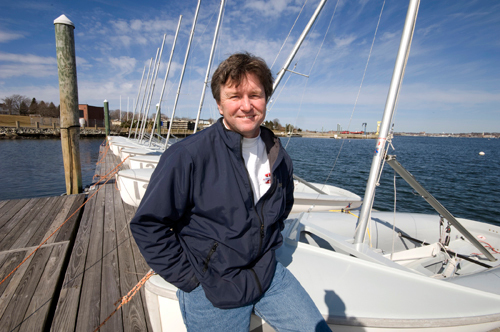
Brad Read, executive director of Sail Newport, a public sailing center that is a tenant of Fort Adams State Park, said any physical improvements would augment what is already a well-used sailing site, which hosts at least three major international sailing events every year.
“The public access mission of Sail Newport can only be enhanced by the appropriate infrastructure improvements to the waterfront [at Fort Adams State Park], which will offer more opportunities to allow us to attract more high-profile, global events,” he said.
Even though the planning committee that he chairs has met more than a dozen times this year, Stokes said there is little that has been – or can be – decided for certain until BMW Oracle Racing announces such integral details as what kind of vessels will be used in the America’s Cup and how many challengers there could be.
But some planning has begun.
The seven-member committee hired Newport Collaborative Architects of Newport to prepare a preliminary site-planning assessment.
“We are right now in the process of designing some site plans and some preliminary engineering plans,” Stokes said. “We can identify where we could build facilities to meet the needs of several [racing] syndicates or upwards of eight to 10 individual teams at one location.” Much of the work will involve improvements to existing dock-side facilities and waterside amenities, he added.
The kind of vessels that will sail the races is key to determining the nature of the improvements. Some vessels are heavier than others and so would require hauling apparatus, for instance, much sturdier than needed for lighter vessels, Read indicated. An 80-foot monohull can weigh as much as 80,000 pounds, he said, versus the lighter catamarans. “We’re rooting for the latter,” he said.
The 33rd America’s Cup held this year in Valencia, Spain, used trimarans, which have three hulls and are, according to Stokes, “probably one of the most complex and expensive sailing vessels. We’ve heard that they [BMW Oracle] might want to come back to a more traditional monohull, but we don’t know that as a fact,” he added.
The 170-acre Fort Adams State Park is the ideal place for a world-class racing center for several reasons.
“It is a state asset,” Stokes said. “The people of Rhode Island own and control Fort Adams State Park and, if we’re going to make any long-term investments in infrastructure improvements, they should go to a state asset.”
Secondly, the park is located at the center of Newport Harbor, “at the very beginning of the racing waters,” Stokes said, “From the standpoint of access to racing waters, there is no location like it anywhere in the country.”
Thirdly, “one of the great advantages we have in Rhode Island is, even though we lost the Cup in 1983, a lot of the designers, engineers and service people for the America’s Cup are still co-located [in this area],” Stokes said. “We still have a large number of those skills sets.”
He sees a similar scenario unfolding at Fort Adams, where Stokes said no specific plans are in place to build commercial space for businesses.
Sullivan suggested the fort itself has interior space that could be transformed into “an attractive boutique hotel,” he said. “There’s a great place for it on the southern rampart.”
The improvements would open the door to what Sullivan called “a host of delightful, potential opportunities.” For instance, about three years ago National Geographic approached the state about establishing a marine mammal museum at Fort Adams, he said, but was not prepared to invest in the infrastructure work needed.
Stokes noted that, when he speaks of Fort Adams State Park, he means “the entire environs – the fort itself, the state park, the roads, the public amenities, the docks” and even Eisenhower House, the state-owned, Victorian mansion on the waterfront where the former president used to spend his summers. “It is underutilized right now and has probably one of the most stunning views of the east passage,” Stokes said. “We will be looking to improve upon that asset.”
The next meeting of the America’s Cup planning committee is scheduled for 3 p.m. July 23, at Newport City Hall and, Stokes noted, it is open to the public.
As a result perhaps of the excitement generated by long-range plans for Fort Adams, the site is portrayed as all-but-abandoned, but such is not the case, Read said. “Every week, every weekend, we have something going on,” he said. Those events include a sailing regatta that is part of New York Yacht Club’s Race Week at Newport, presented by Rolex and scheduled for July 17-24 in the waters of Narragansett Bay and Rhode Island Sound. Many of the best professional and amateur racers have entered, according to the yacht club. •