Two years ago, Forbes magazine ranked Rhode Island No. 8 in the country on a list of “green” states. The Ocean State was praised for its energy consumption – the lowest per capita in the country – its clean-air and energy-efficiency policies and its tiny carbon footprint.
Yet there is evidence that the state’s environmental streak is not a top priority for Rhode Island businesses. Of the roughly 350 companies polled for Sovereign Bank’s annual Economic Outlook report that was released last month, more than two-thirds said green business practices would have little or no impact on how they run their business in 2009.
The question: Does that reflect a relative lack of concern about the environment among local businesses, or is it a short-term response as they deal with the more pressing concern of the recession?
Some industry observers say there has been a marked decline in the number of businesses going green since the economy started sliding downhill last year. Ron Gagnon, who manages the Hospitality Green Certification Program for the R.I. Department of Environmental Management, said that although hotels and restaurants have continued to contact him to learn about the steps necessary to become certified, fewer have been following through.
“It’s definitely slower right now,” Gagnon said. The program, which began in November 2007, had about 30 facilities certified at the end of that year, but has added only eight since. Still, close to 30 people attended a workshop about the program last month, and the New England states are collaborating on regional meetings to push green initiatives, he said.
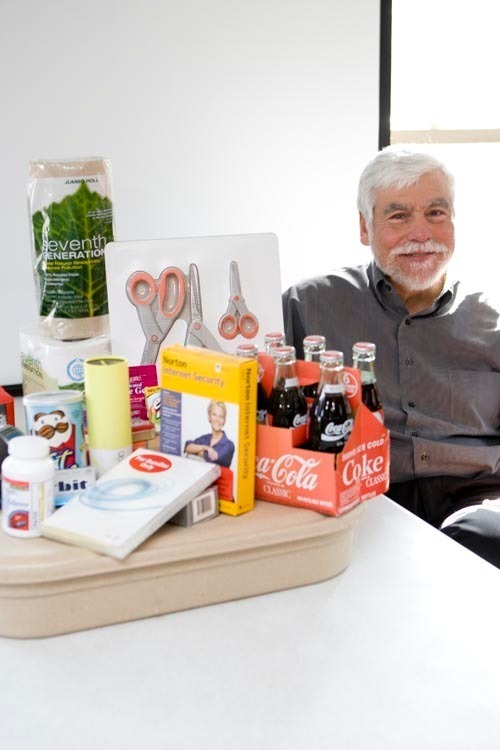
Our (cover subject), Victor A. Bell, president and founder of Environmental Packaging International, a Jamestown consulting firm, argues that the environmental consciousness that has taken hold in recent years could be longer lasting than in previous periods, and will continue to be a force when the current downturn ends.
“Basically, we had a big rise in this area back in the late ’70s, early ’80s, and then it all fell off the cliff,” Bell told PBN. “We’ve seen a growth in the last five years, and it’s gone back up again – but it’s gone up there for many different reasons.” Those include unpredictable energy prices and mounting concern about greenhouse gases.
The building industry has been ground zero for sustainability efforts. Connie McGreavy, a local green consultant, is creating the state’s chapter of the U.S. Green Building Council, the organization that hands out the coveted Leadership in Energy and Environmental Design (LEED) certifications.
Noting the wide range of projects on the state’s list of LEED-certified buildings – from the new corporate headquarters of Blue Cross & Blue Shield of Rhode Island and FM Global to the Salty Brine State Beach bathhouse in Narragansett – McGreavy said: “I don’t think you can draw any other conclusion than that people want to do this for the right reasons, and that is that they know they’re going to have a building that performs better, that’s a healthy building that people want to be in, and that … you’re going to see a great return on investment.”
Indeed, a 2006 study by the construction consultancy Davis Langdon found that “there is no significant difference in average costs for green buildings as compared to nongreen buildings.”
The owners of Forty 1° North, an upscale marina resort property in Newport, are building a 24-room boutique hotel on the city’s waterfront that will open at the end of this year. The new building will be LEED certified, and many of its energy-efficient design attributes will pay off within seven years.
Others are a net cost, but resort spokeswoman Susan Hamilton said being green also is an important branding strategy for the facility that appeals to consumers. “I think for a lot of people it’s very important,” she said. “It’s something that’s part of their personal life on a day-to-day basis.”
Nevertheless, the question of return on investment is the bottom line for most companies, which is why energy consumption has been the primary focus of many green initiatives. Yet with the cost of energy having plummeted since last summer, the equation has changed rapidly for businesses.
“At the end of the day, it depends on your timeline,” said S. Bradley Moran, assistant vice president for research administration at the University of Rhode Island. “If oil sits at $40 a barrel for the next two years … the incentive isn’t there for the bottom line, because that part of the cost is decreased for the business.
Moran thinks smart businesses will use this period of reduced prices to their advantage. “Energy is on sale,” he said. “This is an opportunity, and the smart business will look at this short-term setback in the oil price as an opportunity to get in gear with lower energy costs, lowering their bottom line.”
Moran, who has analyzed URI’s energy consumption, said most organizations can reduce their energy costs by 20 percent through improved efficiency alone.
However, companies may not achieve those savings if they fail to do their homework. Dan Conner, the Rhode Island and Cape Cod territory manager for the HVAC company Sweeney-Rogers Corp., said he has been installing high-efficiency boilers as business customers look for ways to cut consumption.
“Unfortunately,” Conner said, “a lot of people are getting fooled into putting in a high-efficiency boiler, but then putting it in an old-fashioned system or the system that they already have, so they’re not getting the efficiencies that they would. Then they feel like they’ve been misled.” Not all contractors are up to speed on the latest technologies, he added.
Meanwhile, large companies are continuing to pursue green initiatives to burnish their corporate image and connect with consumers. CVS Caremark Corp., the nation’s largest drugstore chain, has been recycling for three decades, but has stepped up efforts in recent years.
In 2006, CVS retrofitted the lighting in its Woonsocket and North Smithfield distribution centers, saving $128,000 in annual energy costs, according to a corporate report. The following year, the company managed to improve its mileage efficiency by 11.2 percent despite a 10 percent increase in the total volume of product being shipped. Last year, the company formally adopted an environmental-commitment statement.
Citizens Bank has introduced a program called Green$ense, which pays customers cash for making electronic transactions rather than paper-based ones. Theresa McLaughlin, Citizens’ chief marketing officer, said the program grew out of market research that found “consumers are becoming much more conscious of the little things they can do to help the environment.”
“These aren’t the hardcore environmentalists,” McLaughlin said. “These are people looking to make little changes in their lives every day to give back to the environment.” Although she declined to disclose exact figures, she said there has been a “very, very strong response” to Green$ense. The fact that it saves Citizens money through reduced paper use is a bonus, she added.
Environmental Packaging’s Victor Bell said his 17 employees remain busy providing guidance to companies that want to reduce the amount of packaging they use. His clients include Wal-Mart, Nike, Johnson & Johnson, Coca-Cola and McDonald’s.
Still, URI’s Moran sees a danger in the continued focus on going green, “and that is it being overdone, [where] everywhere you turn it’s ‘green, green, green,’ ” he said. “There is a risk, a psychological risk, that people will just tune out.”
Businesses and consumers should focus on how environmental practices save money over the long term, Moran said. “At the end of the day, being human is about survival – that’s No. 1, he said, and that “will come down to cost savings. … It’s not about feeling good and saving the planet and hugging trees.” •