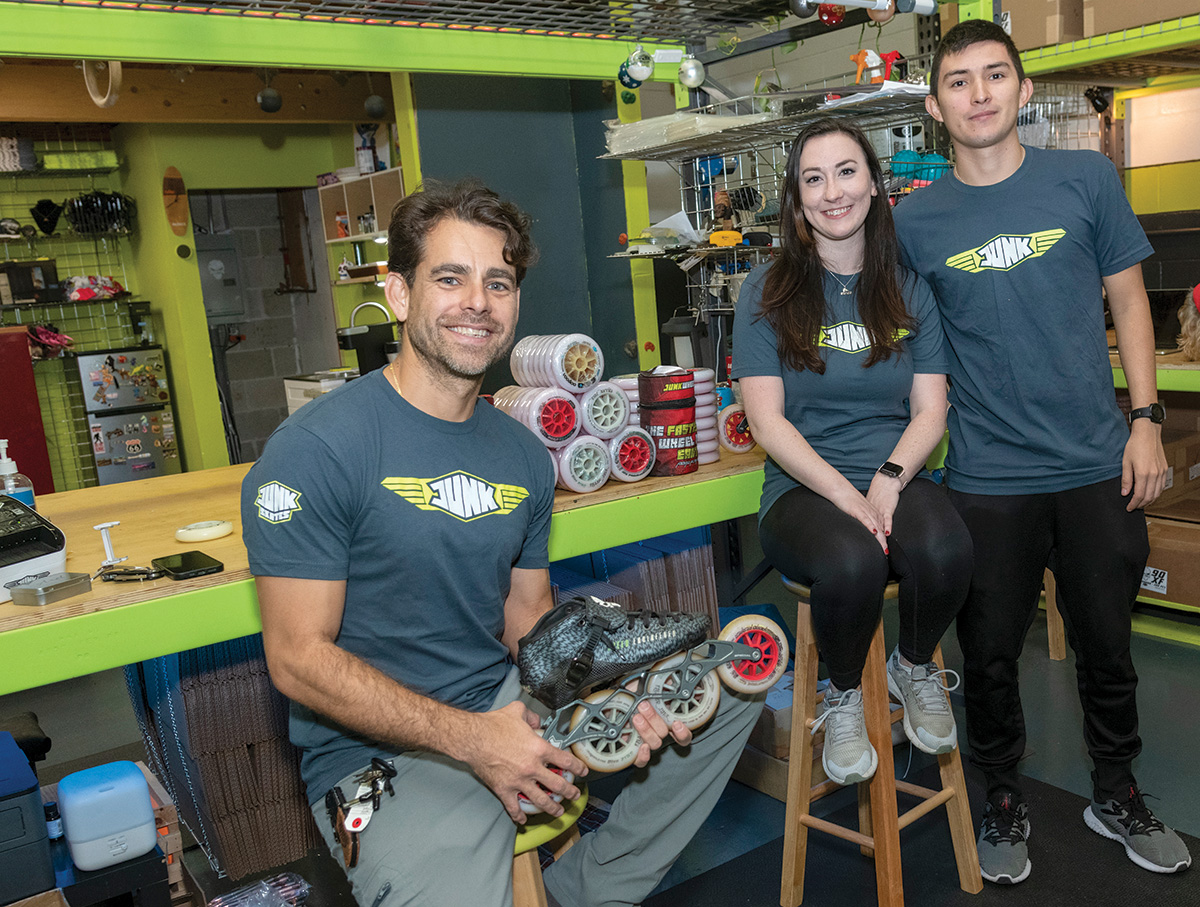
Francisco Ramirez has taken the economic slide in stride.
Despite his Cranston-based in-line skating company being slowed by the pandemic, supply chain bottlenecks and inflation, he retains a Confucian philosophy.
“I would do it for free,” he said.
Raised in Medellin, Colombia, Ramirez immigrated to the United States in 1995. An avid speed skater for years, he eventually created Junk Wheels in 2013.
The company operates in a “super niche market in an already niche sport,” Ramirez said.
Once a popular American pastime, the prevalence of in-line skating has waned in the past two decades. But Ramirez saw a rebound during the pandemic, with people itching to find outdoor, socially distanced recreational activity.
“It’s a growing business,” he said. “I want to continue to grow the sport here in the United States.”
International exports make up over 90% of annual sales, he said.
Junk Wheels was steadily growing before the pandemic. The company made it through the crisis, even keeping sales numbers level. But the lack of supplies getting to the facility on schedule and the rise in costs hampered further growth.
“We maintained sales,” he said. “But all of the growth, we lost because we didn’t have enough product.”
In 2021, realizing the company would not have enough material to fill the needs of both his customers and his team of sponsored athletes competing in international competitions, Ramirez had to make the “painful” decision to prioritize his skate team. As a business decision, it made sense. The marketing and networking that comes from his athletes winning races is vital to success.
But the frustration of not being able to fill every order brought Ramirez to tears, he said.
“I couldn’t sell [to customers] because I had to give it away for free,” he said. “But if [athletes] don’t win one year, I would lose out the next.”
People are curious of the name, said Ramirez, who credits his mother, who after concern with her son’s safety was constantly advising him “to get the junk out of the wheels.”
“It’s funny because no one liked it [the name] at first,” he said.
But given that the Junk Wheels logo is known more widely internationally, the name’s punch and brevity has become an asset.
While others may claim to have the “fastest wheel in the world,” Ramirez has the proof. Speed skater Ioseba Fernandez used patented Road Reaper wheels to set the 100-meter world record in the men’s division at the 2018 Inline Speed Skating World Championships in the Netherlands. Other riders took first place in separate 100-meter events in 2018, 2019 and 2021.
The success has led to copycat companies springing up to eat into revenues. Worse still are the outright intellectual thefts, mostly from China.
“It is a huge problem for us,” said Ramirez, who has spotted fraudulent knockoffs of Junk Wheels, logo and all, on multiple websites.
“They take the wheel design and make it look the same,” he said. “You take one down today and five pop up tomorrow, it’s a never-ending battle. What can we do? Just keep trying to stay ahead of the game.”
Enthralled with the minutia of small business, Ramirez often personally packs and ships deliveries, at times looking up buyers on social media afterward to thank them.
“I do it because I love it,” Ramirez said. “It’s really humbling to see the growth of skating in places you would never think.”
OWNER: Francisco Ramirez
TYPE OF BUSINESS: In-line skate wheels
LOCATION: 101 Comstock Parkway, Cranston
EMPLOYEES: Four
YEAR FOUNDED: 2013
ANNUAL SALES: $1.2 million