
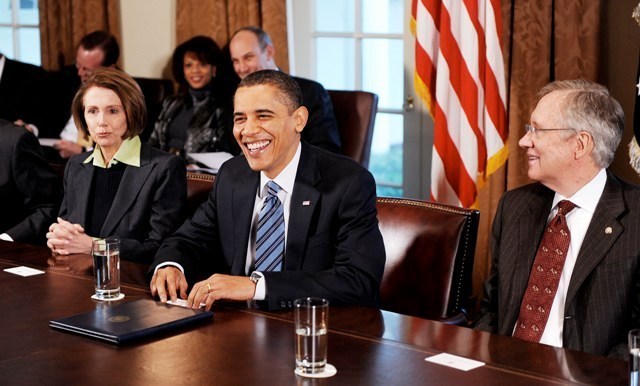
Like it or not, Washington observers are saying, Democrats are going to pass health care reform this year. It’s crucial to their political survival – and on Capitol Hill and across the country, many believe even a flawed plan is far better than none.
So the question is: How will the final bill take shape? And what are the implications for Rhode Island’s health care sector, businesses and state government?
Last week, as Congress was regrouping after the holidays, Providence Business News reached out to major stakeholders to get their views on where reform stands and where it should go. None had easy answers; the House and Senate bills are dauntingly complex. Most important, they all stressed, everything is in flux.
But while all had criticisms of the plans, most agreed with the Democrats’ view that a reform bill must be passed, and soon – even if some problems need to be addressed later.
As Dr. Nick Tsiongas, past president of the Rhode Island Medical Society, put it: “Whether it’s a good outcome or not, I think starting all over isn’t an option. I think if it doesn’t pass, we can kind of forget about systemic reform for a while longer.”
And systemic reform, most believe, is urgently needed. Peter Asen, executive director of Ocean State Action and a leader in pro-reform activism in Rhode Island, noted recently that maintaining the status quo “would make life worse for the millions who are uninsured and for those struggling to afford their coverage now.”
But Gov. Donald L. Carcieri, who had generally favored reform at first, came out forcefully against the Senate version after seeing that it would increase Rhode Island’s Medicaid costs. He has also said the employer mandates would hurt businesses.
In an interview last week, James E. Purcell, president and CEO of Blue Cross & Blue Shield of Rhode Island, said the House and Senate plans both have serious flaws, and Congress could do more harm than good by rushing things.
Blue Cross has been looking at the different provisions’ potential impact on subscribers, Purcell added, and “right now, under either scenario, their costs are going to increase.” Passing a flawed bill “just to get something on the books,” he said, is simply wrong.
Edward J. Quinlan, president of the Hospital Association of Rhode Island, is more optimistic. “The ability to revisit legislation always exists,” he said, noting that there is merit to the notion that “the perfect is the enemy of the good.”
Still, Quinlan has major concerns about the reform bills’ potential impact on payments to hospitals; the Senate version, he said, would cost Rhode Island hospitals more than $500 million over 10 years – and they already lose money on Medicare, which pays them 91 cents for every $1 worth of services, one of the lowest reimbursement rates in the country.
HARI has worked closely with the Rhode Island congressional delegation to ensure local hospitals’ priorities are considered, but it has also backed the American Hospital Association’s efforts, which included a deal with President Barack Obama and the Senate Finance Committee to accept significant payment reductions if the uninsured rate was reduced enough to offset the impact on hospitals. The problem, Quinlan said, is that the final Senate bill didn’t meet the agreed-upon targets, “which we hope will be addressed in conference.”
How it all plays out for hospitals, however, remains to be seen, Quinlan said – a recent analysis he was sent of the provisions affecting hospitals ran 28 pages, with different impacts on institutions across the country depending on the populations they serve.
For most doctors, meanwhile, Tsiongas said the impact may not be substantial – unless they’re involved in primary care, which is expected to get a big boost. Efforts to build “medical homes” for patients should also benefit, Tsiongas said, as will the push toward electronic medical records.
But a key priority for physicians, ending an annual struggle to avoid big Medicare pay cuts, always involving last-minute wrangling in Congress, wasn’t addressed in either version, Tsiongas said. That may be OK; the House has passed separate legislation to do that, he noted, but either way, “that is very important to doctors, to get off this merry-go-round.”
Both Tsiongas and Quinlan also objected to the lack of substantial medical-malpractice reforms. And Tsiongas, who is generally pro-reform, does expect Rhode Island to face increased Medicaid costs – and he expects a “dramatic” impact on local businesses that don’t currently insure their employees, though those who do, he said, may see costs drop a little.
Christopher F. Koller, the state health insurance commissioner, said some of the biggest benefits from reform, such as ending pre-existing-condition clauses and guaranteeing coverage to all, will not make a big impact on Rhode Island, because they are already in state law (the details may change, but the concepts are in place).
For the state, Koller said, the potential increase in Medicaid costs is a real concern, particularly with the roughly 40,000 Rhode Islanders who are already eligible for RIte Care but not currently enrolled, and aren’t covered by generous, federal cost-sharing provisions.
And like Purcell, Koller expressed disappointment that the reforms are unlikely to include major changes to the delivery system, to address cost drivers. “It really leaves that to the states,” he said.
But Mark E. Reynolds, CEO of Neighborhood Health Plan of Rhode Island, said he “very much” hopes a reform bill is passed in the next couple of months, even if it’s imperfect and fails to tackle one key priority for him: changing how Medicaid is financed so it doesn’t strain states’ budgets the most – because of increased demand – amid economic crises.
Passing a reform that signals a commitment to universal coverage “is a critical moral statement,” he said, and “it puts us finally in league with most modern, industrial countries.”
It also makes it easier to address cost issues, Reynolds said, because it removes the incentives to keep shifting costs or pushing high-cost patients off the insurance rolls. If everyone’s in the system, “we can focus on ensuring aggregate value and improving the quality of treatment.”
“We imperil cost control if we delay this bill,” he said. And yes, Reynolds added, there are problems with the measures, but “overall, we have faith that things that are not favorable will get resolved over time.” •











Thanks for updating the status on Medical Insurance industry today. But there Low cost medical coverage on group, family, or individual available at http://bit.ly/68ShhE
This Health Care Bill is so BAD, The notion of some people to say a flawed plan is better than no plan, is just stupid! They need to Kill the Bill, and start over.