Residential boom adds to congestion
Larry O’Toole, 45, a microbiologist who lives in Attleboro and works in the Boston area, has seen crowds soar on the MBTA commuter rail from Providence to Boston since he began riding the line eight to 10 years ago.
Building a Strong Data Foundation in the Age of AI
Artificial intelligence (AI) has become a key priority in the boardroom and across management —…
Learn More
Lucky for O’Toole, his employer the University of Massachusetts Medical Center, in Jamaica Plain, gives him a “flex-time” schedule that allows him to make his own hours. So he takes the earliest MBTA commuter train from Attleboro at 5:45 a.m., getting a jump on the crowds found on later trains that have already picked up passengers at stations in Providence and South Attleboro.
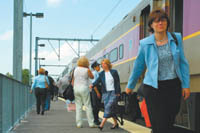
“There’s substantially more traffic when you take the 6:30 or 7:30 trains – you can barely get a seat,” O’Toole said, adding that all the seats are filled once trains reach stations closer to the Hub, such as in Mansfield, at which point it becomes standing room only.
O’Toole claims that his commuting woes stem from the staggering cost of living in Boston, which has pushed the city’s professionals farther into the Ocean State and turned them into interstate commuters. Recent transportation studies substantiate O’Toole’s claim, and have found that Rhode Island commuters make up most of the population using the stations in Attleboro and South Attleboro.
In fact, the daily number of Boston-bound passengers riding commuter trains from Providence swelled 27 percent, or from 800 to 1,090 per day, between June 2001 and the latest tally taken in August 2004, according to the Massachusetts Bay Transportation Authority.
Adding pressure to the rail system is the boom in residential development in downtown Providence, an area which industry members say is marketed aggressively to Boston professionals.
Providence offers all the perks of metropolitan living at a fraction of the cost, as well as easy access to MBTA stations there and in South Attleboro.
Yet the growing number of Boston workers living in the Ocean State has taken its toll on available commuter trains, and transportation officials are taking notice.
Officials from MBTA and the R.I. Department of Transportation say work is afoot to increase rail service from Providence to Boston by the end of this year. Still, it is unclear whether it can keep up with the influx of new residents from the Bay State.
“I think people recognize that we are a suburb of Boston in many ways,” said Thomas E. Deller, director of planning and development for the city of Providence.
The recent spike in downtown residential development has just begun, according to figures released by Deller’s office. The department reports that 420 apartments and condominiums were built since 2002, and 1,185 more are slated for construction within the next five years.
Anthony J. Thomas Jr., a partner of Foundry Associates Ltd., which opens its 220-unit, downtown apartment building, The Promenade, next month, said the firm’s project would not have been economically viable without interest from Boston. With about 53 units already pre-leased, he said, 10 percent of the tenants are moving from Boston – and that was before his firm ran an advertisement in The Boston Globe two weeks ago.
New Yorkers also have expressed interest in renting at The Promenade, Thomas said, because they, like Bostonians, realize they can live in a luxury apartment in a metropolitan area at cheaper rates than found in the other two cities. Apartments at the renovated mill site rent for between $1,100 and $3,500 per month, he said.
Meanwhile, several projects are under way to boost the state’s commuter rail system.
Stephen A. Devine, RIDOT’s chief of intermodal planning, said that plans are to increase rail service from Providence in December, when a layover yard in Pawtucket for MBTA commuter trains is pegged to open. In return for RIDOT funding 80 percent of the $18 million project with federal transit grants, Devine said, MBTA has agreed to provide Providence with as many commuter train departures as the South Attleboro station – which now gets two more than its neighbor to the south, according to a train schedule on MBTA’s Web site.
That would have helped matters for Michelle L. Medina last Tuesday morning, when the 22-year-old accountant had to scurry out of Providence Train Station after hearing that the train she wanted to board would only begin accepting passengers in South Attleboro.
“I’m still living at home (in Cranston) because rent in Boston is really expensive,” said Medina, who works in Boston at Investors Bank & Trust. Like many of her fellow graduates from Bryant University, Medina said she took a job in Boston to make more money and lives in a city well south of the Hub to avoid expensive living costs.
Devine said an intermodal station at T.F. Green Airport and another rail terminal at Wickford Junction, off Route 4 in North Kingstown, could open by early 2008. The transportation department learned in 2002 – by counting license plates and interviewing passengers – that Rhode Islanders accounted for 90 percent of those boarding trains in South Attleboro and 40 to 50 percent of those in Attleboro.
Devine noted that most recent statistics show that more commuters headed for Boston live in “outlying areas” such as Washington and Kent counties.
East Greenwich resident John E. Soule, who works in Boston in the financial services industry, said he has seen triple the number of passengers riding the 6:40 a.m. Amtrak train from Kingston Station. “There’s no question,” he said, “overall there’s been an increase.”
Soule said he thinks adding at least one more train in the morning would help reduce the crowds. However, extending commuter service from Kingston is not on the drawing board, Devine said, because Amtrak has not been receptive to lowering its fees or altering its schedule to accommodate commuters.
Lydia Rivera, a spokeswoman for MBTA, said her agency and RIDOT entered into a contract in 1988 called the Pilgrim Partnership, an agreement to enhance commuter rail services in Rhode Island. Though funding the projects set forth in the pact had relied heavily on the availability of federal transit grants. To address the needs for more services in the meantime, she said, MBTA has done things like add extra rail cars to trains or included double-decker cars.
Devine said the next phase of rail expansion depends heavily on the passage of legislation under consideration in Congress, which he hopes will pass the bill which would release millions in transit grants to the state.
“With better service to Providence, Warwick and Wickford coming on line,” Devine said, “it’s only going to help the overcrowding situation in South Attleboro and Attleboro. Physically, the capacity is really starting to get stretched.”