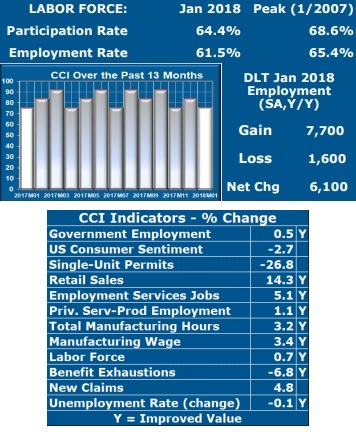
SOUTH KINGSTOWN – The first Current Conditions Index of 2018 fell eight points to 75 from December yet rests level with the January 2017 measure, according to University of Rhode Island Economist Leonard Lardaro’s latest report released Monday.
In describing the January performance, he said the “most noteworthy development with this survey” was the “apparent adoption of some bizarre smoothing method. The inevitable result: long stretches with identical values for key indicators.
Selling Luxury Real Estate Requires More Than Exposure
By Emilio DiSpirito IV License Partner | Private Office Advisor Engel & Völkers Oceanside www.DiSpiritoteam.com…
Learn More
“For the record: I don’t believe these identical value strings for one minute, and neither should you!” Lardaro said.
The CCI measures 12 economic indicators that are generally representative of the economic climate of the state. A value above 50 implies economic expansion while a value less than 50 indicates contraction.
While nine of the CCI’s 12 indicators had improved values in January 2018, the seasonally adjusted unemployment in Rhode Island held steady at 4.5 percent in the first month of 2018.
Lardaro groups the unemployment rate among the indicators that are holding “identical” values for sustained periods, citing the hold at 4.4 percent from March through August 2017 and again at 4.5 percent from September through December 2017.
“The most likely result of this will be that our unemployment rate will tend to consistently understate the actual rate when it is rising and overstate it when it is falling,” he said in the report – an industry phenomenon he called “systematic error.”
The nine indicators that saw growth in January were:
- A leading labor market indicator, employment services jobs increased by 5.1 percent. The indicator has sustained 5-plus percent growth each month since July 2017.
- A “respectable” rise of 3.2 percent occurred in the total manufacturing hours sector due to expanded employment and a “contracted” workweek. This indicator is a measure for manufacturing output.
- Similarly, the manufacturing wage grew 3.4 percent in January.
- A 14.3 percent increase was recorded in retail sales in the first month of the year.
- Government employment saw a 0.5 percent increase in January.
- There was a 1.1 percent increase in private service-producing employment.
- Reflective of longer-term unemployment, benefit exhaustions fell by 6.8 percent.
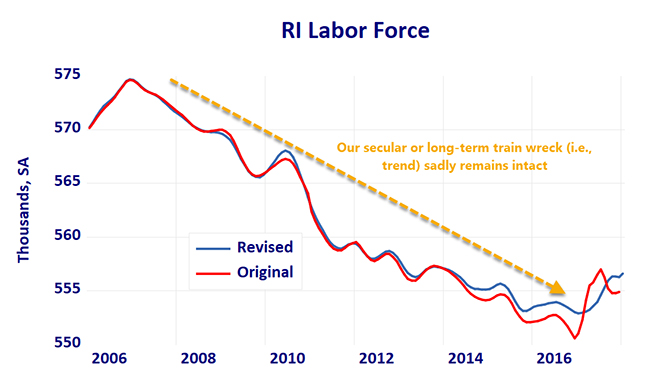
- For the seventh consecutive month, the labor force grew. In January it increased by 0.7 percent.
The three indicators that contracted in January are as follows:
- New claims, the timeliest measure of layoffs, grew 4.8 percent in January. That was the third month out of five in which the indicator fell.
- After a previous 13-consecutive-month increase that ended in December, U.S. consumer sentiment dipped by 2.7 percent in January.
- Reflective of new home construction, single-unit permits “fell sharply” in January, 26.8 percent.
Emily Gowdey-Backus is a staff writer for PBN. You can follow her on Twitter @FlashGowdey or contact her via email, gowdey-backus@pbn.com.