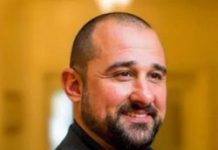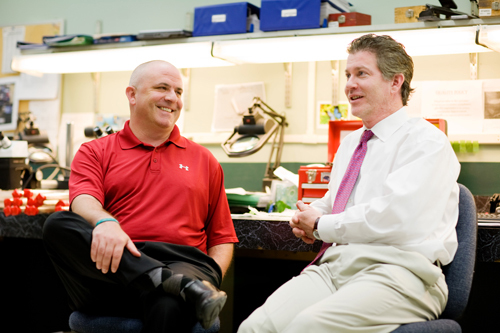
Roland Benjamin and Clifford “Kip” Brockmyre III consider themselves problem solvers who are willing to reinvent the wheel if it means a better wheel and a stronger balance sheet.
In 2003, they saw a problem at their employer, the Infinite Group. Its subsidiary, Laser Fare, was a cash cow but executives kept moving the profits to other divisions and stemming innovation and growth at Laser Fare. So Benjamin, an engineer, Brockmyre, the general manager, along with Brockmyre’s father, also Clifford, a past Infinite CEO, came up with a solution: buy Laser Fare.
They put their homes on the line to finance the deal and crossed their fingers.
Seven years later the bet paid off, and the new company, known as LFI Inc., has grown to 70 employees from 18 and is on pace to reach at least $9 million in revenue this year, compared with $1 million seven years ago. Its customers include the likes of General Electric, Honeywell and Johnson & Johnson, which hire LFI to manufacture metal components for aircraft and medical devices.
In the 1990s, Laser Fare essentially served as a contractor for clients that needed metal cut using high-powered lasers. After Benjamin joined the company in 1994 he saw potential for it to use the same equipment and skills to make components for aircraft and medical devices. Infinite Group’s management eventually let him start a group focused on the two industries, but were never willing to truly invest in it, Benjamin said. When he wanted a $120,000 machine that would secure Laser Fare a $600,000 project and thereby double the company’s revenue, management said no.
Today, the company invests heavily in pursuing new markets. Components for medical devices now comprise about two-thirds of the company’s revenue, with the rest coming from pieces for aircraft.
Workers at LFI’s Smithfield plant churn out thousands of components a year. Lasers make precision cuts, sometimes in metal pieces smaller than the tip of a fingernail. Yet, finding a company to cut metal is relatively easy and major companies like General Electric could move such operations in-house if they chose to. What sets LFI apart, Benjamin said, is a team of engineers who work directly with original-equipment manufacturers to design a process to assemble components and cut down on the number of subcontractors needed to produce one item.
For example, LFI produces a component for a Versajet, a device that uses a stream of high-pressure water to act as a knife for doctors cleaning out wounds or tissue. LFI could make four welds in each component and charge $4. Instead, LFI engineers designed a process to make the welds and assemble smaller components. LFI charges $24 per piece and the customer is happy because fewer contractors are involved.
When the new owners took over they gave their engineers job descriptions with just one requirement: grow positive cash flow. The owners implemented a bonus system for all their employees based on cash flow rather than straight profits. One year the company handed out 5 percent of its revenue in bonuses, something Benjamin said some executives outside of the firm find shockingly high. But the bonuses spurred a record year.
There have been rough spots, though. Last year proved difficult for LSI as the economy sputtered and corporations pulled back on their contracts. Benjamin said the company had a contract with aircraft manufacturer Pratt & Whitney worth $20,000 weekly in revenue. On a Tuesday, the parts from Pratt & Whitney arrived as usual and then, without notice, stopped on Wednesday. Benjamin discovered that Pratt & Whitney had moved the process in-house as demand had fallen.
That’s partly why LFI is aggressively seeking business in the medical-device field. There, LFI engineers can play a larger role in the design of the component and handle a larger portion of the process. That makes LFI difficult to cut out of the supply chain and helps guarantee business.
Last year LFI’s owners spun off LFI Medical in Walpole, Mass., to handle sales. While technically a separate company, the two LFIs work hand-in-hand to bring the Smithfield plant’s services to Boston-area manufacturers.
But the owners say despite the company’s success there’s always a new problem that needs solving. Perhaps that’s why the company’s slogan is “solving complex problems every day.” •
COMPANY PROFILE
LFI Inc.
OWNERS: Roland Benjamin, Clifford “Kip” Brockmyre II and Clifford “Kip” Brockmyre III
TYPE OF BUSINESS: Manufacturer of medical and aircraft metal components
LOCATION: 1 Industrial Drive South, Smithfield
EMPLOYEES: 70
YEAR ESTABLISHED: 2003
ANNUAL SALES: $7 million in 2009
Beyond Cash Donations: How New Forms of Giving Are Transforming Not-for-Profit Accounting
Evolving Funding Landscape for Not-for-Profits Not-for-profit organizations are being asked to do more with less,…
Learn More