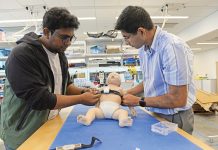
They’re engineers, industrial designers, programmers, artists and artisans. Most have strong technology skills, but what unites them is a love for making things – inventing and hacking and tinkering and exploring the possibilities.
This month, they came together at Maker Faire Rhode Island, the first “maker” gathering of its size in the Northeast, run by local volunteers with the support of MAKE Magazine, which has been sponsoring Maker Faire events in California and Texas for several years.
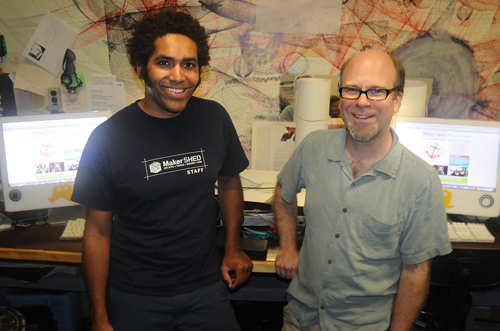
Kipp Bradford and Brian Jepson – an engineer/entrepreneur and a tech writer, respectively, and both avid makers – organized the event. They took a break during workshops at Slater Mill to talk about what inspired them and what they accomplished.
PBN: This started out as a conversation with the Pawtucket Red Sox, then evolved into a collaboration with WaterFire, but then grew well beyond that. Who’s involved?
JEPSON: We brought in AS220, DC401, Providence Geeks, RI Nexus … and it got around through word of mouth and grassroots. … We [had] about 50 exhibitors for [the main event, at WaterFire].
BRADFORD: I got a strong interest in volunteers from Brown and RISD. I probably had 70 or 80 e-mails from people who wanted to volunteer, and the e-mail volume was just unmanageable by me alone. We had students involved with several RISD groups, several Brown groups – like Engineers Without Borders – and faculty and staff at Brown and RISD. And there was strong interest from people in the community.
Rhode Island's Market Has Changed. Developers, Builders, Investors and Sellers Must Change With It.
By Emilio DiSpirito IV License Partner | Engel & Völkers Oceanside Leader | The DiSpirito…
Learn More
PBN: What kinds of people? I know Maker Faire is, to a great extent, about technology, but it’s not all technology.
JEPSON: There’s definitely a lot of stuff that’s in the engineering category, but there’s also a lot of stuff that’s in the crafts category. And a lot of the stuff in engineering really straddles arts and crafts and other areas.
PBN: What were some of the highlights for you of the week?
JEPSON: If I had to pick a highlight, I’d say anything hands-on, the workshops. … At the WaterFire event, we [had] some soldering stations set up, AS220 [brought] their Fab Lab out.
BRADFORD: And Kafe Lila [of Pawtucket] brought ice cream making – another kind of do-it-yourself, hands-on creativity. But what’s exciting for me is that we’ve planted something in the community that’s brought together a really broad range of participants and organizations. Linking the Pawtucket Arts Festival and Slater Mill with WaterFire and the Center for Innovation & Entrepreneurship and on and on – it’s just a really, really great, broad group.
PBN: You were both involved in the founding of the Providence Geeks, which started out of a sense that techies in Rhode Island were isolated from one another. How much did the networks that the Geeks have helped build contribute to Maker Faire’s success?
JEPSON: I think it made it easier to find people, to be able to use RI Nexus and such … and now in Rhode Island, a lot of people who are on Twitter follow each other, so that’s been a huge help, having those networks be closer.
PBN: Asher Dunn of Keeseh Studio [a Pawtucket woodworking shop] ran several workshops, including one I thought was pretty emblematic of the Maker Faire spirit: building flash keys with wooden casings. Did you have a lot of that, combining technology with crafts?
PBN: What kind of exhibitors were involved in the WaterFire event?
BRADFORD: We got some people with two hydrogen-powered vehicles that use different technologies, some biodiesel vehicles … a zero-energy-use greenhouse, Brown computer science robotics that you can teach different movements. [We had] a Brooklyn group that uses trash and found objects to build remote-controlled airplanes; Waste Not Want Not, which is recycling things into objects of desire; Circle A Bicycles, which makes racing bikes locally, by hand; the FIRST LEGO League, which does robotics for kids.
PBN: Based on your experience this year, do you think this can become an annual event?
BRADFORD: I think so. We certainly have tapped a well of creativity that’s been under pressure for a while and hadn’t had an outlet. Looking at the response and at the diversity of categories … I feel like we’re just hitting the tip of what exists in this state. … We didn’t get a strong showing from student groups, and most of the companies we had are two- or three-person companies; we have larger companies we’d like to get in. •