Despite the recent lack of venture capital activity, Barrett Bready says he wasn’t worried as his life sciences company, NABsys Inc., prepared to seek a capital infusion a few months ago.
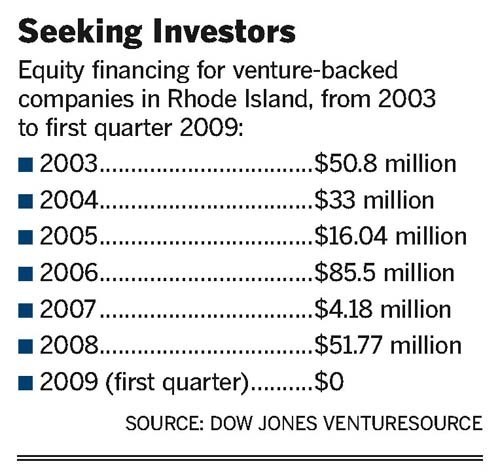
Nationwide, venture capital investment had fallen 50 percent in the first quarter from the year-ago period as venture capital firms pulled back on early-stage investments, according to Dow Jones VentureSource.
In Rhode Island, there hadn’t been a financing since a relatively small $500,000 deal in the fourth quarter 2008.
Still Bready, NABsys president and CEO, was right not to worry.
Before seeking a deal, Bready heard from a group of investors led by Providence-based, early-stage venture capital firm Point Judith Capital. Now the investors have provided $4 million in equity financing to NABsys, a Providence startup working on developing a widely affordable method of genome sequencing.
“I was confident given how good the technology looks at this point,” Bready said last week.
As part of the deal, Gina Raimondo, a general partner at Point Judith, has been named to the NABsys board of directors.
In a statement after the financing was announced last week, Raimondo called NABsys’ approach to genome sequencing a “game-changing technology in the field of genomics.”
Raimondo could not be reached for comment last week.
But indeed those involved say the financing – particularly in light of a historic slide in venture capitalism nationwide – is an indication of NABsys’ vast potential.
A genome is the total DNA sequence that characterizes an individual’s genetic makeup. Since 2004, NABsys has been working to lower the cost of DNA sequencing, which would enable the technology to be widely used by doctors to determine a patient’s predisposition to particular diseases and by pharmaceutical companies to develop more effective drugs.
Using current technology, it costs millions of dollars to sequence just one person’s genome. And Bready says the process is slow and prone to error.
The NABsys approach is electronic – as opposed to the existing optical approach – that combines physical and biochemical methods and uses solid-state materials that would have a relatively low cost to manufacture.
Making sequencing affordable to everyone could have far-reaching impact. It would allow people to go through life knowing predisposition to diseases such as heart disease and cancer and what actions to take to prevent or delay those diseases, Bready said.
A business that could provide “a solution to those problems is a great business to have,” said Bready, a 32-year-old doctor who received his medical degree at Brown University.
That’s why Point Judith and other investors are willing to put money into NABsys, despite it not making any money.
The company said it would use the latest round of funding to continue its research, which was developed at and licensed from Brown.
The research has attracted lots of attention in the past.
In 2007, NABsys received a prestigious $500,000 grant from the National Human Genome Research Institute (NHGRI), an arm of the National Institutes of Health. The NHGRI – the foremost authority on DNA sequencing in the world – only awarded eight grants that year, and NABsys was the only for-profit entity to receive one.
The following January, NABsys was the recipient of a grant from the Research Alliance program at the R.I. Science and Technology Advisory Council.
The company was established in 2004 by Brown physics professor Xinsheng Ling after receiving a $225,000 loan from the quasi-public Slater Technology Fund.
Bready joined the firm as CEO in 2005. At the time, he was the youngest chief executive of a funded biotech firm in the state.
Then in 2006, NABsys acquired another DNA research company, GeneSpectrum, in an all-stock transaction. John Oliver, another Brown professor and founder of GeneSpectrum, joined the company as the vice president of research and development, in 2007.
Ling has since left the company and is now part of a Brown University team pursuing a different approach to DNA sequencing.
Slater Technology Fund, along with other previous NABsys investors, participated with Point Judith in the funding round. In fact, NABsys’ seven-person staff operates out of Slater’s incubator, the Richmond Square complex in Providence that provides space to biomedical ventures that come out of research labs at Brown, Lifespan and other universities and health care institutions. •