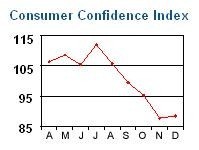
NEW YORK – Confidence among U.S. consumers rose this month, ending a four-month decline, in a preliminary report released today by The Conference Board.
The Consumer Confidence Index edged up 0.8 percentage points to 88.6 (1985 = 100 points) after falling a revised 7.4 points in November to 87.8. Last month’s decline was less sharp than the 7.9 points of the Conference Board’s Nov. 27 preliminary estimate. (READ MORE)
Analysts had expected the index to continue its decline, to 86.5 points, Econoday said. The increase “is just one of those anomalies that sometimes happen,” Brian Bethune, an economist at forecasting firm Global Insight Inc. in Lexington, Mass., told Bloomberg News. “The present situation is more influenced by the problem with energy prices. Unless we get some relief from oil prices, we are in for a very rough first quarter.”
The survey’s Expectations Index – reflecting the outlook for the next six months – surged to 75.5 points from last month’s 69.1.
But the Current Conditions Index – reflecting consumers’ views of the economy right now – Index fell to 108.3 points from November’s 115.7. Jobs were seen as “hard to get” by 23.5 percent of respondents, up from 21.4 percent in October, and were seen as “plentiful” by 22.7 percent, down from 23.3 percent the month before.
“Momentum has just nosedived over the last couple of months,” said Michael Gregory, a senior economist at BMO Nesbitt Burns in Toronto. “When businesses see those order books getting a lot leaner, they start to change their plans in terms of hiring and so forth.”
Meanwhile, nationwide demand for durable goods last month edged up 0.1 percent from its level in October as defense orders plunged, after falling a revised 0.4 percent the month before, according to a separate report today from the Manufacturing and Construction Division of the U.S. Commerce Department’s Bureau of the Census. Analysts had expected durable goods orders to rise 2.0 percent last month, based on the mean prediction from a Bloomberg survey of 67 economists.
Orders excluding the volatile transportation sector fell 0.7 percent, the Census Bureau said, while orders for non-defense equipment rose 1.2 percent.
Non-defense capital goods orders excluding aircraft – considered a leading indicator for business investment – fell 0.4 percent last month after falling 2.9 percent the month before.
“You are starting to see some evidence that housing weakness is spilling over to the broader economy,” Michelle Meyer, an economist at Lehman Brothers Holdings Inc. in New York, told Bloomberg News. “
The Conference Board is a nonpartisan, nonprofit business membership and research organization with offices in New York City, Chicago and abroad. Additional information is available at www.Conference-Board.org.
Additional information on November orders of durable and capital goods, including the full Advance Report on Manufacturers’ Shipments, Inventories and Orders (M3), is available from the U.S. Commerce Department’s Bureau of the Census, Manufacturing and Construction Division, at www.census.gov/m3.